

Bilingual
En/Fa
Geographical Research is Published in both Persian and English Full-text.
Volume 40, Issue 4 (2025)
GeoRes 2025, 40(4): 305-317 |
Back to browse issues page
Article Type:
Subject:




History
Received: 2024/10/22 | Accepted: 2025/12/9 | Published: 2025/12/12
Received: 2024/10/22 | Accepted: 2025/12/9 | Published: 2025/12/12
How to cite this article
Lalehpour M, Sarvar H, Bordbar H, Salmanzadeh S. Urban Waste Management in Maragheh Using Grounded Theory. GeoRes 2025; 40 (4) :305-317
URL: http://georesearch.ir/article-1-1502-en.html
URL: http://georesearch.ir/article-1-1502-en.html
Download citation:
BibTeX | RIS | EndNote | Medlars | ProCite | Reference Manager | RefWorks
Send citation to:


Rights and permissions
BibTeX | RIS | EndNote | Medlars | ProCite | Reference Manager | RefWorks
Send citation to:

1- Department of Geography and Urban Planning, Faclty of Humanities, University of Maragheh, Maragheh, Iran
2- Department of Geography and Urban Planning, Faclty of Planning and Environmental Sciences, University of Tabriz, Tabriz, Iran
3- Department of Urban and Regional Planning and Design, Faculty of Architecture and Urban Planning, Shahid Beheshti University, Tehran, Iran
2- Department of Geography and Urban Planning, Faclty of Planning and Environmental Sciences, University of Tabriz, Tabriz, Iran
3- Department of Urban and Regional Planning and Design, Faculty of Architecture and Urban Planning, Shahid Beheshti University, Tehran, Iran
Full-Text (HTML) (47 Views)
Background
Urban waste management in Maragheh faces serious challenges due to inadequate infrastructure, limited financial resources, a shortage of skilled human resources, and low levels of public awareness. These constraints have resulted in adverse consequences such as environmental pollution, threats to public health, and a decline in the quality of urban life, thereby underscoring the urgent need for comprehensive and sustainable planning.
Previous Studies
Previous studies indicate that insufficient infrastructure, financial constraints, and a lack of qualified personnel constitute the most significant challenges to urban waste management in developing cities, leading to environmental pollution and risks to public health [Khalifa Al-Zarbi et al., 2023; Nizar, 2023]. Research has emphasized the critical role of citizen awareness and participation in source separation and increasing recycling rates, demonstrating that weak social cooperation significantly raises waste management costs [Al-Sani et al., 2018; Benai Omar, 2023]. Several studies, employing multi-criteria decision-making methods and scenario planning, have highlighted the uncertainty and complexity inherent in planning waste collection and disposal systems [Moeini et al., 2024; Rahnama et al., 2022]. Moreover, the importance of good urban governance, social capacity building, civil society institutions, and the application of emerging technologies, such as blockchain and intelligent predictive models in enhancing the efficiency of waste management systems has been widely acknowledged [Khoshnavaz et al., 2023; Saghaei, 2021; Khosravi Moghaddam et al., 2021].
Aim(s)
This study aims to explain and conceptualize urban waste management in Maragheh using the grounded theory approach.
Research Type
This research was designed as a qualitative study employing the Straussian grounded theory methodology.
Research Society, Place and Time
The research society consisted of all stakeholders involved in the planning, implementation, supervision, and evaluation of municipal solid waste management in Maragheh City. This included municipal managers and experts (such as the mayor, deputy of urban services, and environmental experts), members of the city council, representatives of related governmental organizations (Environmental Protection Organization), urban service workers (waste collectors), environmental activists and non-governmental organizations, private sector representatives (shop owners and business operators), citizens from both central and peripheral neighborhoods, and representatives of the agricultural sector due to their involvement in composting activities. The study was conducted in Maragheh City, located in East Azerbaijan Province, Iran in 2025.
Sampling Method and Number
Sampling was conducted using theoretical sampling in accordance with the principles of Straussian Grounded Theory. The process was carried out in three stages: (1) purposive sampling to identify key informants and primary stakeholders with rich knowledge and experience in municipal solid waste management; (2) iterative theoretical sampling based on preliminary findings to explore emerging concepts and categories and to cover all dimensions of the central phenomenon; and (3) continued sampling until theoretical saturation was achieved, meaning that no new concepts or categories emerged from additional data. In total, 10 in-depth semi-structured interviews were conducted with key stakeholders.
Used Devices & Materials
Data were collected using several tools and materials. The primary instrument was a semi-structured in-depth interview guide designed based on the research objectives, grounded theory concepts, and the components of the Strauss and Corbin paradigm model. A digital audio recorder was used to record the interviews after obtaining informed consent, and all interviews were transcribed verbatim. Field notes, observation checklists, and photographic documentation were employed during participatory observations and field visits. In addition, official documents and archival materials including municipal master plans, waste management strategies, city council resolutions, performance reports, statistical data on population and waste generation, and budgetary documents, were reviewed. For data management, coding, and analysis, MAXQDA software (version 2020) was used
Findings
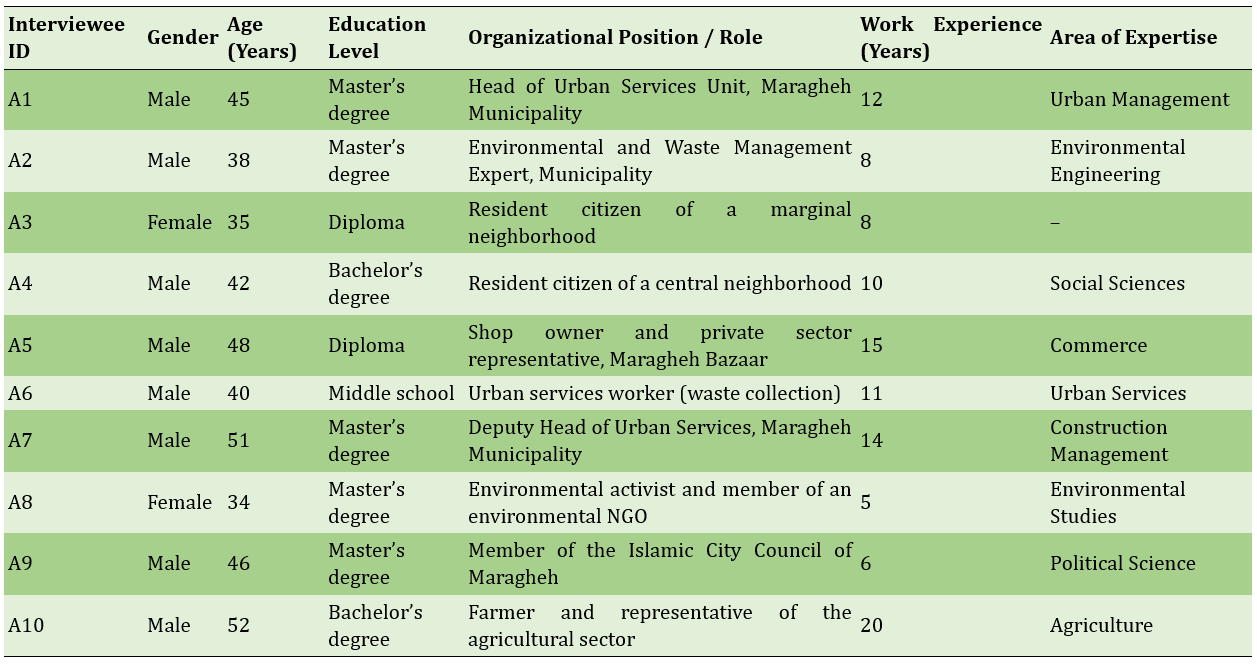
The findings indicate that interviewees were selected through theoretical sampling with the aim of achieving maximum diversity among stakeholders. In total, 10 in-depth interviews were conducted with a balanced distribution in terms of gender, age, educational background, and organizational roles. This diversity ensured comprehensive coverage of managerial, operational, social, and economic levels and led to the achievement of theoretical saturation by the tenth interview. The individual, educational, and professional characteristics of the interviewees are presented (Table 1).
Table 1. Individual characteristics of the interviewees
Data analysis was conducted using the Straussian grounded theory approach through open, axial, and selective coding. This process resulted in the extraction of 72 initial codes, 17 secondary codes, 11 subcategories, and 7 main categories. This hierarchical structure clearly explained the dynamic relationships among the components of the paradigmatic model, including causal conditions, contextual conditions, intervening conditions, the core phenomenon, strategies, and consequences (Table 2).
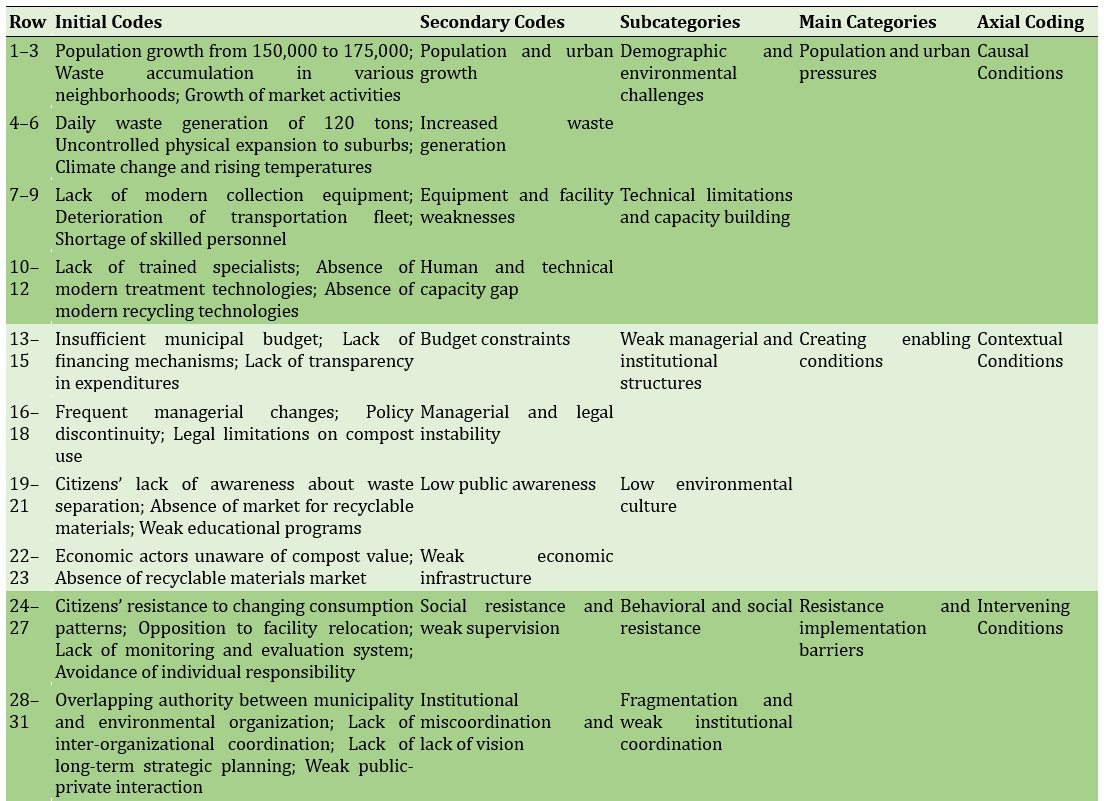
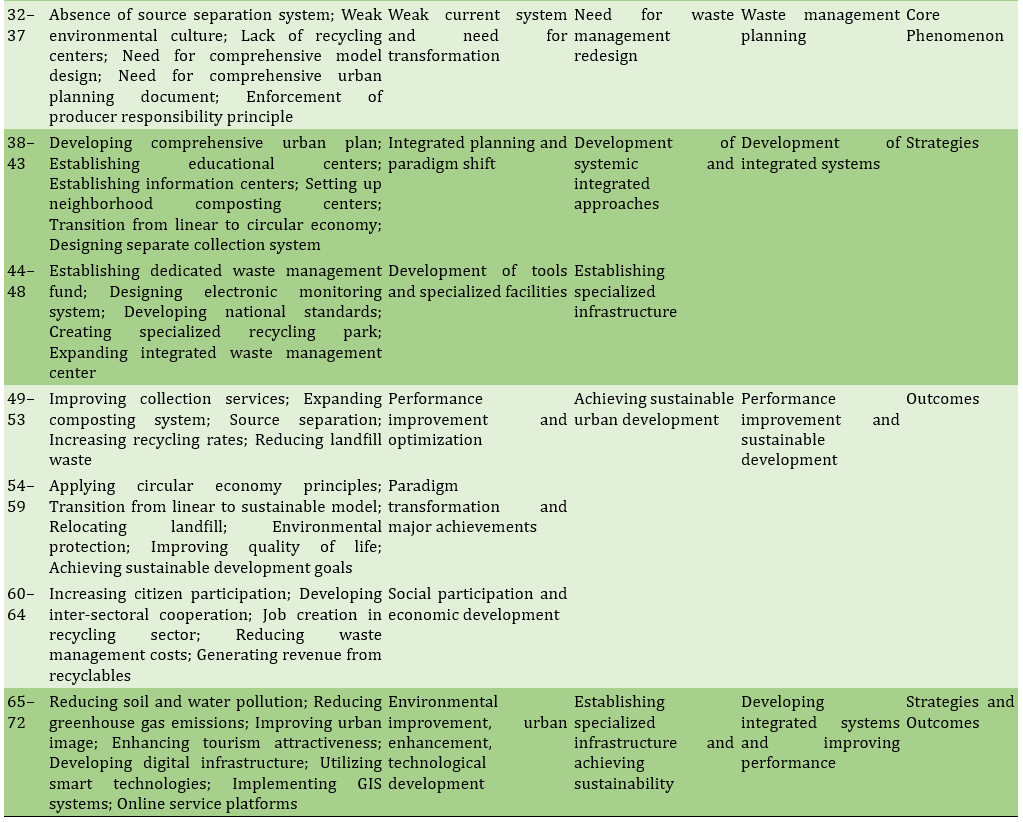
The findings revealed that population growth, increasing waste generation, weaknesses in technical infrastructure, financial constraints, managerial instability, low levels of environmental awareness, social resistance, and weak institutional coordination constitute the main challenges. In contrast, redesigning the waste management system, developing integrated approaches, establishing specialized infrastructure, transitioning toward a circular economy, and utilizing smart technologies were identified as key strategies for achieving sustainable urban development.
Main Comparisons to Similar Studies
The findings of this study in Maragheh showed substantial convergence with previous studies at national, regional, and international levels, while also exhibiting important distinctions. Similar to studies by Rezaei and Gholampour Arbestan (2021) and Nizar (2023), “sustainable urban waste management” was identified as the core phenomenon, emphasizing the necessity of a systemic and integrated perspective beyond purely operational approaches. Consistent with Moeini et al. (2024), Al-Jali (2020), and Ali et al. (2024), population pressure and increasing waste volumes were identified as major drivers of change. However, unlike many earlier studies, the present research also addresses qualitative challenges such as infrastructure deterioration, weak institutional coordination, and a lack of financial transparency. Compared with European studies that focus on advanced technologies, the Maragheh model emphasizes localized, gradual, and cost-effective strategies such as neighborhood-based composting and social participation. This demonstrates that the proposed model not only confirms previous findings but also provides a context-specific and operational framework for medium-sized cities in developing countries.
Suggestions
The study recommends conducting comparative and longitudinal research in medium-sized Iranian cities using qualitative, quantitative, and mixed-method approaches to generalize and test the proposed waste management model.
Further emphasis is placed on examining the role of the informal sector, undertaking regional comparative studies, and designing applied interventions such as educational programs, citizen participation incentives, and innovative financing mechanisms as practical pathways for improvement. Finally, greater attention to the economic, environmental, health-related, technological, and policy dimensions of waste management is considered essential for enhancing system efficiency and advancing toward a circular economy.
Conclusion
The urban waste management system of Maragheh remains distant from optimal performance due to population pressures, weak institutional coordination, financial and technical constraints, and low levels of environmental awareness
Acknowledgments: We sincerely thank the experienced urban planners and municipal managers who supported us throughout this study.
Ethical Approval: Not applicable.
Conflict of Interest: The authors declare no conflict of interest.
Author Contributions: Lalehpour M (first author), Main Researcher/Introduction Writer (60%); Sarvar H (second author), Introduction Writer/Methodologist (30%); Bordbar H (third author), Assistant Researcher (5%); Salmanzadeh S (fourth author), Discussion Writer (5%)
Funding: No specific institution or organization provided funding. Research expenses were covered by the first author
Urban waste management in Maragheh faces serious challenges due to inadequate infrastructure, limited financial resources, a shortage of skilled human resources, and low levels of public awareness. These constraints have resulted in adverse consequences such as environmental pollution, threats to public health, and a decline in the quality of urban life, thereby underscoring the urgent need for comprehensive and sustainable planning.
Previous Studies
Previous studies indicate that insufficient infrastructure, financial constraints, and a lack of qualified personnel constitute the most significant challenges to urban waste management in developing cities, leading to environmental pollution and risks to public health [Khalifa Al-Zarbi et al., 2023; Nizar, 2023]. Research has emphasized the critical role of citizen awareness and participation in source separation and increasing recycling rates, demonstrating that weak social cooperation significantly raises waste management costs [Al-Sani et al., 2018; Benai Omar, 2023]. Several studies, employing multi-criteria decision-making methods and scenario planning, have highlighted the uncertainty and complexity inherent in planning waste collection and disposal systems [Moeini et al., 2024; Rahnama et al., 2022]. Moreover, the importance of good urban governance, social capacity building, civil society institutions, and the application of emerging technologies, such as blockchain and intelligent predictive models in enhancing the efficiency of waste management systems has been widely acknowledged [Khoshnavaz et al., 2023; Saghaei, 2021; Khosravi Moghaddam et al., 2021].
Aim(s)
This study aims to explain and conceptualize urban waste management in Maragheh using the grounded theory approach.
Research Type
This research was designed as a qualitative study employing the Straussian grounded theory methodology.
Research Society, Place and Time
The research society consisted of all stakeholders involved in the planning, implementation, supervision, and evaluation of municipal solid waste management in Maragheh City. This included municipal managers and experts (such as the mayor, deputy of urban services, and environmental experts), members of the city council, representatives of related governmental organizations (Environmental Protection Organization), urban service workers (waste collectors), environmental activists and non-governmental organizations, private sector representatives (shop owners and business operators), citizens from both central and peripheral neighborhoods, and representatives of the agricultural sector due to their involvement in composting activities. The study was conducted in Maragheh City, located in East Azerbaijan Province, Iran in 2025.
Sampling Method and Number
Sampling was conducted using theoretical sampling in accordance with the principles of Straussian Grounded Theory. The process was carried out in three stages: (1) purposive sampling to identify key informants and primary stakeholders with rich knowledge and experience in municipal solid waste management; (2) iterative theoretical sampling based on preliminary findings to explore emerging concepts and categories and to cover all dimensions of the central phenomenon; and (3) continued sampling until theoretical saturation was achieved, meaning that no new concepts or categories emerged from additional data. In total, 10 in-depth semi-structured interviews were conducted with key stakeholders.
Used Devices & Materials
Data were collected using several tools and materials. The primary instrument was a semi-structured in-depth interview guide designed based on the research objectives, grounded theory concepts, and the components of the Strauss and Corbin paradigm model. A digital audio recorder was used to record the interviews after obtaining informed consent, and all interviews were transcribed verbatim. Field notes, observation checklists, and photographic documentation were employed during participatory observations and field visits. In addition, official documents and archival materials including municipal master plans, waste management strategies, city council resolutions, performance reports, statistical data on population and waste generation, and budgetary documents, were reviewed. For data management, coding, and analysis, MAXQDA software (version 2020) was used
Findings
The findings indicate that interviewees were selected through theoretical sampling with the aim of achieving maximum diversity among stakeholders. In total, 10 in-depth interviews were conducted with a balanced distribution in terms of gender, age, educational background, and organizational roles. This diversity ensured comprehensive coverage of managerial, operational, social, and economic levels and led to the achievement of theoretical saturation by the tenth interview. The individual, educational, and professional characteristics of the interviewees are presented (Table 1).
Table 1. Individual characteristics of the interviewees
Data analysis was conducted using the Straussian grounded theory approach through open, axial, and selective coding. This process resulted in the extraction of 72 initial codes, 17 secondary codes, 11 subcategories, and 7 main categories. This hierarchical structure clearly explained the dynamic relationships among the components of the paradigmatic model, including causal conditions, contextual conditions, intervening conditions, the core phenomenon, strategies, and consequences (Table 2).
The findings revealed that population growth, increasing waste generation, weaknesses in technical infrastructure, financial constraints, managerial instability, low levels of environmental awareness, social resistance, and weak institutional coordination constitute the main challenges. In contrast, redesigning the waste management system, developing integrated approaches, establishing specialized infrastructure, transitioning toward a circular economy, and utilizing smart technologies were identified as key strategies for achieving sustainable urban development.
Main Comparisons to Similar Studies
The findings of this study in Maragheh showed substantial convergence with previous studies at national, regional, and international levels, while also exhibiting important distinctions. Similar to studies by Rezaei and Gholampour Arbestan (2021) and Nizar (2023), “sustainable urban waste management” was identified as the core phenomenon, emphasizing the necessity of a systemic and integrated perspective beyond purely operational approaches. Consistent with Moeini et al. (2024), Al-Jali (2020), and Ali et al. (2024), population pressure and increasing waste volumes were identified as major drivers of change. However, unlike many earlier studies, the present research also addresses qualitative challenges such as infrastructure deterioration, weak institutional coordination, and a lack of financial transparency. Compared with European studies that focus on advanced technologies, the Maragheh model emphasizes localized, gradual, and cost-effective strategies such as neighborhood-based composting and social participation. This demonstrates that the proposed model not only confirms previous findings but also provides a context-specific and operational framework for medium-sized cities in developing countries.
Suggestions
The study recommends conducting comparative and longitudinal research in medium-sized Iranian cities using qualitative, quantitative, and mixed-method approaches to generalize and test the proposed waste management model.
Further emphasis is placed on examining the role of the informal sector, undertaking regional comparative studies, and designing applied interventions such as educational programs, citizen participation incentives, and innovative financing mechanisms as practical pathways for improvement. Finally, greater attention to the economic, environmental, health-related, technological, and policy dimensions of waste management is considered essential for enhancing system efficiency and advancing toward a circular economy.
Conclusion
The urban waste management system of Maragheh remains distant from optimal performance due to population pressures, weak institutional coordination, financial and technical constraints, and low levels of environmental awareness
Acknowledgments: We sincerely thank the experienced urban planners and municipal managers who supported us throughout this study.
Ethical Approval: Not applicable.
Conflict of Interest: The authors declare no conflict of interest.
Author Contributions: Lalehpour M (first author), Main Researcher/Introduction Writer (60%); Sarvar H (second author), Introduction Writer/Methodologist (30%); Bordbar H (third author), Assistant Researcher (5%); Salmanzadeh S (fourth author), Discussion Writer (5%)
Funding: No specific institution or organization provided funding. Research expenses were covered by the first author
References
1. Abid Jasem FH, Ismail FM (2020). Environmental pollution by solid waste and methods used in its management: A case study in Ramadi municipality case. Journal of Economics and Administrative Sciences. 26(122):145-162. [Arabic] [Link] [DOI:10.33095/jeas.v26i122.2002]
2. Ahmed Kh (2018). Municipal public service in the field of household waste management "A study in light of Law 01-19 related to waste management in Algeria". Journal of Economics and Business Administration. 2(1):26-42. [Arabic] [Link]
3. Al-Amoudi MA (2023). Recycling household waste as an entry point for sustainable development, the case of Algeria-France. Afaq Journal for Research and Studies. 6(1):348-366. [Arabic] [Link]
4. Ali F, Maheshwari S, Iqtidar V (2024). Municipal solid waste management system: A study of Aligarh city, Uttar Pradesh, India. Advances in Research. 25(5):325-336. [Link] [DOI:10.9734/air/2024/v25i51165]
5. Al-Jali JAJ(2020). Solid household waste management in Tobruk. Journal of Faculty of Arts. (47):73-91. [Arabic] [Link]
6. Al-Qinai A (2022). An analytical study of the reality of electronic waste around the world. Journal of Modern Economy and Sustainable Development. 5(2):8-20. [Arabic] [Link]
7. Al-Sani H, Daw A, Swidan A (2018). The role of media in spreading family awareness in dealing with solid waste: A field study on the Nujaylah area. Proceedings of the 5th Conference on Environment and Sustainable Development in Arid and Semi-Arid Regions, Ajabya. [Arabic] [Link]
8. Badi I, Karadash M (2020). They evaluated the importance of criteria determining the decision to select a location for municipal solid waste landfills through a case study in Libya. Journal of Academic Research. 16:7-11. [Arabic] [Link]
9. Bahi M (2019). The position of the Algerian legislator on the export of hazardous waste. Journal of Legal and Political Sciences. 10(2):1566-1583. [Arabic] [Link]
10. Ben Omar AA (2021). Environmental methods for hazardous waste disposal. Scientific Prospects. 13(1):525-543. [Arabic] [Link]
11. Benai Omar (2023). Environmental citizenship as a religious duty and life necessity-Household waste management as a model. In: Citizen participation in achieving sustainable management of household waste: Reality, challenges and prospects. Boudouaou: Laboratory of Legal Mechanisms for Sustainable Development, Faculty of Law and Political Sciences, University of Boumerdes Algeria. p. 1-510. [Arabic] [Link]
12. Fates N, Yedou M (2021). Waste valorization as a strategy for achieving sustainable development (Algeria case study). Recherches Économiques. 16(2):422-441. [Arabic] [Link]
13. Garnache J (2023). Legal orientation to reduce the risks of medical waste ... what effectiveness?. Journal of Legal Studies. 9(1):282-295. [Arabic] [Link]
14. Georgiev M, Georgieva V, Blagoeva N (2023). Adaptive institutional change in municipal waste management. Agricultural and Resource Economics International Scientific E-Journal. 9(3):5-28. [Arabic] [Link] [DOI:10.51599/are.2023.09.03.01]
15. Ghellit Ch (2020). The environment in the grip of solid waste. ANNALES DE L'UNIVERSITÉ D'ALGER. 34(5):700-717. [Arabic] [Link]
16. Jathir SH (2016). Developing system of solid waste management (applied research in Hilla City). Journal of Economics and Administrative Sciences. 22(91):129. [Arabic] [Link] [DOI:10.33095/jeas.v22i91.478]
17. Khalifa Al-Zarbi AH, Faraj Al-Hamali A, Al-Raqiq MA (2023). The Environmental awareness among residents of Al-Laithi Benghazi - Libya for treating solid wastes. Albayan Scientific Journal. (11):41-53. [Arabic] [Link]
18. Khoshnavaz B, Mousavi MS, Akbari Namdar Sh (2023). Identifying and explaining key drivers affecting citizens' participation in urban waste management, the case study of Tabriz metropolis. Geographical Planning of Space Quarterly Journal. 13(2):17-35. [Persian] [Link]
19. Khosravi Moghaddam A, Shayannia SA, Movahedi MM, Azizi Kh (2021). Provide an intelligent model for municipal waste management. Quarterly of Geography & Regional Planning. 11(45):19-30. [Persian] [Link]
20. Mai M, Farouk M (2016). Solid household waste management guide. Beirut: Nature Conservation Center. [Arabic] [Link]
21. Moeini S, Manouri SM, Zamani Hargelani F (2024). Investigating environmental pollutants released in integrated urban waste management centers (case study: Koohak). Iranian Journal of Health and Environment. 17(2):261-278. [Persian] [Link]
22. Nizar A (2017). Mechanisms for household waste management in Algeria. Journal of Human Sciences of Oum El Bouaghi University. 4(1):37-48. [Arabic] [Link]
23. Nizar A (2023). Mechanisms for household waste management in Algeria. Skikda: Faculty of Law and Political Sciences, University of August 20, 1955. [Arabic] [Link]
24. Norouzi Gh, Aghaei M (2021). The role of municipalities in guaranteeing the right to a healthy environment in urban waste management, Case study of Isfahan municipality waste management organization. Legal Research Journal. 24(94):295-319. [Persian] [Link]
25. Primus A, Buntner D, Rosik-Dulewska C, Chmielniak T (2024). Energy efficiency of waste gasification plants in the national municipal waste management system. Archives of Environmental Protection. [Link] [DOI:10.24425/aep.2024.152899]
26. Rafiq Asaad R, Mustafa AKQ (2021). Religious treatments of human medical waste. Eddakhira Journal for Academic Research & Islamic Studies. 5(1):296-333. [Arabic] [Link]
27. Rahnama MR, Ejza Shokouhi M, Davari R (2022). Presenting integrated waste management scenarios in Mashhad. Geography and Territorial Spatial Arrangement. 12(43):149-178. [Persian] [Link]
28. Rezaei M, Gholampour Arbestan H (2021). Analysis of future drivers affecting urban waste management. Tehran: Islamic Consultative Assembly Research Center. [Persian] [Link]
29. Saghaei E (2021). The role of blockchain in the municipal waste management services industry. Proceedings of the 1st International Conference on the Mutation of Management Science, Economics and Accounting. Sari: CIVILICA. [Persian] [Link]
30. Samaain F (2024). Regulation of hazardous waste in Algerian legislation. Comparative Legal Studies. 10(2):133-146. [Arabic] [Link]
31. Senapati S, Bhunia GS, Brahma S, Pandey M (2023). Geographical analysis of municipal waste management-A case study of Patna Municipal Corporation (Bihar, India). In: Urban commons, future smart cities and sustainability. Cham: Springer. p. 551-568. [Link] [DOI:10.1007/978-3-031-24767-5_24]
32. Shanta MH, Choudhury IA, Salman S (2023). Municipal solid waste management: Identification and analysis of technology selection criteria using Fuzzy Delphi and Fuzzy DEMATEL technique. Heliyon. 10(1):e23236. [Link] [DOI:10.1016/j.heliyon.2023.e23236]
33. Snehalatha B, Jamuna Bai A, Anil Kumar KM, Patil SJ (2025). Municipal solid waste recycling and management: Formal and informal sectors. In: Solid waste management. Cham: Springer. p. 329-353. [Link] [DOI:10.1007/978-3-031-78420-0_14]
34. Thielman F (2024). Victorian municipal waste management. Victorian Literature and Culture. 52(2):307-312. [Link] [DOI:10.1017/S1060150323000864]
35. Valach M, Cifranič M (2024). Financial aspects of municipal waste management. EU Agrarian Law. 13(1):39-47. [Link] [DOI:10.2478/eual-2024-0005]