

Bilingual
En/Fa
Geographical Research is Published in both Persian and English Full-text.
Volume 40, Issue 4 (2025)
GeoRes 2025, 40(4): 361-370 |
Back to browse issues page
Article Type:
Subject:




History
Received: 2025/11/1 | Accepted: 2025/12/11 | Published: 2025/12/17
Received: 2025/11/1 | Accepted: 2025/12/11 | Published: 2025/12/17
How to cite this article
Heidari Sareban V, Yari Hesar A, Imani B, Amani Kelarigani A. (2025). Pathology of Rural Empowerment Programs Regarding Spatial Justice in North Savadkuh and Savadkuh Counties, Iran. GeoRes. 40(4), 361-370. doi:10.58209/geores.40.4.361
URL: http://georesearch.ir/article-1-1871-en.html
URL: http://georesearch.ir/article-1-1871-en.html
Download citation:
BibTeX | RIS | EndNote | Medlars | ProCite | Reference Manager | RefWorks
Send citation to:


Rights and permissions
BibTeX | RIS | EndNote | Medlars | ProCite | Reference Manager | RefWorks
Send citation to:


1- Department of Geography and Urban and Rural Planning, Faculty of Social Sciences, University of Mohaghegh Ardabili, Ardabil, Iran
Full-Text (HTML) (5 Views)
1. Background
Justice is a concept that has no clear and comprehensive definition in any intellectual tradition. In its most comprehensive form, justice in propositions is associated with concepts such as equality, harmony, fairness, balance, equity, and rights [Dadashpour & Alidadi, 2019]. According to Sandel, justice means producing maximum benefit or welfare — the greatest happiness for the greatest number — and elsewhere he defined justice as respect for freedom of choice [Sandel, 2014]. According to Rawls, justice as fairness expands the theory of justice based on the social contract [Rawls, 2023].
Spatial justice is primarily an analytical framework and background for the role of space (a set of material and ideological relations in which actions take place and which are simultaneously shaped by social relations) in the production of justice and injustice [Reigh et al., 2022]. The spatiality of justice is generally either ignored or absorbed into other related concepts such as territorial justice, environmental justice, injustice and rural poverty, or even the just city and just society. This form of justice is not a substitute for economic, social, or other forms of justice; rather, it seeks justice from a critical spatial perspective [Tzanni et al., 2022]. Spatial justice encompasses the equitable distribution of valuable resources and opportunities across the space of society [Nyamai & Schramm, 2023; Przybylinski, 2023]. Examining the pattern of spatial justice in rural areas is one of the important scientific topics that has attracted the attention of the scientific community and policymakers [Hafeznia et al., 2015]. Neglecting spatial justice in rural development plans and programs has led to the formation of social, economic, political, cultural, and environmental rural damages [Soja, 2009; Zhang et al., 2024].
2. Previous Studies
Ghouchani et al. [2022] stated that space achieves spatial justice when it includes indicators such as simplicity, legibility, equality of opportunity, and human scale, and presented a space design model based on these principles to ensure equitable spatial development. Baciu et al. [2021] believe that considerable differences exist among various geographic regions in terms of access to facilities, and that incorporating spatial justice into healthcare system strategies is essential for addressing health disparities, emphasizing the need for health systems to consider historical and contemporary spatial injustices. Beheshti et al. [2023] found that the performance of the Relief Committee in poverty alleviation from rural areas is not appropriate in various sectors and suggested that the Imam Khomeini Relief Committee could be more effective by removing banking barriers, properly identifying real needy individuals, monitoring the performance of charitable institutions, attracting public participation, establishing appropriate relationships with other government institutions, promoting a work ethic, holding vocational training courses and social counseling, and creating optimal employment patterns for poverty alleviation in these areas. Nasiri Lakeh et al. [2022] found that the current management system has 4 institutional-managerial damages, 5 environmental-ecological damages, 8 physical-spatial damages, 5 economic damages, and 6 social-cultural damages, proposing 5 strategies of empowerment and capacity building of village administrators. Bavnbæk & Thuesen [2025] showed that municipalities should distribute resources and services strategically and equitably among villages using a participatory approach based on residents' demand. Imani & Jafari [2024] reported an unbalanced spatial distribution pattern of development indicators in Ardabil County villages, with the greatest inequality in the distribution of health-medical and infrastructural indicators. Shucksmith et al. [2021] showed that spatial justice should be pursued through a place-based approach and empowerment of local communities. Hajarian & Shafiei [2021] reported the physical indicator as having the greatest effect on quality of life (coefficient 0.99), differing from the findings of the present study, a difference that may be attributed to the different dependent variable (quality of life vs. spatial justice) and differences in geographic scope.
3. Aim(s)
This study sought to diagnose the pathology of empowerment programs related to spatial justice in the rural areas of Savadkuh and North Savadkuh counties. The objective was to analyze: (1) the desirability of empowerment program indicators among rural residents across and within both counties; (2) the difference between foothill villages of North Savadkuh and mountain villages of Savadkuh from residents' perspectives; and (3) the pathologies of empowerment programs in four dimensions — policy and governance, institutional-executive, economic, and social-cultural — regarding spatial justice, based on experts' opinions.
4. Research Type
This is an original survey research study conducted in 2025 among rural residents and professionals in North Savadkuh and Savadkuh counties. The study combines quantitative methods (one-sample t-test for resident data) and multi-criteria decision analysis (DANP model for expert data).
5. Research Society, Place and Time
The study was conducted in 2025 in North Savadkuh County (northern slopes of the central Alborz mountain range) and Savadkuh County (mountainous areas of Mazandaran Province), Iran. The study population comprised rural residents and specialists in both counties. A total of 50 villages were selected proportionate to population from Savadkuh (34 villages) and North Savadkuh (16 villages).
6. Sampling Method and Number
Village residents were sampled using a simple cluster method. Sample size was determined at 384 using Cochran's formula. Accounting for a 10% attrition probability, the final sample was 424 participants: 224 questionnaires distributed in North Savadkuh villages and 200 in Savadkuh villages. Specialists were sampled using purposive sampling until conceptual saturation was reached.
7. Used Devices & Materials
Through a systematic review of specialized literature and adaptation from credible research on spatial justice in rural empowerment, 24 items were initially extracted across the indicators of 'Policy and Governance' [Kaufmann et al., 2010; Soja, 2010; Cox, 2019], 'Institutional and Executive' [North, 1990; Nasiri Lakeh et al., 2022], 'Economic' [Akbarian Ronizi et al., 2025; Afrakhteh et al., 2013], and 'Social-Cultural' [Heidari Sarban, 2019; Ghasemi et al., 2022; Liu et al., 2020; Zhu & Guo, 2022; Putnam, 2000; Heidari Sarban & Saeb, 2019] and provided to the expert panel. The influence of the 24 indicators on each other was expressed on a scale of 0 (no influence), 1 (very low influence), 2 (low influence), 3 (high influence), and 4 (very high influence). Based on experts' opinions in semi-structured interviews and surveys, the final questionnaire was prepared with 42 items in 7 indicators (social, economic, physical, environmental, managerial, political, and mental-psychological). A mean below 3 was considered an unfavorable status with damage present; a mean above 3 was considered a desirable status. Face validity of the residents' questionnaire was confirmed by 10 specialist professors. Content validity was calculated via factor analysis at 0.89 and CVR index at 0.88. Reliability was determined using Cronbach's alpha coefficient at 0.87.
For analyzing desirability of variables and indicators, a one-sample t-test was used in SPSS 27, applied once for the entire study area (both counties) and once for each county separately. For identifying and determining the importance of pathology variables of empowerment programs from a spatial justice perspective, the multi-criteria decision-making method based on the DANP model (DEMATEL-based Analytic Network Process), which is based on DEMATEL (Decision Making Trial and Evaluation Laboratory), was used.
8. Findings
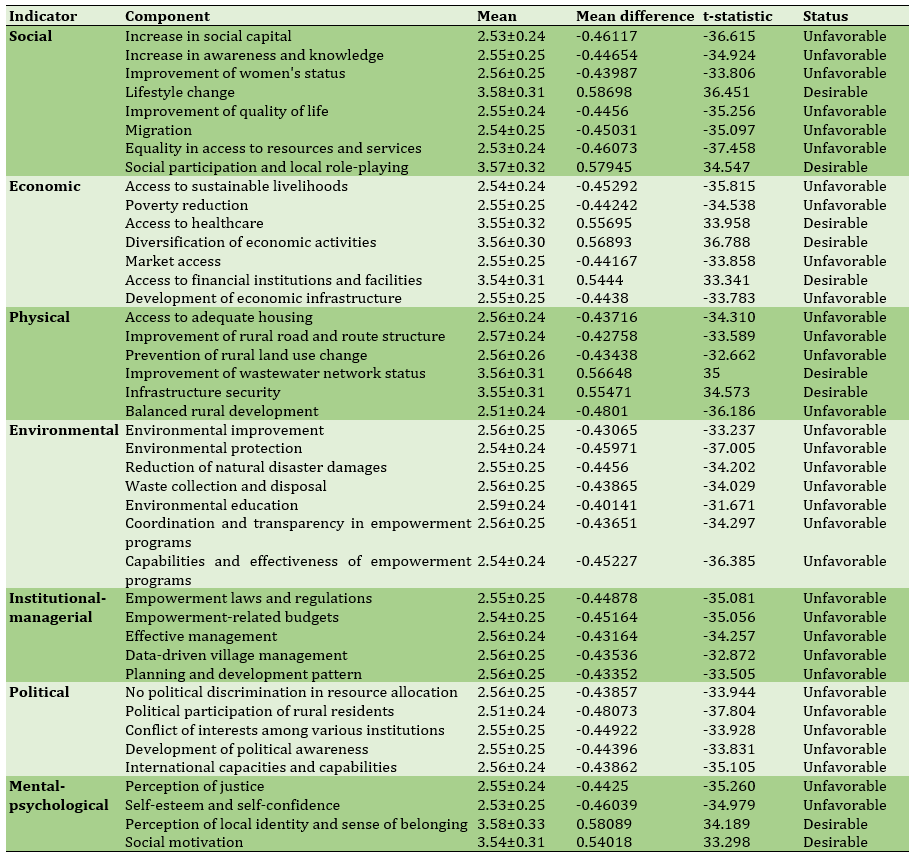
The vast majority of empowerment components (approximately 75%) were in an unfavorable status, and only a limited portion (approximately 25%) reached a desirable status. In the social indicator, only 'lifestyle change' and 'social participation and local role-playing' were rated as desirable. In the economic indicator, the situation was relatively more balanced (4 unfavorable and 3 desirable components) but still concerning. In the physical indicator, only 'improvement of wastewater network status' and 'infrastructure security' were rated as desirable. All 7 components of the environmental indicator, all 6 components of the institutional-managerial indicator, and all 5 components of the political indicator were in an unfavorable status. In the mental-psychological indicator, 2 components — 'perception of justice' and 'self-esteem and self-confidence' — were unfavorable (Table 1).
Table 1. Status of empowerment indicators in the framework of spatial justice among residents of North Savadkuh and Savadkuh villages (in all cases, the significance level was p<0.001)
In the indicators of empowerment programs regarding spatial justice from a pathological perspective, significant differences between residents of mountain villages of Savadkuh and residents of foothill villages of North Savadkuh existed across all social (p=0.004), economic (p=0.0001), physical (p=0.001), environmental (p=0.0001), managerial (p=0.0001), political (p=0.001), and psychological (p=0.002) dimensions (Table 2).
Table 2. Comparative analysis of spatial justice indicators in mountain versus foothill areas based on field data

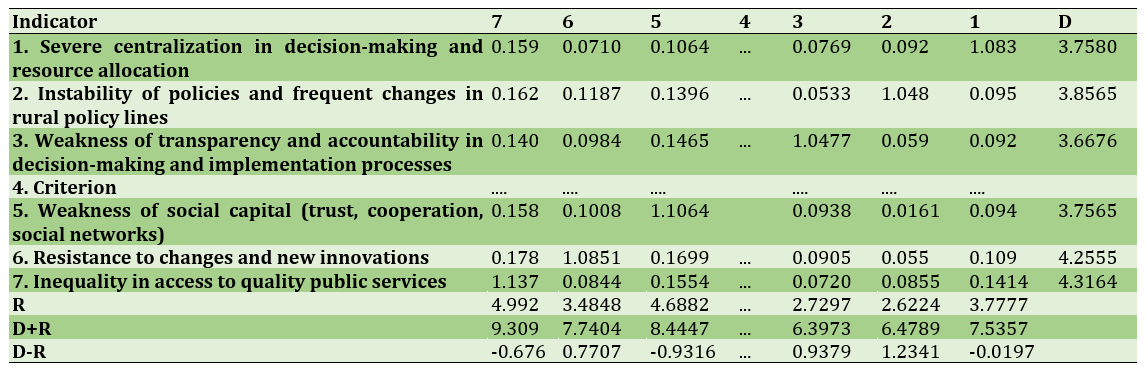
Based on the sum of row elements (D) as an indicator of the level of influence of variables and the sum of column elements (R) as the level of susceptibility of variables, D+R indicates the degree of influence and interaction of each factor with other factors, and D-R shows the influencing power of each factor. If D-R was positive, the variable was considered a causal variable; if negative, it was considered an effect variable (Table 3).
Table 3. Total relations matrix of DEMATEL
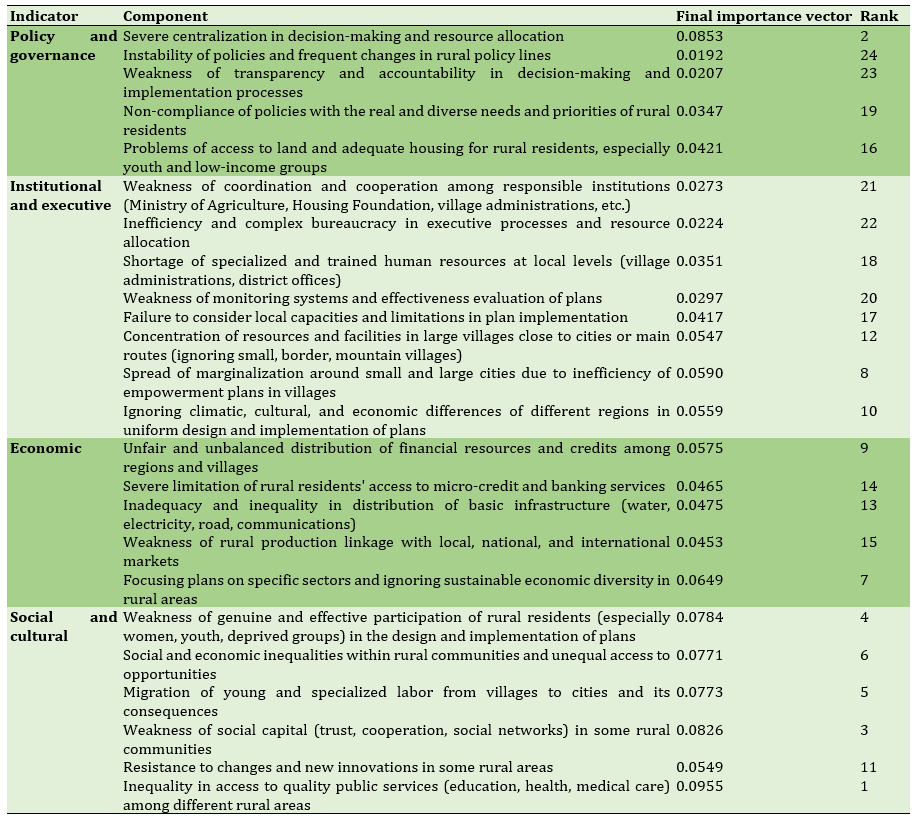
Based on the final importance vector of indicators in the DANP model, 'inequality in access to quality public services (education, health, medical care) among different rural areas' was the most influential, and 'instability of policies and frequent changes in rural policy lines' was the least influential. Social-cultural indicators with the highest importance weight (0.0955 to 0.0549) played the central role in program inefficiency. The second indicator was severe centralization in decision-making and resource allocation (weight 0.0853, rank 2), which was identified as the fundamental cause of other pathologies (Table 4).
Table 4. Final importance vector of influential variables based on analysis of the study area
9. Main Comparisons to Similar Studies
This study's emphasis on institutional and political failure as the primary root of inequality aligns with Soja's [2009] analytical focus, which considers spatial injustice a product of political processes. Like the study of Baciu et al. [2021], which showed the need for health systems to address historical spatial inequalities, this research also emphasizes the necessity of reforming local governance structures for more equitable resource distribution. The identification of centralization and weakness of genuine participation as causal variables confirmed and deepened the findings of Nasiri Lakeh et al. [2022] regarding the damages of inefficient rural management. The crisis in the physical and environmental dimensions and the significant difference between mountain and foothill areas reinforces the findings of Ghouchani et al. [2022] on the need for context-based and place-sensitive planning, showing that spatial justice cannot be achieved without attention to geography and environment. While studies such as Beheshti et al. [2023] focused on the inefficiency of poverty alleviation policies, this study shows that inequality in access to quality basic services (education and healthcare) is considered an even more important damage than economic poverty — extending the common understanding of rural deprivation from purely economic to multidimensional and spatial deprivation. Finally, the paradoxical finding of relative preservation of psychological capital (sense of belonging and motivation) despite the objective failure of programs is a distinguishing and hopeful point of this research, showing that the gap between the mental capacities of the community and inefficient institutional structures provides a valuable opportunity for participatory redesign of programs — a topic that received less attention in most previous studies. The results align with Imani & Jafari [2024], who reported an unbalanced spatial distribution pattern of development indicators in Ardabil County, with the greatest inequality in health-medical and infrastructural indicators. They also align with Shucksmith et al. [2021], who showed that spatial justice should be pursued through a place-based approach and community empowerment. In contrast, Hajarian & Shafiei [2021], who reported the physical indicator as having the greatest effect on quality of life, differ from the present study's findings — a difference that may be attributed to the different dependent variable and geographic scope. In rural areas of Mazandaran Province, soft factors (mental, political, and social) appear to play a more decisive role in achieving spatial justice than hard factors (physical and economic).
10. Suggestions & Limitations
LIMITATIONS: The limitations of the present study include a focus on two specific counties (which limits the generalizability of results) and the partial reliance of analyses on perceptual data and subjective opinions of stakeholders. Additionally, causal relationship modeling in this study, although showing general directions of influence, requires longitudinal studies for more precise measurement of changes over time.
SUGGESTIONS: It is recommended that, in pursuit of justice, a transparent, accountable, and participatory local management system be established, providing specialized training to village administrations in the fields of data-driven, justice-oriented, and participatory management; economic infrastructure and diversification of rural livelihoods be strengthened — with emphasis on creating new opportunities in areas such as rural tourism, handicrafts, smart agriculture, and local services — alongside easy access to markets and financial facilities; participatory intermediary institutions between the government and rural residents be established in the form of multipurpose cooperatives and rural development councils, with budget allocation, resource management, evaluation, and rural planning delegated to these institutions; sustainable agricultural methods, rural tourism, entrepreneurship in villages, and special programs for strengthening rural resilience against natural and economic crises be taught — including crisis management projects, rural insurance plans, building and communications network reinforcement, and disaster response training. Furthermore, delegation of decision-making authority to rural councils with the establishment of 'local development funds' under the supervision of village administrations; allocation of 60% of development credits to small and mountain villages based on deprivation-alleviation indicators; support for 'local processing industries' (such as packaging of agricultural products) with low-interest banking facilities; expansion of rural production chains; and establishment of educational-vocational hubs in sustainable natural resource management and resilience economy (centered on ranching, forestry, modern animal husbandry, medicinal plants, and responsible mining) can help empower rural areas.
11. Conclusion
Rural empowerment programs regarding spatial justice in rural areas lack equity-orientation, participation, and sustainability. For success, there is a need to reform management, distribute resources equitably, increase public participation, adapt programs to local needs, and strengthen monitoring. These challenges show that, for sustainable rural development, the perspective on empowerment must fundamentally change.
Acknowledgments
We extend our sincere appreciation and thanks to the respondents in the rural settlements of Savadkuh and North Savadkuh counties.
Ethical Permission
Nothing has been reported.
Conflict of Interest
The authors declare that they have no conflict of interest in relation to this article.
Authors' Contributions
Vakil Heidari Sareban (First Author): Introduction writer / Methodologist (25%); Aristotle Yari Hesar (Second Author): Introduction writer / Methodologist (25%); Bahram Imani (Third Author): Statistical analyst (25%); Ayoub Amani Kelarigani (Fourth Author): Principal researcher / Discussion writer (25%).
Funding/Support
Nothing has been reported.
Justice is a concept that has no clear and comprehensive definition in any intellectual tradition. In its most comprehensive form, justice in propositions is associated with concepts such as equality, harmony, fairness, balance, equity, and rights [Dadashpour & Alidadi, 2019]. According to Sandel, justice means producing maximum benefit or welfare — the greatest happiness for the greatest number — and elsewhere he defined justice as respect for freedom of choice [Sandel, 2014]. According to Rawls, justice as fairness expands the theory of justice based on the social contract [Rawls, 2023].
Spatial justice is primarily an analytical framework and background for the role of space (a set of material and ideological relations in which actions take place and which are simultaneously shaped by social relations) in the production of justice and injustice [Reigh et al., 2022]. The spatiality of justice is generally either ignored or absorbed into other related concepts such as territorial justice, environmental justice, injustice and rural poverty, or even the just city and just society. This form of justice is not a substitute for economic, social, or other forms of justice; rather, it seeks justice from a critical spatial perspective [Tzanni et al., 2022]. Spatial justice encompasses the equitable distribution of valuable resources and opportunities across the space of society [Nyamai & Schramm, 2023; Przybylinski, 2023]. Examining the pattern of spatial justice in rural areas is one of the important scientific topics that has attracted the attention of the scientific community and policymakers [Hafeznia et al., 2015]. Neglecting spatial justice in rural development plans and programs has led to the formation of social, economic, political, cultural, and environmental rural damages [Soja, 2009; Zhang et al., 2024].
2. Previous Studies
Ghouchani et al. [2022] stated that space achieves spatial justice when it includes indicators such as simplicity, legibility, equality of opportunity, and human scale, and presented a space design model based on these principles to ensure equitable spatial development. Baciu et al. [2021] believe that considerable differences exist among various geographic regions in terms of access to facilities, and that incorporating spatial justice into healthcare system strategies is essential for addressing health disparities, emphasizing the need for health systems to consider historical and contemporary spatial injustices. Beheshti et al. [2023] found that the performance of the Relief Committee in poverty alleviation from rural areas is not appropriate in various sectors and suggested that the Imam Khomeini Relief Committee could be more effective by removing banking barriers, properly identifying real needy individuals, monitoring the performance of charitable institutions, attracting public participation, establishing appropriate relationships with other government institutions, promoting a work ethic, holding vocational training courses and social counseling, and creating optimal employment patterns for poverty alleviation in these areas. Nasiri Lakeh et al. [2022] found that the current management system has 4 institutional-managerial damages, 5 environmental-ecological damages, 8 physical-spatial damages, 5 economic damages, and 6 social-cultural damages, proposing 5 strategies of empowerment and capacity building of village administrators. Bavnbæk & Thuesen [2025] showed that municipalities should distribute resources and services strategically and equitably among villages using a participatory approach based on residents' demand. Imani & Jafari [2024] reported an unbalanced spatial distribution pattern of development indicators in Ardabil County villages, with the greatest inequality in the distribution of health-medical and infrastructural indicators. Shucksmith et al. [2021] showed that spatial justice should be pursued through a place-based approach and empowerment of local communities. Hajarian & Shafiei [2021] reported the physical indicator as having the greatest effect on quality of life (coefficient 0.99), differing from the findings of the present study, a difference that may be attributed to the different dependent variable (quality of life vs. spatial justice) and differences in geographic scope.
3. Aim(s)
This study sought to diagnose the pathology of empowerment programs related to spatial justice in the rural areas of Savadkuh and North Savadkuh counties. The objective was to analyze: (1) the desirability of empowerment program indicators among rural residents across and within both counties; (2) the difference between foothill villages of North Savadkuh and mountain villages of Savadkuh from residents' perspectives; and (3) the pathologies of empowerment programs in four dimensions — policy and governance, institutional-executive, economic, and social-cultural — regarding spatial justice, based on experts' opinions.
4. Research Type
This is an original survey research study conducted in 2025 among rural residents and professionals in North Savadkuh and Savadkuh counties. The study combines quantitative methods (one-sample t-test for resident data) and multi-criteria decision analysis (DANP model for expert data).
5. Research Society, Place and Time
The study was conducted in 2025 in North Savadkuh County (northern slopes of the central Alborz mountain range) and Savadkuh County (mountainous areas of Mazandaran Province), Iran. The study population comprised rural residents and specialists in both counties. A total of 50 villages were selected proportionate to population from Savadkuh (34 villages) and North Savadkuh (16 villages).
6. Sampling Method and Number
Village residents were sampled using a simple cluster method. Sample size was determined at 384 using Cochran's formula. Accounting for a 10% attrition probability, the final sample was 424 participants: 224 questionnaires distributed in North Savadkuh villages and 200 in Savadkuh villages. Specialists were sampled using purposive sampling until conceptual saturation was reached.
7. Used Devices & Materials
Through a systematic review of specialized literature and adaptation from credible research on spatial justice in rural empowerment, 24 items were initially extracted across the indicators of 'Policy and Governance' [Kaufmann et al., 2010; Soja, 2010; Cox, 2019], 'Institutional and Executive' [North, 1990; Nasiri Lakeh et al., 2022], 'Economic' [Akbarian Ronizi et al., 2025; Afrakhteh et al., 2013], and 'Social-Cultural' [Heidari Sarban, 2019; Ghasemi et al., 2022; Liu et al., 2020; Zhu & Guo, 2022; Putnam, 2000; Heidari Sarban & Saeb, 2019] and provided to the expert panel. The influence of the 24 indicators on each other was expressed on a scale of 0 (no influence), 1 (very low influence), 2 (low influence), 3 (high influence), and 4 (very high influence). Based on experts' opinions in semi-structured interviews and surveys, the final questionnaire was prepared with 42 items in 7 indicators (social, economic, physical, environmental, managerial, political, and mental-psychological). A mean below 3 was considered an unfavorable status with damage present; a mean above 3 was considered a desirable status. Face validity of the residents' questionnaire was confirmed by 10 specialist professors. Content validity was calculated via factor analysis at 0.89 and CVR index at 0.88. Reliability was determined using Cronbach's alpha coefficient at 0.87.
For analyzing desirability of variables and indicators, a one-sample t-test was used in SPSS 27, applied once for the entire study area (both counties) and once for each county separately. For identifying and determining the importance of pathology variables of empowerment programs from a spatial justice perspective, the multi-criteria decision-making method based on the DANP model (DEMATEL-based Analytic Network Process), which is based on DEMATEL (Decision Making Trial and Evaluation Laboratory), was used.
8. Findings
The vast majority of empowerment components (approximately 75%) were in an unfavorable status, and only a limited portion (approximately 25%) reached a desirable status. In the social indicator, only 'lifestyle change' and 'social participation and local role-playing' were rated as desirable. In the economic indicator, the situation was relatively more balanced (4 unfavorable and 3 desirable components) but still concerning. In the physical indicator, only 'improvement of wastewater network status' and 'infrastructure security' were rated as desirable. All 7 components of the environmental indicator, all 6 components of the institutional-managerial indicator, and all 5 components of the political indicator were in an unfavorable status. In the mental-psychological indicator, 2 components — 'perception of justice' and 'self-esteem and self-confidence' — were unfavorable (Table 1).
Table 1. Status of empowerment indicators in the framework of spatial justice among residents of North Savadkuh and Savadkuh villages (in all cases, the significance level was p<0.001)
In the indicators of empowerment programs regarding spatial justice from a pathological perspective, significant differences between residents of mountain villages of Savadkuh and residents of foothill villages of North Savadkuh existed across all social (p=0.004), economic (p=0.0001), physical (p=0.001), environmental (p=0.0001), managerial (p=0.0001), political (p=0.001), and psychological (p=0.002) dimensions (Table 2).
Table 2. Comparative analysis of spatial justice indicators in mountain versus foothill areas based on field data
Based on the sum of row elements (D) as an indicator of the level of influence of variables and the sum of column elements (R) as the level of susceptibility of variables, D+R indicates the degree of influence and interaction of each factor with other factors, and D-R shows the influencing power of each factor. If D-R was positive, the variable was considered a causal variable; if negative, it was considered an effect variable (Table 3).
Table 3. Total relations matrix of DEMATEL
Based on the final importance vector of indicators in the DANP model, 'inequality in access to quality public services (education, health, medical care) among different rural areas' was the most influential, and 'instability of policies and frequent changes in rural policy lines' was the least influential. Social-cultural indicators with the highest importance weight (0.0955 to 0.0549) played the central role in program inefficiency. The second indicator was severe centralization in decision-making and resource allocation (weight 0.0853, rank 2), which was identified as the fundamental cause of other pathologies (Table 4).
Table 4. Final importance vector of influential variables based on analysis of the study area
9. Main Comparisons to Similar Studies
This study's emphasis on institutional and political failure as the primary root of inequality aligns with Soja's [2009] analytical focus, which considers spatial injustice a product of political processes. Like the study of Baciu et al. [2021], which showed the need for health systems to address historical spatial inequalities, this research also emphasizes the necessity of reforming local governance structures for more equitable resource distribution. The identification of centralization and weakness of genuine participation as causal variables confirmed and deepened the findings of Nasiri Lakeh et al. [2022] regarding the damages of inefficient rural management. The crisis in the physical and environmental dimensions and the significant difference between mountain and foothill areas reinforces the findings of Ghouchani et al. [2022] on the need for context-based and place-sensitive planning, showing that spatial justice cannot be achieved without attention to geography and environment. While studies such as Beheshti et al. [2023] focused on the inefficiency of poverty alleviation policies, this study shows that inequality in access to quality basic services (education and healthcare) is considered an even more important damage than economic poverty — extending the common understanding of rural deprivation from purely economic to multidimensional and spatial deprivation. Finally, the paradoxical finding of relative preservation of psychological capital (sense of belonging and motivation) despite the objective failure of programs is a distinguishing and hopeful point of this research, showing that the gap between the mental capacities of the community and inefficient institutional structures provides a valuable opportunity for participatory redesign of programs — a topic that received less attention in most previous studies. The results align with Imani & Jafari [2024], who reported an unbalanced spatial distribution pattern of development indicators in Ardabil County, with the greatest inequality in health-medical and infrastructural indicators. They also align with Shucksmith et al. [2021], who showed that spatial justice should be pursued through a place-based approach and community empowerment. In contrast, Hajarian & Shafiei [2021], who reported the physical indicator as having the greatest effect on quality of life, differ from the present study's findings — a difference that may be attributed to the different dependent variable and geographic scope. In rural areas of Mazandaran Province, soft factors (mental, political, and social) appear to play a more decisive role in achieving spatial justice than hard factors (physical and economic).
10. Suggestions & Limitations
LIMITATIONS: The limitations of the present study include a focus on two specific counties (which limits the generalizability of results) and the partial reliance of analyses on perceptual data and subjective opinions of stakeholders. Additionally, causal relationship modeling in this study, although showing general directions of influence, requires longitudinal studies for more precise measurement of changes over time.
SUGGESTIONS: It is recommended that, in pursuit of justice, a transparent, accountable, and participatory local management system be established, providing specialized training to village administrations in the fields of data-driven, justice-oriented, and participatory management; economic infrastructure and diversification of rural livelihoods be strengthened — with emphasis on creating new opportunities in areas such as rural tourism, handicrafts, smart agriculture, and local services — alongside easy access to markets and financial facilities; participatory intermediary institutions between the government and rural residents be established in the form of multipurpose cooperatives and rural development councils, with budget allocation, resource management, evaluation, and rural planning delegated to these institutions; sustainable agricultural methods, rural tourism, entrepreneurship in villages, and special programs for strengthening rural resilience against natural and economic crises be taught — including crisis management projects, rural insurance plans, building and communications network reinforcement, and disaster response training. Furthermore, delegation of decision-making authority to rural councils with the establishment of 'local development funds' under the supervision of village administrations; allocation of 60% of development credits to small and mountain villages based on deprivation-alleviation indicators; support for 'local processing industries' (such as packaging of agricultural products) with low-interest banking facilities; expansion of rural production chains; and establishment of educational-vocational hubs in sustainable natural resource management and resilience economy (centered on ranching, forestry, modern animal husbandry, medicinal plants, and responsible mining) can help empower rural areas.
11. Conclusion
Rural empowerment programs regarding spatial justice in rural areas lack equity-orientation, participation, and sustainability. For success, there is a need to reform management, distribute resources equitably, increase public participation, adapt programs to local needs, and strengthen monitoring. These challenges show that, for sustainable rural development, the perspective on empowerment must fundamentally change.
Acknowledgments
We extend our sincere appreciation and thanks to the respondents in the rural settlements of Savadkuh and North Savadkuh counties.
Ethical Permission
Nothing has been reported.
Conflict of Interest
The authors declare that they have no conflict of interest in relation to this article.
Authors' Contributions
Vakil Heidari Sareban (First Author): Introduction writer / Methodologist (25%); Aristotle Yari Hesar (Second Author): Introduction writer / Methodologist (25%); Bahram Imani (Third Author): Statistical analyst (25%); Ayoub Amani Kelarigani (Fourth Author): Principal researcher / Discussion writer (25%).
Funding/Support
Nothing has been reported.
References
1. Afrakhteh H, Hajipour M, Gerazin M, Nejati B (2013). The situation of sustainable agricultural development in Iran development plans case: Five-year plans after the revolution. Quarterly Journal of the Macro and Strategic Policies. 1(1):43-62. [Persian] [Link]
2. Ahmad MIS, Idrus MI, Rijal S (2023). The role of education in fostering entrepreneurial spirit in the young generation. Journal of Contemporary Administration and Management. 1:93-100. [Link] [DOI:10.61100/adman.v1i2.28]
3. Akbarian Ronizi S, Khodabakhshi R, Nasiri Zarghani A (2025). Evaluation of spatial justice in the distribution of public services in the villages of Chaharmahal and Bakhtiari provinces. Journal of Geography and Human Relationships. 8(2):64-83. [Persian] [Link]
4. Angelia N, Batubara BM, Zulyadi R, Hidayat TW, Hariani RR (2020). Analysis of community institution empowerment as a village government partner in the participative development process. Budapest International Research and Critics Institute Journal. 3(2):1352-1359. [Link] [DOI:10.33258/birci.v3i2.991]
5. Baciu A, Rodríguez L, Bibbins-Domingo K (2021) Spatial justice and implications for US health care. JAMA Health Forum. 2(10):e214082. [Link] [DOI:10.1001/jamahealthforum.2021.4082]
6. Bandara NA, Al-Anzi SMF, Zhdanova A, Hirani S (2024). Women's empowerment and mental health: A scoping review. Women. 4(3):277-289. [Link] [DOI:10.3390/women4030021]
7. Bavnbæk KF, Thuesen AA (2025). Navigating spatial justice: Exploring municipal planners' logics in differentiated village planning. Journal of Rural Studies. 114:103496. [Link] [DOI:10.1016/j.jrurstud.2024.103496]
8. Bebbington A, Abdulai AG, Humphreys Bebbington D, Hinfelaar M, Sanborn C (2018). Governing extractive industries: Politics, histories, ideas. Oxford: Oxford University Press. [Link] [DOI:10.1093/oso/9780198820932.001.0001]
9. Beheshti S, Rezaei R, Mohammadi Y (2023). Pathology of poverty alleviation policies of Imam Khomeini Relief Committee in rural areas (Case study: Clients under coverage in Tangestan County). Quarterly Journal of Rural Development Studies. 12(2):45-67. [Persian] [Link]
10. Cox K (2019). Local autonomy, development and spatial justice. Lessons from the United States. Spatial Justice. (13). [Link]
11. Dadashpour H, Alidadi M (2019). Integrated local development planning: A theoretical and operational framework for Iran. Tehran: BONYAD-E MASKAN Publications. [Persian] [Link]
12. Deci EL, Ryan RM (1985). Intrinsic motivation and self-determination in human behavior. New York: Plenum Press. [Link] [DOI:10.1007/978-1-4899-2271-7]
13. Enns CC, Kombe WJ (2022). Child rights and displacement in East Africa: Agency and spatial justice in planning policy. London: Routledge. [Link] [DOI:10.4324/9781003187820]
14. Ghasemi J, Gholami H, Afzali Goruh A, Alam Beigi A (2022). Analysis of the effects of ecotourism on empowerment of local communities (Case study: Savadkuh County). Quarterly Journal of Environmental Education and Sustainable Development. 11(2):45-68. [Persian] [Link]
15. Ghouchani M, Taji M, Arabi N (2022). Analysis of the role of institutionalism and good governance in sustainable rural development (Case study: Villages of Khaf County). Gazi University Journal of Science. 35(1):298-313. [Link]
16. Gibson J, Datt G, Murgai R (2021). For India's rural poor, growing towns matter more than growing cities. World Development. 138:105156. [Link]
17. Habermas J (1984). The theory of communicative action. Boston: Beacon Press. [Link]
18. Hafeznia MR, Ghadiri H, Ahmadypour M, Roknoddin Eftekhari AR, Gohari M (2015). Designing a model for measuring spatial justice (case study: Iran). Journal of Spatial Planning. 19(1):33-52. [Persian] [Link]
19. Hajarian A, Shafiei B (2021). Explaining the effects of economic, social, physical and environmental indicators on quality of life from the perspective of villagers with structural equation modeling approach. Village and Development. 25(1):53-76. [Persian] [Link]
20. Havivi S, Rotman SR, Blumberg DG, Maman S (2022). Damage assessment in rural environments following natural disasters using multi-sensor remote sensing data. Sensors. 22(24):9998. [Link] [DOI:10.3390/s22249998]
21. Heidari Sarban V (2019). The role of social capital in rural empowerment (case study: Meshkin Shahr, Central District). Geography and Regional Planning Quarterly. 8(2):239-253. [Persian] [Link]
22. Heidari Sarban V, Sabet S (2019). Explaining the relationship between social justice and the feeling of social security of residents in rural areas of Ardabil County. Regional Planning Quarterly. 9(36):67-82. [Persian] [Link]
23. Imani B, Jafari S (2024). Measuring the level of spatial justice in the distribution of sustainable rural development indicators (Case study: Villages of Ardabil County). Journal of Geographical Engineering of Land. 8(2):149-162. [Persian] [Link]
24. Jacobs J (1961). The death and life of great American cities. New York: Random House. [Link]
25. Kaufmann D, Kraay A, Mastruzzi M (2010). The worldwide governance indicators: Methodology and analytical issues. Washington DC: World Bank Policy Research Working Paper. No. 5430. [Link] [DOI:10.1596/1813-9450-5430]
26. Knight J, Weir S, Woldehanna T (2022). The role of education in facilitating adaptation to climate change: Evidence from Ethiopia. Journal of Development Studies. 58(4):632-650. [Link]
27. Liu Y, Fan P, Yue W, Song Y (2018). Impacts of land finance on urban sprawl in China: A case study of the Yangtze River Delta region. Land Use Policy. 112:105851. [Link] [DOI:10.1016/j.landusepol.2018.01.004]
28. Liu Y, Zang Y, Yang Y (2020). China's rural revitalization and development: Theory, technology and management. Journal of Geographical Sciences. 30(12):1923-1942. [Link] [DOI:10.1007/s11442-020-1819-3]
29. López-Penabad MC, Iglesias-Casal A, Rey-Ares L (2022). Proposal for a sustainable development index for rural municipalities. Journal of Cleaner Production. 357:131876. [Link] [DOI:10.1016/j.jclepro.2022.131876]
30. Mansuri G, Rao V (2013). Localizing development: Does participation work? World Bank policy research report. Washington, DC: The World Bank. [Link] [DOI:10.1596/978-0-8213-8256-1]
31. Moroni S (2020). The just city. Three background issues: Institutional justice and spatial justice, social justice and distributive justice, concept of justice and conceptions of justice. Planning Theory. 19(3):251-267. [Link] [DOI:10.1177/1473095219877670]
32. Nasiri Lakeh M, Molaee Hashjin N, Pourramazan E (2022). Evaluation and pathology of the new rural management system and rural development (case study: Central district of Guilan). Journal of Studies of Human Settlements Planning. 17(60):665-677. [Persian] [Link]
33. North DC (1990). Institutions, institutional change and economic performance. Cambridge: Cambridge University Press. [Link] [DOI:10.1017/CBO9780511808678]
34. Nyamai DN, Schramm S (2023). Accessibility, mobility, and spatial justice in Nairobi, Kenya. Journal of Urban Affairs. 45(3):367-389. [Link] [DOI:10.1080/07352166.2022.2071284]
35. Przybylinski S (2023). Spatial justice. In: Theorizing justice: A primer for social scientists. Bristol: Bristol University Press. p. 191-204. [Link] [DOI:10.51952/9781529232233.ch012]
36. Purnomo S, Rahayu ES, Riani AL, Suminah S, Udin UDIN (2020). Empowerment model for sustainable tourism village in an emerging country. Journal of Asian Finance, Economics and Business. 7(2):261-270. [Link] [DOI:10.13106/jafeb.2020.vol7.no2.261]
37. Putnam RD (2000). Bowling alone: The collapse and revival of American community. London: Simon & Schuster. [Link] [DOI:10.1145/358916.361990]
38. Rachele R (2022). A long-term vision for the EU's rural areas. Journal of European Rural Development. 28:15-34. [Link]
39. Rawls J (2023). Justice as fairness: A restatement. Sabeti A, translator. Tehran: Ghoqnoos Publishing. [Persian] [Link]
40. Reigh E, Escudé M, Bakal M, Rivero E, Wei X, Roberto C, et al (2022). Mapping racespace: Data stories as a tool for environmental and spatial justice. Occasional Paper Series. 2022(48). [Link] [DOI:10.58295/2375-3668.1452]
41. Rigolon A, Nemeth J (2023). Planning for equitable urban green spaces: A review of justice-oriented assessments. Landscape and Urban Planning. 229:104591. [Link] [DOI:10.1016/j.landurbplan.2022.104591]
42. Sandel MJ (2014). Justice: What's the right thing to do?. Afshar H, translator. Tehran: Markaz Publishing. [Persian] [Link]
43. Schlosberg D (2007). Defining environmental justice: Theories, movements, and nature. Oxford: Oxford University Press. [Link] [DOI:10.1093/acprof:oso/9780199286294.001.0001]
44. Schumpeter JA (1934). The theory of economic development: An inquiry into profits, capital, credit, interest, and the business cycle. Cambridge: Harvard University Press. [Link]
45. Setianto M, Gamal A (2021). Spatial justice in the distribution of public services. IOP Conference Series: Earth and Environmental Science. 673(1):012024. [Link] [DOI:10.1088/1755-1315/673/1/012024]
46. Setiawan S, Saifunuha MA, Kautsar JL, Wulandari C (2019). Community empowerment on establishment of friendly-village for women and children. Indonesian Journal of Advocacy and Legal Services. 1(1):5-22. [Link] [DOI:10.15294/ijals.v1i1.33756]
47. Shucksmith M, Brooks EL, Madanipour A (2021). LEADER and spatial justice. Sociologia Ruralis. 61(3):512-534. [Link] [DOI:10.1111/soru.12334]
48. Soja EW (2009). The city and spatial justice. Spatial Justice. 1(1):1-5. [Link] [DOI:10.5749/minnesota/9780816666676.003.0001]
49. Soja EW (2010). Seeking spatial justice. Minneapolis: University of Minnesota Press. [Link] [DOI:10.5749/minnesota/9780816666676.001.0001]
50. Statistical Center of Iran (2016). Statistical Blocks of North Savadkuh and Savadkuh Counties, 2016. [Link]
51. Tarshis S, Scott-Marshall H, Alogia R (2022). An analysis of comparative perspectives on economic empowerment among employment-seeking survivors of Intimate Partner Violence (IPV) and service providers. Societies. 12(1):16. [Link] [DOI:10.3390/soc12010016]
52. Tsai LC (2022). A survivor-defined framework for economic empowerment: Findings from a photovoice study with survivors of human trafficking and gender-based violence. Journal of Human Trafficking. [Link]
53. Tzanni O, Nikolaou P, Giannakopoulou S, Arvanitis A, Basbas S (2022). Social dimensions of spatial justice in the use of the public transport system in Thessaloniki, Greece. Land. 11(11). [Link] [DOI:10.3390/land11112032]
54. Wang B, Ji T, He R (2023). Empowerment or disempowerment: The (dis)empowering processes and outcomes of co-designing with rural craftspeople. Sustainability. 15(5):4468. [Link] [DOI:10.3390/su15054468]
55. Zhang H, He L, Zhang Z (2024). Can policy achieve environmental fairness and environmental improvement? Evidence from the Xin'an River project in China. Journal of Policy Modeling. 46(1):212-234. [Link] [DOI:10.1016/j.jpolmod.2023.11.008]
56. Zhu J, Guo Y (2022). Social justice in spatial change: Transition from autonomous rural development to integrated urbanization in China. Cities. 122:103539. [Link] [DOI:10.1016/j.cities.2021.103539]