

Bilingual
En/Fa
Geographical Research is Published in both Persian and English Full-text.
Volume 40, Issue 4 (2025)
GeoRes 2025, 40(4): 295-304 |
Back to browse issues page
Article Type:
Subject:




History
Received: 2025/10/3 | Accepted: 2025/12/9 | Published: 2025/12/12
Received: 2025/10/3 | Accepted: 2025/12/9 | Published: 2025/12/12
How to cite this article
Bagheri R, Rashidvash V, Sharbatian Y, Karimian H. Anthropological Analysis of the Role of Qajar-Era Architecture in Tourism Development in Shiraz. GeoRes 2025; 40 (4) :295-304
URL: http://georesearch.ir/article-1-1868-en.html
URL: http://georesearch.ir/article-1-1868-en.html
Download citation:
BibTeX | RIS | EndNote | Medlars | ProCite | Reference Manager | RefWorks
Send citation to:


Rights and permissions
BibTeX | RIS | EndNote | Medlars | ProCite | Reference Manager | RefWorks
Send citation to:


1- Department of Social Sciences, Central Tehran Campus (CT.C.), Islamic Azad University, Tehran, Iran
2- Department of Sociology, Garmsar Campus (Ga.C.), Islamic Azad University, Garmsar, Iran
2- Department of Sociology, Garmsar Campus (Ga.C.), Islamic Azad University, Garmsar, Iran
Full-Text (HTML) (48 Views)
Background
Qajar architecture, as both a cultural–symbolic text and a functional institution, reflects cultural meanings, national identity, and social structures, and can play a significant role in shaping tourist experiences and promoting sustainable cultural tourism. However, these dimensions have been less frequently examined comprehensively in previous studies.
Previous Studies
Previous studies on Qajar architecture have primarily focused on formal, technical, and historical-descriptive aspects of buildings, with limited attention to interpretive and social analyses [PanjehBashi & Doulab, 2018]. In contrast, some research has analyzed this period’s architecture as a reflection of the reconstitution of national identity in response to modernity and Western influences, highlighting the deliberate role of symbolic elements in expressing Iran’s multilayered identity [Grigor, 2016; Shirazi & Mousavilar, 2017]. Theoretically, studies grounded in phenomenology and interpretive anthropology have considered architecture as a “cultural text,” emphasizing the connection between space, meaning, and lived experience [Seamon, 2000; Rashidvash & Yousef Nejad, 2021]. In the field of cultural tourism, scholars have stressed the importance of accurate interpretation of heritage to convey authenticity and sustainability [Cooper et al., 2001; Saraei & Shamshiri, 2013]. Moreover, some studies have highlighted the significance of qualitative, gendered, and memory-oriented dimensions of space in understanding Qajar heritage [Amirzadeh Dana & Armaghan, 2023]. Nevertheless, the simultaneous integration of semantic and functional approaches in the context of Qajar architecture in Shiraz has received limited attention.
Aim(s)
This study was conducted with the aim of elucidating the cultural and functional role of Qajar architecture in Shiraz in promoting sustainable cultural tourism, adopting an ethnographic approach.
Research Type
This qualitative study was an interpretive case study with a predominantly ethnographic approach.
Research Society, Place and Time
The research population of this study comprised experts and specialists in fields related to Qajar architecture and cultural tourism, including cultural heritage and historical building restoration specialists, architects specializing in traditional Iranian architecture, and cultural tourism guides active in Qajar-era monuments in Shiraz. The study was conducted in Qajar-era buildings and historical sites in Shiraz, including Narenjestan-e Ghavam, Zinat al-mulk House, Afif Abad Garden, Eram Garden, and Nasir al-Mulk Mosque. Data collection took place during the spring and autumn seasons of 2024.
Sampling Method and Number
The participants were selected through purposive judgmental sampling, and the sample size was determined after conducting 15 semi-structured interviews and achieving theoretical saturation.
Used Devices & Materials
The data were collected using semi-structured interview guides, field observation checklists, audio recording devices for documenting interviews, and documentary sources, including archival documents, historical texts, and visual materials related to Qajar-era architecture in Shiraz.
Findings
The qualitative findings of this study were analyzed using a hierarchical thematic analysis approach, progressing from raw interview data to core themes (Table 1). In the open coding stage, 150 initial codes were extracted from 15 in-depth interviews, capturing meaningful concepts related to Qajar architecture and its role in cultural tourism. These codes were then organized into 15 secondary codes (sub-themes) through axial coding, and finally grouped into two central themes in the selective coding stage: Qajar architecture as a cultural text and Qajar architecture as a functional institution (Table 1).
Table 1. Thematic Analysis of Codes Extracted from Interviews
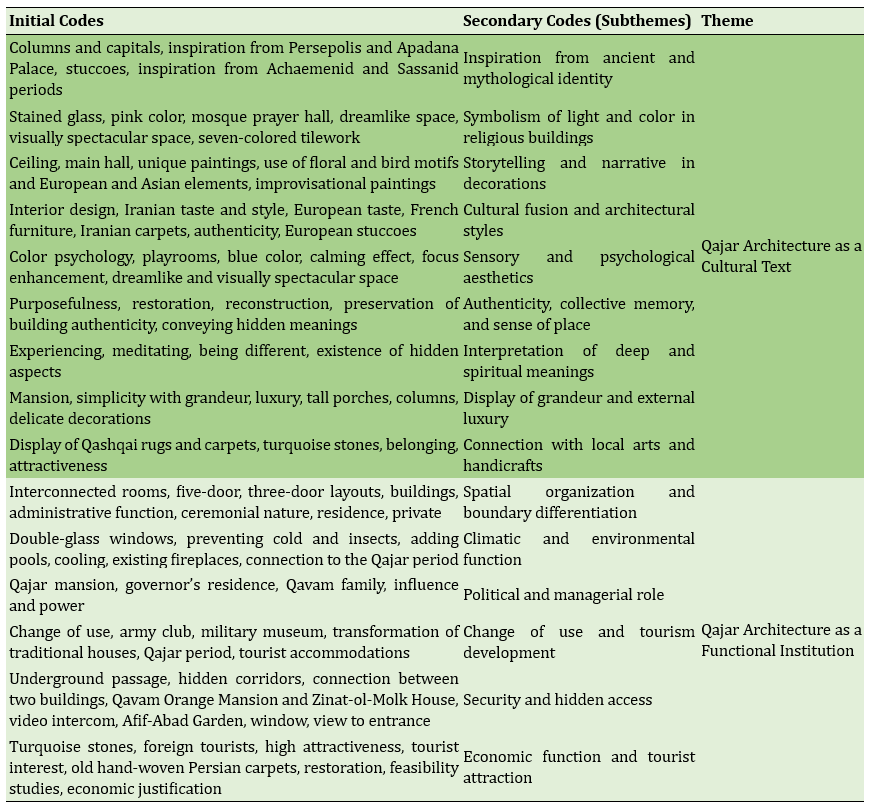
The first theme, Qajar architecture as a cultural text, included nine sub-themes: inspiration from ancient identity, symbolism of light and color, narrative decoration, cultural fusion of styles, sensory and psychological aesthetics, authenticity and collective memory, grandeur and splendor, deep spiritual meanings, and connections to local arts and crafts (Table 1). The second theme, Qajar architecture as a functional institution, comprised six sub-themes emphasizing spatial organization and privacy, climatic and environmental functions, hidden security and access, political and managerial roles, adaptive reuse for tourism, and economic functions attracting visitors (Table 1).
Overall, this analysis highlights the dual role of Qajar architecture in Shiraz, combining cultural-symbolic and functional-social dimensions, which collectively support heritage preservation, urban identity, and sustainable cultural tourism (Table 1).
Main Comparisons to Similar Studies
The findings of this study align closely with prior research emphasizing the dual cultural and functional dimensions of Qajar architecture in shaping meaningful tourist experiences. The interpretive reading of visual symbolism and ornamentation corroborates Geertz’s perspective of architecture as a cultural text [Geertz, 2014] and Peirano’s ethnographic insights on “house” meanings in cultural contexts [Peirano, 1998]. Decorative elements, including Qajar tilework and mirror designs, were consistent with studies highlighting their communicative and social significance [Riyazi, 2023; Psarra, 2009; Kiyanmehr & Karimipur Davani Nezhad, 2023; Zarei & Shirvani Dashtak, 2022]. The symbolic use of light and color parallels findings on Iranian architectural semiotics [Avaznejad & Sheibani, 2021; Danesh & Khazaei, 2020]. Functional aspects, such as spatial segregation, climate adaptation, and privacy management, confirm Malinowski’s functionalist perspective [Malinowski, 1944] and support previous analyses of historical urban identity preservation [Momeni & Naseri, 2016; Kutsal, 2013]. These parallels reinforce the argument that Qajar architecture simultaneously facilitates cultural interpretation and functional engagement, promoting sustainable cultural tourism [Karimi et al., 2022; Shirazi & Mousavilar, 2017; Goodarzi & Shirazbakht, 2020].
Suggestions
It is recommended that future research adopt a qualitative-comparative approach to examine the impact of Qajar architecture on tourist experiences in comparison with the Zand and Safavid periods. Additionally, tourism authorities should utilize ethnographic findings to provide cultural and social interpretations of architecture in guidebooks, and investment in converting Qajar houses into eco-lodges while preserving their cultural authenticity should be strengthened.
Conclusion
The Qajar architectural heritage in Shiraz functions beyond its physical and technical dimensions as a dynamic “cultural and social institution.” On one hand, as a “cultural text,” this architecture conveys profound symbolic meanings, divinity (through light and color), and historical narratives, communicating Iran’s revived national identity to tourists. On the other hand, as a “functional institution,” Qajar architecture regulates social relations, ensures privacy (through the distinction between interior and exterior spaces), and addresses the climatic and security needs of its time.
Acknowledgments: The authors express their sincere gratitude to the esteemed experts from the Cultural Heritage Organization, architects specialized in historical building restoration, and cultural tourism guides at the studied sites (Narenjestan-e Ghavam, Nasir al-Mulk Mosque, Eram Garden, Zinat-al-Mulk House, and Afif Abad Garden) for sharing their valuable insights and experiences, which significantly enriched this research. The authors also appreciate the academic support provided by the Department of Anthropology at the Islamic Azad University, Tehran Central Branch, throughout the research process.
Ethical Permission: This study was conducted in accordance with the ethical principles for human research. All participants (experts and specialists) were fully informed about the objectives and procedures of the study before the interviews and provided written informed consent to participate. Confidentiality of information and the personal identity of participants was strictly maintained.
Conflict of Interest: None to declare.
Authors’ Contributions: Bagheri R (first author), Introduction Writer/Methodologist/Principal Researcher/Statistical Analyst/Discussion Writer (40%); Rashidvash V (second author), Introduction Writer/Methodologist/Principal Researcher/Statistical Analyst/Discussion Writer (20%); Sharbatian Y (third author), Introduction Writer/Methodologist/Principal Researcher/Statistical Analyst/Discussion Writer (20%); Karimian H (fourth author), Introduction Writer/Methodologist/Principal Researcher/Statistical Analyst/Discussion Writer (20%).
Funding: None to declare.
Qajar architecture, as both a cultural–symbolic text and a functional institution, reflects cultural meanings, national identity, and social structures, and can play a significant role in shaping tourist experiences and promoting sustainable cultural tourism. However, these dimensions have been less frequently examined comprehensively in previous studies.
Previous Studies
Previous studies on Qajar architecture have primarily focused on formal, technical, and historical-descriptive aspects of buildings, with limited attention to interpretive and social analyses [PanjehBashi & Doulab, 2018]. In contrast, some research has analyzed this period’s architecture as a reflection of the reconstitution of national identity in response to modernity and Western influences, highlighting the deliberate role of symbolic elements in expressing Iran’s multilayered identity [Grigor, 2016; Shirazi & Mousavilar, 2017]. Theoretically, studies grounded in phenomenology and interpretive anthropology have considered architecture as a “cultural text,” emphasizing the connection between space, meaning, and lived experience [Seamon, 2000; Rashidvash & Yousef Nejad, 2021]. In the field of cultural tourism, scholars have stressed the importance of accurate interpretation of heritage to convey authenticity and sustainability [Cooper et al., 2001; Saraei & Shamshiri, 2013]. Moreover, some studies have highlighted the significance of qualitative, gendered, and memory-oriented dimensions of space in understanding Qajar heritage [Amirzadeh Dana & Armaghan, 2023]. Nevertheless, the simultaneous integration of semantic and functional approaches in the context of Qajar architecture in Shiraz has received limited attention.
Aim(s)
This study was conducted with the aim of elucidating the cultural and functional role of Qajar architecture in Shiraz in promoting sustainable cultural tourism, adopting an ethnographic approach.
Research Type
This qualitative study was an interpretive case study with a predominantly ethnographic approach.
Research Society, Place and Time
The research population of this study comprised experts and specialists in fields related to Qajar architecture and cultural tourism, including cultural heritage and historical building restoration specialists, architects specializing in traditional Iranian architecture, and cultural tourism guides active in Qajar-era monuments in Shiraz. The study was conducted in Qajar-era buildings and historical sites in Shiraz, including Narenjestan-e Ghavam, Zinat al-mulk House, Afif Abad Garden, Eram Garden, and Nasir al-Mulk Mosque. Data collection took place during the spring and autumn seasons of 2024.
Sampling Method and Number
The participants were selected through purposive judgmental sampling, and the sample size was determined after conducting 15 semi-structured interviews and achieving theoretical saturation.
Used Devices & Materials
The data were collected using semi-structured interview guides, field observation checklists, audio recording devices for documenting interviews, and documentary sources, including archival documents, historical texts, and visual materials related to Qajar-era architecture in Shiraz.
Findings
The qualitative findings of this study were analyzed using a hierarchical thematic analysis approach, progressing from raw interview data to core themes (Table 1). In the open coding stage, 150 initial codes were extracted from 15 in-depth interviews, capturing meaningful concepts related to Qajar architecture and its role in cultural tourism. These codes were then organized into 15 secondary codes (sub-themes) through axial coding, and finally grouped into two central themes in the selective coding stage: Qajar architecture as a cultural text and Qajar architecture as a functional institution (Table 1).
Table 1. Thematic Analysis of Codes Extracted from Interviews
The first theme, Qajar architecture as a cultural text, included nine sub-themes: inspiration from ancient identity, symbolism of light and color, narrative decoration, cultural fusion of styles, sensory and psychological aesthetics, authenticity and collective memory, grandeur and splendor, deep spiritual meanings, and connections to local arts and crafts (Table 1). The second theme, Qajar architecture as a functional institution, comprised six sub-themes emphasizing spatial organization and privacy, climatic and environmental functions, hidden security and access, political and managerial roles, adaptive reuse for tourism, and economic functions attracting visitors (Table 1).
Overall, this analysis highlights the dual role of Qajar architecture in Shiraz, combining cultural-symbolic and functional-social dimensions, which collectively support heritage preservation, urban identity, and sustainable cultural tourism (Table 1).
Main Comparisons to Similar Studies
The findings of this study align closely with prior research emphasizing the dual cultural and functional dimensions of Qajar architecture in shaping meaningful tourist experiences. The interpretive reading of visual symbolism and ornamentation corroborates Geertz’s perspective of architecture as a cultural text [Geertz, 2014] and Peirano’s ethnographic insights on “house” meanings in cultural contexts [Peirano, 1998]. Decorative elements, including Qajar tilework and mirror designs, were consistent with studies highlighting their communicative and social significance [Riyazi, 2023; Psarra, 2009; Kiyanmehr & Karimipur Davani Nezhad, 2023; Zarei & Shirvani Dashtak, 2022]. The symbolic use of light and color parallels findings on Iranian architectural semiotics [Avaznejad & Sheibani, 2021; Danesh & Khazaei, 2020]. Functional aspects, such as spatial segregation, climate adaptation, and privacy management, confirm Malinowski’s functionalist perspective [Malinowski, 1944] and support previous analyses of historical urban identity preservation [Momeni & Naseri, 2016; Kutsal, 2013]. These parallels reinforce the argument that Qajar architecture simultaneously facilitates cultural interpretation and functional engagement, promoting sustainable cultural tourism [Karimi et al., 2022; Shirazi & Mousavilar, 2017; Goodarzi & Shirazbakht, 2020].
Suggestions
It is recommended that future research adopt a qualitative-comparative approach to examine the impact of Qajar architecture on tourist experiences in comparison with the Zand and Safavid periods. Additionally, tourism authorities should utilize ethnographic findings to provide cultural and social interpretations of architecture in guidebooks, and investment in converting Qajar houses into eco-lodges while preserving their cultural authenticity should be strengthened.
Conclusion
The Qajar architectural heritage in Shiraz functions beyond its physical and technical dimensions as a dynamic “cultural and social institution.” On one hand, as a “cultural text,” this architecture conveys profound symbolic meanings, divinity (through light and color), and historical narratives, communicating Iran’s revived national identity to tourists. On the other hand, as a “functional institution,” Qajar architecture regulates social relations, ensures privacy (through the distinction between interior and exterior spaces), and addresses the climatic and security needs of its time.
Acknowledgments: The authors express their sincere gratitude to the esteemed experts from the Cultural Heritage Organization, architects specialized in historical building restoration, and cultural tourism guides at the studied sites (Narenjestan-e Ghavam, Nasir al-Mulk Mosque, Eram Garden, Zinat-al-Mulk House, and Afif Abad Garden) for sharing their valuable insights and experiences, which significantly enriched this research. The authors also appreciate the academic support provided by the Department of Anthropology at the Islamic Azad University, Tehran Central Branch, throughout the research process.
Ethical Permission: This study was conducted in accordance with the ethical principles for human research. All participants (experts and specialists) were fully informed about the objectives and procedures of the study before the interviews and provided written informed consent to participate. Confidentiality of information and the personal identity of participants was strictly maintained.
Conflict of Interest: None to declare.
Authors’ Contributions: Bagheri R (first author), Introduction Writer/Methodologist/Principal Researcher/Statistical Analyst/Discussion Writer (40%); Rashidvash V (second author), Introduction Writer/Methodologist/Principal Researcher/Statistical Analyst/Discussion Writer (20%); Sharbatian Y (third author), Introduction Writer/Methodologist/Principal Researcher/Statistical Analyst/Discussion Writer (20%); Karimian H (fourth author), Introduction Writer/Methodologist/Principal Researcher/Statistical Analyst/Discussion Writer (20%).
Funding: None to declare.
Keywords:
References
1. Aghajan V, Abedi H, Behboodi O (2014). Investigating the role of cultural marketing in the development of the tourism industry. Tourism Space Geography. 3(10):39-51. [Persian] [Link]
2. Amirzadeh Dana E, Armaghan M (2023). Representation of urban space and architecture in Qajar women's memoirs. Women's Studies. 14(45):1-27. [Persian] [Link]
3. Avaznejad F, Sheibani H (2021). Study of color in the architecture of Nasir Al-Molk Mosque in Shiraz. Journal of Studies in Color World. 11(1):23-34. [Persian] [Link]
4. Cheng Z, Chen X (2022). The effect of tourism experience on tourists' environmentally responsible behavior at cultural heritage sites: The mediating role of cultural attachment. Sustainability. 14(1):565. [Link] [DOI:10.3390/su14010565]
5. Cooper C, Fletcher J, Gilbert D, Wanhill S (2001). Tourism: Principles and practices. Ghamkhar A, translator. Tehran: Faramad Publication. [Persian] [Link]
6. Danesh K, Khazaei M (2020). The symbolism of green color in Iranian-Islamic culture and art. PAYKAREH. 9(19):18-29. [Persian] [Link]
7. Etesam I, Mirmiran H (2009). Contemporary Iranian architecture: 75 years of experience in public buildings (2 Volumes). Tehran: PAYAM-E SIMA Publishing and Planning Company. [Presian] [Link]
8. Geertz C (2014). The interpretation of cultures: Selected essays. New York: Basic Books. [Link]
9. Ghobadian V (2021). Iranian contemporary architecture: Stylistics and theoretical foundations. Tehran: FEKR-E NO Publication. [Presian] [Link]
10. Goodarzi R, ShirazbakhtF (2020). Evaluation and comparison of the Tourism status of Eram, Jahan Nama, and Afif Abad gardens in Shiraz with an approach to improving citizen participation. Journal of Architecture. 3(16):51-59. [Presian] [Link]
11. Grigor T (2016). Persian architectural revivals in the British Raj and Qajar Iran. Comparative Studies of South Asia, Africa and the Middle East. 36(3):384-397. [Link] [DOI:10.1215/1089201x-3698959]
12. Karimi M, Rahmani A, Ashari E (2022). The role of advertising through modern visual media in the development of tourism in the Qajari gardens of Shiraz. Journal of Tourism and Development. 11(1):225-241. [Presian] [Link]
13. Kiyanmehr Q, Karimipur Davani Nezhad F (2024). An analysis of social factors influencing on the formation of tiling motifs in Shiraz Qajar Houses. Journal of Visual and Applied Arts. 17(43):43-61. [Presian] [Link]
14. Kutsal B (2013). The effects of the changing of urban identity on historic towns. Proceedings of the 1st International Conference on Architecture and Urban Design. Albania: Epoka University. [Link]
15. Malinowski, B. (1944). A scientific theory of culture and other essays. Chapel Hill: University of North Carolina Press [Link]
16. Momeni K, Naseri N (2016). Surveying the tools and methods of creating privacy in the Zinat-ol Mulk traditional house in shiraz (based on the Quran verses and Islamic hadiths). Journal of Researches in Islamic Architecture. 3(4):18-35. [Persian] [Link]
17. Najjarnejad Mashhadi M, Afzalian K, Sheibani M, Seyedalhoseni SM (2020). Understanding the nature of maintenant patterns in Iranian native architecture (by adapting the concept of maintenance from Christopher Alexander's perspective on architectural patterns). Journal of Architectural Thought. 5(9):1-18. [Persian] [Link]
18. PanjehBashi E, Doulab F (2018). Study of the features and structure of the embellishments of facades in tiled buildings in Shiraz. NEGAREH. 13(48):104-125. [Persian] [Link]
19. Peirano MGS (1998). When anthropology is at home: The different contexts of a single discipline. Annual Review of Anthropology. 27:105-128. [Link] [DOI:10.1146/annurev.anthro.27.1.105]
20. Pirnia MK, Memarian G (2023). Acquaintance with the Islamic architecture of Iran. 27th edition. Tehran: Goljam Publications. [Persian] [Link]
21. Psarra S (2009). Architecture and narrative: The formation of space and cultural meaning. London: Routledge. [Link] [DOI:10.4324/9780203639672]
22. Ramyar R (2020). Learning from tradition: The role of environment perception layers in space making-the case of the Persian Garden. Journal of Urban Management. 9(2):238-249. [Link] [DOI:10.1016/j.jum.2020.02.002]
23. Rashidvash V, Yousef Nejad H (2021). Interpretation of culture from the viewpoint of Clifford Geertz with emphasis on symbolism school. Journal of Humanities Horizons. 5(50):101-120. [Persian] [Link]
24. Riyazi MR (2023). Qajar tilework. Tehran: Yassavoli Publication. [Persian] [Link]
25. Saraei MH, Shamshiri M (2013). Tourism situation study in the city of Shiraz towards sustainable development using the SWOT Technique. Journal of Geography and Environmental Planning. 24(1):69-88. [Persian] [Link]
26. Seamon D (2000). Phenomenology, place, environment, and architecture: A review. Journal of Architectural Education. 54(1):195-207. [Link]
27. Shafiei M, Fakhr M (2019). Performance evaluation of hotels affiliated to Shiraz municipality in order to promote tourism industry. Tourism Management Studies. 14(46):283-308. [Persian] [Link]
28. Shirazi M, Mousavilar A (2017). Retrieval of identity layers in Qajar Era (case study: Ceramics). NEGAREH. 12(41):17-29. [Persian] [Link]
29. Taslimi N (2010). Thought and aesthetics in ancient Iran and the Islamic World. Qom: Radnegar Publication. [Persian] [Link]
30. Zarei H, Shirvani Dashtak S (2022). Characteristics of mirror work in the houses of Qajar period in Shiraz City (in terms of implementation techniques and type of decorations). Archaeological Research of Iran. 11(29):223-244. [Persian] [Link]