

Bilingual
En/Fa
Geographical Research is Published in both Persian and English Full-text.
Volume 40, Issue 3 (2025)
GeoRes 2025, 40(3): 279-286 |
Back to browse issues page
Article Type:
Subject:




History
Received: 2025/08/19 | Accepted: 2025/09/27 | Published: 2025/10/5
Received: 2025/08/19 | Accepted: 2025/09/27 | Published: 2025/10/5
How to cite this article
Pooshasb A. Effects of Physical and Social Attributes of Urban Spaces on Users’ Behavioral Patterns. GeoRes 2025; 40 (3) :279-286
URL: http://georesearch.ir/article-1-1838-en.html
URL: http://georesearch.ir/article-1-1838-en.html
Download citation:
BibTeX | RIS | EndNote | Medlars | ProCite | Reference Manager | RefWorks
Send citation to:


Rights and permissions
BibTeX | RIS | EndNote | Medlars | ProCite | Reference Manager | RefWorks
Send citation to:

Authors
A. Pooshasb * 
Department of Urban Planning, College of Fine Arts, University of Tehran, Tehran, Iran
Full-Text (HTML) (256 Views)
Background
In recent decades, the quality of public spaces has emerged as a key indicator of urban livability, and studies have shown that user behavior results from the interaction between physical (built) and social factors. Despite numerous investigations, most research has been unidimensional, and integrative or comparative studies, particularly in Middle Eastern contexts, remain limited. With its diverse public spaces, Tehran necessitates a simultaneous analysis of both physical and social characteristics to understand the actual behavioral patterns of its citizens.
Previous Studies
Previous studies have extensively emphasized the role of physical characteristics of public spaces in shaping user behavior patterns. Numerous investigations have shown that factors such as spatial form, accessibility, environmental legibility, and the quality of urban furniture influence both the extent and type of public space usage [Lei et al., 2025; Liang & Leng, 2025]. Additionally, research on social interactions indicates that design quality can enhance voluntary activities, vitality, and social safety [Vidal et al., 2022; Mehta & Bosson, 2018]. However, part of the literature has focused solely on physical aspects, neglecting the analysis of social and cultural dimensions [Lei et al., 2025], while other studies have adopted exclusively social approaches [Askarizad & Safari, 2020; Vidal et al., 2022]. Moreover, most studies have concentrated on single case spaces, with comparatively few examining multiple, diverse spaces. A geographical gap also exists, as the majority of research has been conducted in Europe and North America, with limited attention to Middle Eastern contexts [Liang & Leng, 2025; Luo et al., 2025].
Aim(s)
The ultimate aim of this study is to provide an analytical framework for understanding and enhancing the quality of urban public spaces, based on the reciprocal interaction between the physical environment and the social context.
Research Type
This study was designed as a survey with an applied-analytical approach.
Research Society, Place and Time
This study was conducted in 2025 across three public spaces in Tehran, including Mellat Park, Laleh Park, and the Bamland Recreational–Cultural Complex. The research population comprised all users of these three urban spaces. Sampling was carried out using stratified random sampling based on different age, gender, and family groups.
Sampling Method and Number
The sampling for this study was conducted using stratified random sampling to ensure the representation of different demographic groups, including age, gender, and family structures.
The sample size was calculated as 376 participants using Cochran's formula. During implementation, approximately 125 questionnaires were distributed for each of the three studied spaces, resulting in a total of 375 valid responses. The samples were categorized based on demographic composition and patterns of presence in the spaces to enable a precise analysis of individual and group behavioral patterns.
Used Devices & Materials
In this study, a structured questionnaire was employed as the main data collection instrument. The questionnaire comprised 42 items organized into seven core components: Physical characteristics of the space, social characteristics of users, social interactions, discretionary activities, social activities, spatial experience evaluation, and environmental–climatic factors. To ensure clarity and reliability, a pilot version of the questionnaire was distributed among 30 users, and its reliability was assessed using Cronbach's alpha. The collected data were reviewed, cleaned, and entered into SPSS 27 for statistical analysis. In addition to the questionnaire, field observations were conducted as a complementary tool to identify high-traffic areas and user behavioral patterns.
Findings
The findings of this study were presented in two main sections including (a) a comparison among the spaces based on the primary components, and (b) an analysis of the relationships among parameters. One-way ANOVA indicated that among the three studied spaces of Laleh Park, Bamland, and Mellat Park significant differences existed in certain behavioral components. Specifically, users’ social characteristics (p=0.025) and discretionary activities (p=0.001) showed notable differences across the spaces, whereas other components, including physical characteristics, social interactions, social activities, spatial feedback, environmental factors, and urban furniture, did not exhibit significant differences. These results suggest that users’ behavioral dimensions play a more prominent role than physical dimensions in distinguishing among spaces.
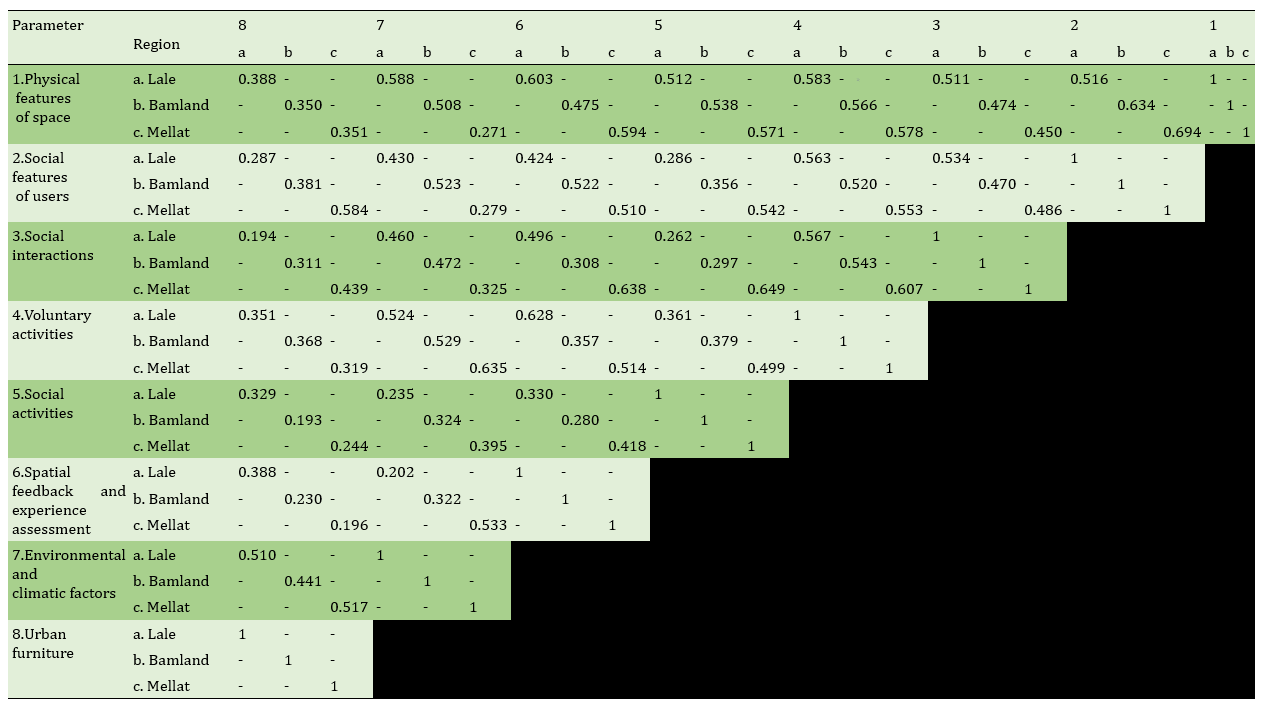
Pearson correlation analysis revealed that most behavioral, physical, social, and environmental components were positively and mutually correlated (Table 1). For example, in Laleh Park, physical characteristics were strongly correlated with discretionary activities (r=0.583) and spatial feedback (r=0.628); in Bamland, users’ social characteristics were associated with environmental–climatic factors (r=0.523); and in Mellat Park, social interactions showed high correlations with social activities (r=0.649) and spatial feedback (r=0.638). Overall, the results indicate that the interaction between the physical quality of space and users’ social behavior is the most important factor in shaping a positive spatial experience, and spaces with optimal design, appropriate amenities, and favorable environmental conditions enhance social participation and user satisfaction.
Table 1. Results of the Pearson Correlation Test
Main Comparisons to Similar Studies
The present study demonstrated that significant differences among the three public spaces in Tehran were primarily observed in users’ social characteristics and discretionary activities, while physical attributes and other components showed no notable differences. This finding aligns with the perspectives of Gehl [2011] and Mehta [2019], who emphasize that social life in spaces results from human–environment interaction and that physical design alone does not guarantee social vitality. Mellat Park, with its historical background and physical coherence, exhibited the strongest correlations between physical features and user behavior, consistent with the findings of Lei and Vidal [Lei et al., 2025; Vidal et al., 2022] regarding the influence of spatial legibility, accessibility, and urban furniture on stable social behaviors. In contrast, at Bamland, social and behavioral relationships were stronger, with usage patterns shaped by individual and social motivations, in agreement with Wronkowski [2025]. In Laleh Park, behaviors were calmer and more individual-oriented, similar to the findings of Yıldırım & Çelik [2023] and Askarizad & Safari [2020], indicating that demographic composition and cultural norms have the greatest influence on behavior. Moreover, the lack of significant differences in physical characteristics aligns with Barros & Mehta [2024], suggesting that in spaces with similar design quality, behavioral differences are primarily driven by social factors.
Suggestions
It is recommended that future studies employ a combination of quantitative and qualitative methods, particularly video analysis and systematic observation, to capture more accurate patterns of user presence, interaction, and movement. Additionally, analyzing the influence of contextual factors such as gender, age group, educational level, and psychological motivations on spatial behavior can provide deeper insights into how public spaces are actually used.
Conclusion
Users’ social characteristics and their discretionary activities play a more decisive role than physical attributes in shaping behavioral patterns in Tehran’s urban public spaces.
Acknowledgments: None reported by the authors.
Ethical Permission: None reported by the authors.
Conflict of Interest: None reported by the authors.
Authors’ Contributions: Pooshasb A (First author), Main Researcher/Introduction Writer/Discussion Writer/Methodologist/Statistical Analyst (100%)
Funding: None reported by the authors.
In recent decades, the quality of public spaces has emerged as a key indicator of urban livability, and studies have shown that user behavior results from the interaction between physical (built) and social factors. Despite numerous investigations, most research has been unidimensional, and integrative or comparative studies, particularly in Middle Eastern contexts, remain limited. With its diverse public spaces, Tehran necessitates a simultaneous analysis of both physical and social characteristics to understand the actual behavioral patterns of its citizens.
Previous Studies
Previous studies have extensively emphasized the role of physical characteristics of public spaces in shaping user behavior patterns. Numerous investigations have shown that factors such as spatial form, accessibility, environmental legibility, and the quality of urban furniture influence both the extent and type of public space usage [Lei et al., 2025; Liang & Leng, 2025]. Additionally, research on social interactions indicates that design quality can enhance voluntary activities, vitality, and social safety [Vidal et al., 2022; Mehta & Bosson, 2018]. However, part of the literature has focused solely on physical aspects, neglecting the analysis of social and cultural dimensions [Lei et al., 2025], while other studies have adopted exclusively social approaches [Askarizad & Safari, 2020; Vidal et al., 2022]. Moreover, most studies have concentrated on single case spaces, with comparatively few examining multiple, diverse spaces. A geographical gap also exists, as the majority of research has been conducted in Europe and North America, with limited attention to Middle Eastern contexts [Liang & Leng, 2025; Luo et al., 2025].
Aim(s)
The ultimate aim of this study is to provide an analytical framework for understanding and enhancing the quality of urban public spaces, based on the reciprocal interaction between the physical environment and the social context.
Research Type
This study was designed as a survey with an applied-analytical approach.
Research Society, Place and Time
This study was conducted in 2025 across three public spaces in Tehran, including Mellat Park, Laleh Park, and the Bamland Recreational–Cultural Complex. The research population comprised all users of these three urban spaces. Sampling was carried out using stratified random sampling based on different age, gender, and family groups.
Sampling Method and Number
The sampling for this study was conducted using stratified random sampling to ensure the representation of different demographic groups, including age, gender, and family structures.
The sample size was calculated as 376 participants using Cochran's formula. During implementation, approximately 125 questionnaires were distributed for each of the three studied spaces, resulting in a total of 375 valid responses. The samples were categorized based on demographic composition and patterns of presence in the spaces to enable a precise analysis of individual and group behavioral patterns.
Used Devices & Materials
In this study, a structured questionnaire was employed as the main data collection instrument. The questionnaire comprised 42 items organized into seven core components: Physical characteristics of the space, social characteristics of users, social interactions, discretionary activities, social activities, spatial experience evaluation, and environmental–climatic factors. To ensure clarity and reliability, a pilot version of the questionnaire was distributed among 30 users, and its reliability was assessed using Cronbach's alpha. The collected data were reviewed, cleaned, and entered into SPSS 27 for statistical analysis. In addition to the questionnaire, field observations were conducted as a complementary tool to identify high-traffic areas and user behavioral patterns.
Findings
The findings of this study were presented in two main sections including (a) a comparison among the spaces based on the primary components, and (b) an analysis of the relationships among parameters. One-way ANOVA indicated that among the three studied spaces of Laleh Park, Bamland, and Mellat Park significant differences existed in certain behavioral components. Specifically, users’ social characteristics (p=0.025) and discretionary activities (p=0.001) showed notable differences across the spaces, whereas other components, including physical characteristics, social interactions, social activities, spatial feedback, environmental factors, and urban furniture, did not exhibit significant differences. These results suggest that users’ behavioral dimensions play a more prominent role than physical dimensions in distinguishing among spaces.
Pearson correlation analysis revealed that most behavioral, physical, social, and environmental components were positively and mutually correlated (Table 1). For example, in Laleh Park, physical characteristics were strongly correlated with discretionary activities (r=0.583) and spatial feedback (r=0.628); in Bamland, users’ social characteristics were associated with environmental–climatic factors (r=0.523); and in Mellat Park, social interactions showed high correlations with social activities (r=0.649) and spatial feedback (r=0.638). Overall, the results indicate that the interaction between the physical quality of space and users’ social behavior is the most important factor in shaping a positive spatial experience, and spaces with optimal design, appropriate amenities, and favorable environmental conditions enhance social participation and user satisfaction.
Table 1. Results of the Pearson Correlation Test
Main Comparisons to Similar Studies
The present study demonstrated that significant differences among the three public spaces in Tehran were primarily observed in users’ social characteristics and discretionary activities, while physical attributes and other components showed no notable differences. This finding aligns with the perspectives of Gehl [2011] and Mehta [2019], who emphasize that social life in spaces results from human–environment interaction and that physical design alone does not guarantee social vitality. Mellat Park, with its historical background and physical coherence, exhibited the strongest correlations between physical features and user behavior, consistent with the findings of Lei and Vidal [Lei et al., 2025; Vidal et al., 2022] regarding the influence of spatial legibility, accessibility, and urban furniture on stable social behaviors. In contrast, at Bamland, social and behavioral relationships were stronger, with usage patterns shaped by individual and social motivations, in agreement with Wronkowski [2025]. In Laleh Park, behaviors were calmer and more individual-oriented, similar to the findings of Yıldırım & Çelik [2023] and Askarizad & Safari [2020], indicating that demographic composition and cultural norms have the greatest influence on behavior. Moreover, the lack of significant differences in physical characteristics aligns with Barros & Mehta [2024], suggesting that in spaces with similar design quality, behavioral differences are primarily driven by social factors.
Suggestions
It is recommended that future studies employ a combination of quantitative and qualitative methods, particularly video analysis and systematic observation, to capture more accurate patterns of user presence, interaction, and movement. Additionally, analyzing the influence of contextual factors such as gender, age group, educational level, and psychological motivations on spatial behavior can provide deeper insights into how public spaces are actually used.
Conclusion
Users’ social characteristics and their discretionary activities play a more decisive role than physical attributes in shaping behavioral patterns in Tehran’s urban public spaces.
Acknowledgments: None reported by the authors.
Ethical Permission: None reported by the authors.
Conflict of Interest: None reported by the authors.
Authors’ Contributions: Pooshasb A (First author), Main Researcher/Introduction Writer/Discussion Writer/Methodologist/Statistical Analyst (100%)
Funding: None reported by the authors.
References
1. Askarizad R, He J (2025). The role of urban furniture in promoting gender equality and static social activities in public spaces. Ain Shams Engineering Journal. 16(2):103250. [Link] [DOI:10.1016/j.asej.2024.103250]
2. Askarizad R, Safari H (2020). The influence of social interactions on the behavioral patterns of the people in urban spaces (case study: The pedestrian zone of Rasht Municipality Square, Iran). Cities. 101:102687. [Link] [DOI:10.1016/j.cities.2020.102687]
3. Barker RG (1963). The stream of behavior: Explorations of its structure & content. New York: Appleton-Century-Crofts. [Link] [DOI:10.1037/11177-000]
4. Barros P, Mehta V (2024). Does restorativeness support liveliness on commercial streets?. Journal of Urban Design. 29(4):400-427. [Link] [DOI:10.1080/13574809.2023.2288625]
5. Carmona M (2019). Principles for public space design, planning to do better. Urban Design International. 24:47-59. [Link] [DOI:10.1057/s41289-018-0070-3]
6. Gehl j (2011). Life between buildings: Using public space. Washington: Island press. [Link]
7. Lei T, Hu H, Feng G, Wang L, Chen Y, Chen B, et al (2025). Evaluation and application of public space in commercial buildings based on user behaviour needs. Alexandria Engineering Journal. 125:29-41. [Link] [DOI:10.1016/j.aej.2025.04.028]
8. Liang S, Leng H (2025). Residents' seasonal behavior patterns and spatial preferences in public open spaces of severely cold regions: Evidence from Harbin, China. Habitat International. 156:103279. [Link] [DOI:10.1016/j.habitatint.2024.103279]
9. Luo Z, Marchi L, Gaspari J (2025). A systematic review of factors affecting user behavior in public open spaces under a changing climate. Sustainability. 17(6):2724. [Link] [DOI:10.37766/inplasy2025.1.0117]
10. Marasinghe R, Yigitcanlar T, Mayere S, Washington T, Limb M (2024). Computer vision applications for urban planning: A systematic review of opportunities and constraints. Sustainable Cities and Society. 100:105047. [Link] [DOI:10.1016/j.scs.2023.105047]
11. Mehta V, Nogalski S (2024). Suburban camouflage in urban neighbourhoods: New building typologies and their impact on social life of residential streets. Journal of Urban Design.1-27. [Link] [DOI:10.1080/13574809.2024.2399537]
12. Mehta V (2019). Streets and social life in cities: A taxonomy of sociability. Urban Design International. 24:16-37. [Link] [DOI:10.1057/s41289-018-0069-9]
13. Mehta V, Bosson JK (2018). Revisiting lively streets: Social interactions in public space. Journal of Planning Education and Research. 41(2):160-172. [Link] [DOI:10.1177/0739456X18781453]
14. Mulyadi AM, Sihombing AVR, Hendrawan H, Vitriana A, Nugroho A (2022). Walkability and importance assessment of pedestrian facilities on central business district in capital city of Indonesia. Transportation Research Interdisciplinary Perspectives. 16:100695. [Link] [DOI:10.1016/j.trip.2022.100695]
15. Pooshasb A, Mansori M, Khezerlou A (2025). Explaining the indicators of Life between buildings in Honarmandan park. SOFFEH. [Persian] [Link]
16. Vidal DG, Teixeira CP, Fernandes CO, Olszewska-Guizzo A, Dias RC, Vilaça H, et al (2022). Patterns of human behaviour in public urban green spaces: On the influence of users' profiles, surrounding environment, and space design. Urban Forestry & Urban Greening. 74:127668. [Link] [DOI:10.1016/j.ufug.2022.127668]
17. Wronkowski A (2025). Towards discovering human urban activity-tactics of human spatial behavior. Journal of Human Behavior in the Social Environment. 35(4):624-642. [Link] [DOI:10.1080/10911359.2024.2323052]
18. Yıldırım ÖC, Çelik E (2023). Understanding pedestrian behavior and spatial relations: A pedestrianized area in Besiktas, Istanbul. Frontiers of Architectural Research. 12(1):67-84. [Link] [DOI:10.1016/j.foar.2022.06.009]