

Bilingual
En/Fa
Geographical Research is Published in both Persian and English Full-text.
Volume 37, Issue 4 (2022)
GeoRes 2022, 37(4): 467-476 |
Back to browse issues page
Article Type:
Subject:




History
Received: 2022/07/8 | Accepted: 2022/09/26 | Published: 2022/11/1
Received: 2022/07/8 | Accepted: 2022/09/26 | Published: 2022/11/1
How to cite this article
Saremi M, Arbabi Sabzevari A, Adibi Saedi Nezhad F. Promotion Strategy of the Quality of Life in City Development Strategies; a Case Study of Borujerd City. GeoRes 2022; 37 (4) :467-476
URL: http://georesearch.ir/article-1-1376-en.html
URL: http://georesearch.ir/article-1-1376-en.html
Download citation:
BibTeX | RIS | EndNote | Medlars | ProCite | Reference Manager | RefWorks
Send citation to:


Rights and permissions
BibTeX | RIS | EndNote | Medlars | ProCite | Reference Manager | RefWorks
Send citation to:

1- Department of Geography and Urban Planning, Islamshahr Branch, Islamic Azad University, Tehran, Iran
Full-Text (HTML) (281 Views)
Introduction
One of the modern approaches in urban development planning is the City Development Strategy (CDS). This strategy emphasizes the economic growth of cities and, by identifying and utilizing the potential and latent economic capacities of cities, it also lays the groundwork for development in other areas [Farjam et al., 2013]. In 2016, approximately 30% of the world’s 7.3 billion people were living in cities, and it is estimated that by 2050, about 67% of the world’s population will be urban dwellers [Yang, 2008]. This situation has generated a high demand for the development of basic infrastructure [Schouten & Mathenge, 2010], encouraging serious studies by urban managers, planners, and policymakers [Ebrahimzadeh et al., 2019]. The City Development Strategy (CDS) is a process in which a long-term vision for urban development and planning is created, based on which short-term practical actions are designed to achieve that vision. The ultimate goal of this process is to improve urban governance and management, increase economic growth and employment, and reduce poverty [Rahnama & Ebrahimi, 2018]. CDS employs participatory techniques and aims to achieve sustainable urban development through social capacity building for participatory vision-making and collective action. It also seeks to foster urban social justice through widespread community participation and collaboration, aimed at enhancing the overall quality of life for all citizens [Ashrafi & Malekzadeh, 2010]. According to the Cities Alliance studies, urban development strategies are founded upon good governance and management, bankability, competitiveness, and livability. Among these, livability is especially emphasized in enhancing quality of life. Thus, one of the main criteria for assessing livability is the quality of life itself. A city is considered livable when all residents have equal opportunities to participate in and benefit from economic and political life [Mouratidis, 2021]. Today, quality of life studies primarily focus on urban environments, and evaluating it has become a crucial issue, so much so that it has always been a central concern for urban planners [Shach-Pinsly & Ganor, 2021]. For years, researchers in social sciences and environmental design professions have argued that the quality of any existence has both subjective and objective dimensions. At the core of this argument is the concept that the environment consists of physical, natural, and socio-cultural components [Marans, 2003]. Based on these components, environments differ in their unique characteristics. Places where people live encompass all three dimensions, and research has clearly shown that all three are significant components of quality of life or subjective well-being in a particular location [Shekhar et al., 2019]. Quality of life indicators, at various levels and over time, have been widely recognized as metrics for public well-being. Many efforts have been made by different organizations to rank cities and countries based on quality of life. However, Cummins notes that “quality of life has a complex structure, so it is perhaps not surprising that there is no agreed-upon definition or standard form of measurement” [Mouratidis, 2021; Cummins, 1996]. To assess quality of life, both subjective and objective indicators, or a combination of both—are commonly used. In fact, subjective quality of life reflects how people perceive their living conditions and is measured through subjective indicators. These indicators assess levels of expressed satisfaction by individuals or groups, often referred to as subjective well-being. They are based on personal reports regarding perceptions of different aspects of life and examine the extent to which needs are met. In contrast, objective indicators refer to external or tangible living conditions and are typically derived from secondary data such as demographic, economic-social, and public service reports [Shahin, 2022]. Urban planners, who are responsible for managing the objective urban environment (e.g., building permits, land use zoning, and transportation infrastructure planning), are interested in understanding how their decisions impact residents’ satisfaction with urban life [McCrea et al., 2006]. Quality of life is a historical product of cultural, social, economic, and political systems, and cannot be explained separately from these structures. Therefore, it is a composite variable, dependent on the level of development of societies and can be defined and implemented using properly designed indicators [Shahhoseini & Tavakoli, 2014]. Over the past two decades, strategic urban planning has dominated the field of urban planning. Its goal is to improve the performance of cities and ensure that future development is well planned and accountable. Its reliance on participatory approaches enriches the process, enhances local ownership, and helps ensure successful implementation. The overall objective is to improve city performance through strategic development planning. This approach can be viewed as a powerful tool for enhancing quality of life in cities [Khalil, 2012]. The city of Borujerd has experienced rapid population growth over recent decades. Located in one of the fertile plains of Lorestan province, and benefiting from economic, administrative, and cultural facilities, Borujerd has attracted significant population within the province and has become the second-largest city in Lorestan in terms of population. The population of Borujerd has consistently increased during the reviewed periods, rising by approximately 4.9 times from 1956 to 2016. Naturally, this rapid population growth has led to uncontrolled physical expansion, resulting in unbalanced urban growth and a decline in the quality of life for citizens. The main objective of this study was to assess the level of quality of life within the urban development strategy of Borujerd.
Methodology
This research adopted a descriptive-analytical approach and was conducted using a survey method in Borujerd County during the year 2021. The required data were gathered through document analysis and the distribution of a researcher-designed questionnaire. The study was carried out in two stages. In the first stage, the dimensions influencing the indicators of urban development were initially identified through documentary research, prior studies, and expert opinion, taking into account the specific characteristics of Borujerd. Subsequently, the perspectives of the local population were assessed regarding these indicators. The data collection instrument was a questionnaire developed by the researchers. A total of 383 residents of Borujerd were selected through simple random sampling, and the sample size was determined using Cochran’s formula. The collected data were analyzed using the one-sample T-test in SPSS version 23. The second stage aimed to identify and evaluate the internal and external factors influencing the formulation of strategies to improve the quality of life in the context of Borujerd’s urban development plans. More specifically, it sought to determine which factors facilitated or hindered the achievement of planning goals. In this stage, a list of internal influencing factors was compiled using various sources, including field observations, documentary and library resources, and expert interviews. The Delphi technique was used to obtain expert consensus: 30 urban planners and city development practitioners from Borujerd were selected purposefully and asked to evaluate the strengths, weaknesses, opportunities, and threats (SWOT) relevant to the city's urban development. To better understand the experts' perspectives on the strategies for urban development, the SWOT analysis method was employed, which is categorized as a qualitative approach. In parallel, Analytic Network Process (ANP) was used for quantitative prioritization of these strategies. This combination of qualitative and quantitative methodologies allowed for both the identification and ranking of strategic actions. The SWOT model, an acronym for Strengths, Weaknesses, Opportunities, and Threats is a widely used and effective tool in strategic management. It serves as a decision-support framework for systematically analyzing an organization’s or city’s internal and external environments. Internal evaluations examine controllable aspects of the city (strengths and weaknesses), while external evaluations focus on uncontrollable factors such as economic, political, social, technological, and competitive conditions (opportunities and threats). The SWOT matrix is formed by intersecting these dimensions, from which various strategies are generated [Dayson, 2004].
However, one of the key limitations of SWOT analysis is its inability to measure the relative importance of each factor quantitatively. In other words, it cannot determine which factor or group of factors has a greater influence on strategic decision-making. To overcome this limitation, Analytic Network Process (ANP) was integrated into the analysis. ANP allows for numerical weighting and ranking of the factors identified in the SWOT analysis. It is a multi-criteria decision-making tool and part of the family of compensatory models. Developed by Saaty as an extension of the Analytic Hierarchy Process (AHP), ANP eliminates the hierarchical structure and enables each criterion in any cluster to be compared with others both within the same cluster and across different clusters.
The modeling process in ANP includes four steps: conducting pairwise comparisons and estimating relative weights, forming the initial supermatrix, converting it into a weighted supermatrix, and calculating the general weighted vector that determines the final priorities [Rezaali et al., 2016].
Findings
The results of this study revealed that both objective and subjective livability indicators in the city of Borujerd were not in a desirable condition. Approximately 80% of respondents expressed moderate or low satisfaction with the indicators of urban quality of life. Accordingly, the findings indicate a generally low level of satisfaction among citizens regarding quality of life in Borujerd (Table 1).
It appears that the City Development Strategy (CDS) in Borujerd is not in a favorable position regarding the principle of bankability for improving quality of life. Each of the criteria under the bankability principle was analyzed using the one-sample T-test with a mid-value of 3 as the benchmark. A mean value greater than 3 was considered favorable, a value close to 3 moderate, and a value less than 3 unfavorable. The confidence intervals for all mentioned criteria under the bankability principle were below 3, indicating an overall undesirable status. Among the indicators, only the electronic banking criterion, with a T-value of 3.212, reflected a favorable condition (Table 1).
Table 1. Evaluation of urban development indicators in Borujerd using One-Sample T-Test (N = 383)
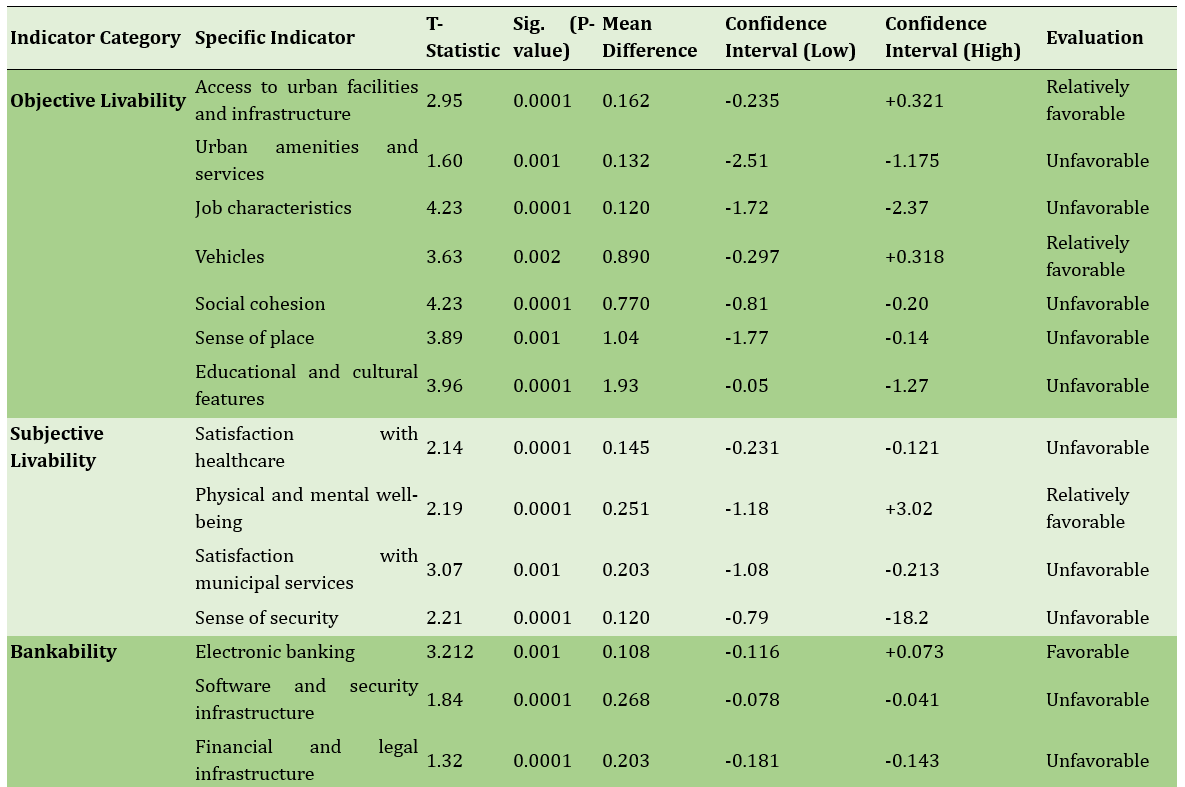
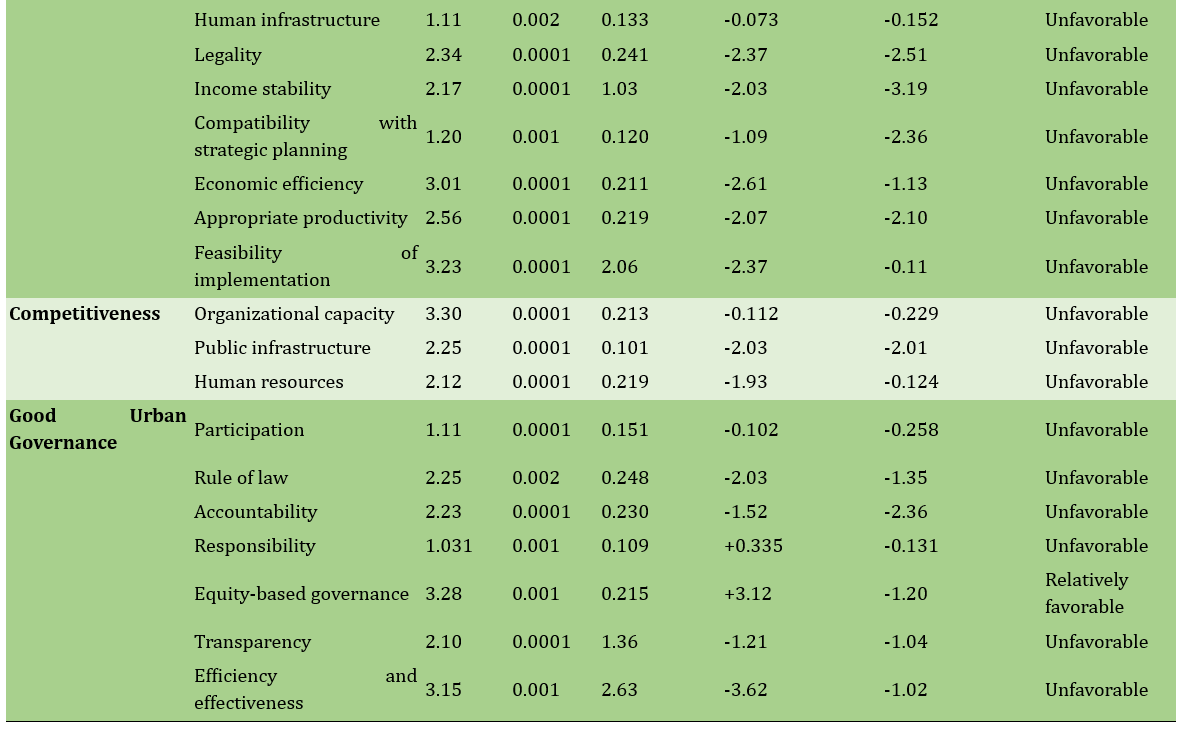
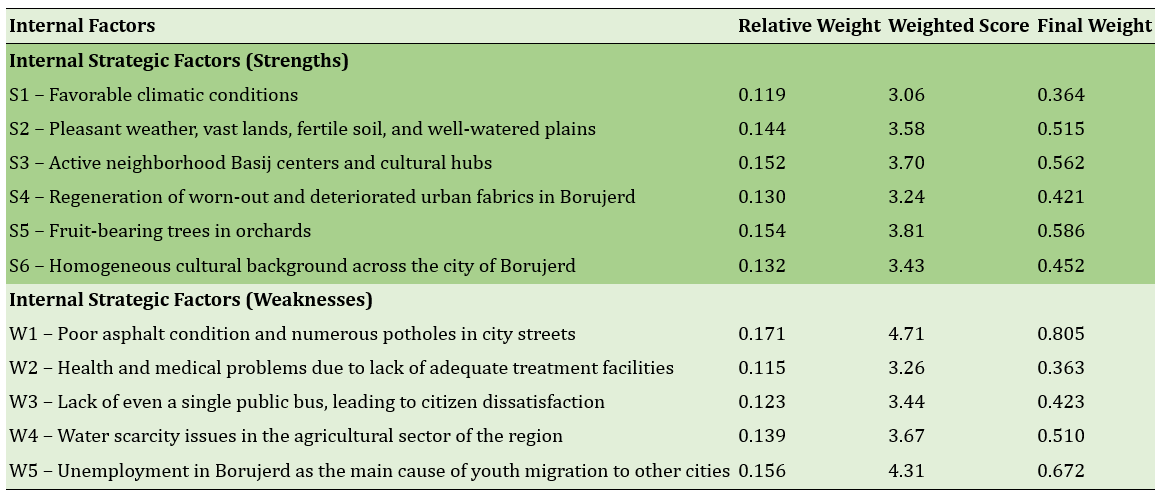
Regarding the competitiveness index, the criteria of organizational capacities, public infrastructure, and human resources with respective mean differences of 0.213, 0.25, and 0.219 demonstrated undesirable conditions, as reflected by T-values and confidence intervals lower than the expected range. Within the good urban governance index, only the criterion of equity-orientation showed a relatively favorable status, while the remaining indicators, based on the results of the T-test, were in unfavorable conditions. The participation criterion was assessed to be inadequate due to the lack of willingness by the municipal administration to involve citizens in urban affairs, and simultaneously, citizens themselves, due to low awareness and limited mechanisms, were not actively involved in city management. This combination has led to no effective structures for community participation in urban development. In addition, the findings point to a general lack of accountability among urban managers and city authorities in this region, which has contributed to an increase in urban administrative corruption. The rule of law, while not in a critical state, was found to be unfavorable, primarily due to the lack of public education and cultural development, which prevents the emergence of a sense of citizenship and belonging. Although not in a state of crisis, the legality indicator remains a limitation. Similarly, responsibility and accountability among city officials were rated poorly and are considered constraints in fulfilling the requirements of this index. Following the identification of strengths, weaknesses, opportunities, and threats based on expert opinions, participants were asked to perform pairwise comparisons. The absolute weights of the criteria were calculated using the SWOT method, and the relative weights were obtained using the Analytic Network Process (ANP). The results of prioritizing the strengths and weaknesses, along with the internal factor evaluation matrix, revealed that within the strengths group, factor S5 (“Presence of fruit-bearing trees in orchards”) had the highest relative weight (0.154), whereas S1 (“Favorable climate conditions”) received the lowest relative weight. In the weaknesses group, factor W1 (“Poor asphalt and numerous potholes”) had the highest weight (0.171), while W2 (“Inadequate medical facilities”) had the lowest (Table 2).
Table 2. Internal Factors Evaluation Matrix (Strengths and Weaknesses)
The evaluation of external factors focused on identifying opportunities and threats and their roles in shaping future conditions. For example, the highest-scoring opportunity was O4 (“Improving public health and reducing the risk of disease”), while the most severe threat was T4 (“Youth migration”), reflecting the outmigration of young people due to a lack of appropriate job opportunities in Borujerd (Table 3).
Table 3. External Factors Evaluation Matrix (Threats and Opportunities)
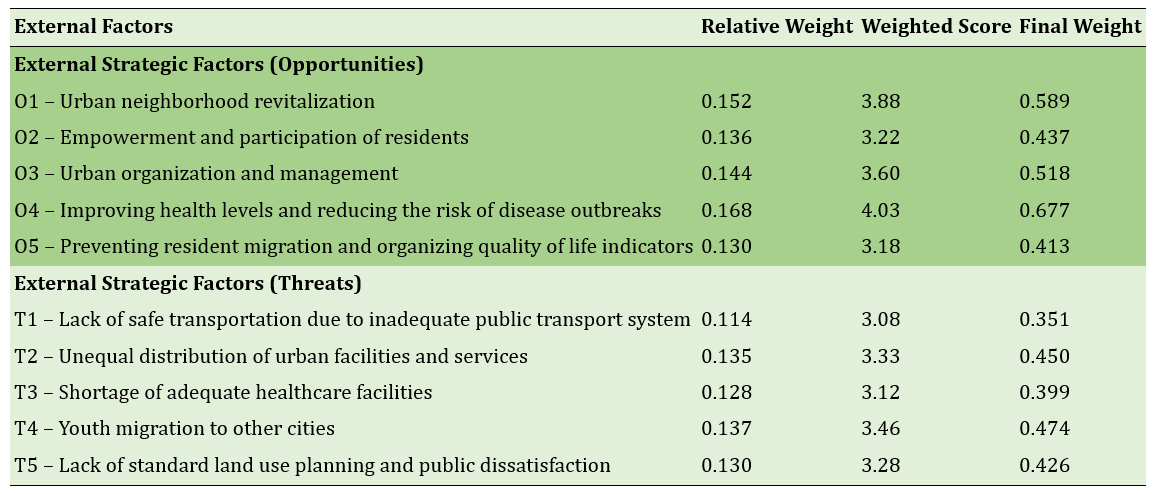
According to Table 3, sustainable development aimed at neighborhood revitalization and urban planning and management, with weighted scores of 0.152 and 0.144 respectively, are considered the most significant opportunities in the studied area. Additionally, the migration of young individuals to other cities, migration to Borujerd due to the lack of adequate medical facilities, and the absence of standard urban land uses in different districts, along with public dissatisfaction, are identified as the most critical threats in the region, with weighted scores of 0.137, 0.135, and 0.130, respectively.
Based on the final obtained weights, the strategies for improving the quality of life in the urban development plans of Borujerd, which include the four WT, WO, ST, and SO strategies, can be evaluated and the most appropriate strategy selected. According to the final weights, one of the quadrants of the diagram receives a higher score, which indicates the most suitable strategic direction for enhancing the quality of life in Borujerd’s urban development plans. Selecting this strategy would improve the urban condition of Borujerd (Table 4).
Table 4. Weighted Coefficients and Impact Percentages of Internal and External Factors
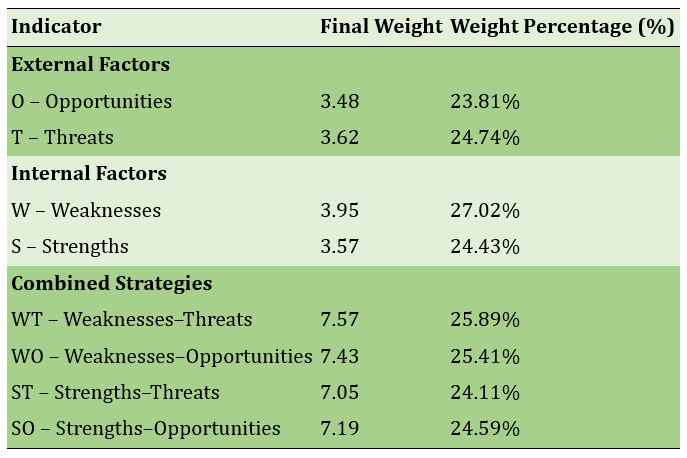
The final weights of internal and external factors, shows a higher score in the Weakness–Opportunity (WO) quadrant.
Based on the results of the SWOT-ANP model, the suggested strategy with the highest priority is the WT strategy, also known as the defensive or protective strategy. This strategy aims to minimize weaknesses and simultaneously capitalize on opportunities. According to this approach, in order to improve the quality of life and achieve urban development in Borujerd, it is essential to adopt strategies such as: creating spaces for leisure activities; fulfilling citizens' needs and demands; organizing and expanding educational and cultural spaces across the city; creating employment opportunities and encouraging the young population to stay in the city to reduce social harms; enhancing the quality of life by providing essential land services and urban amenities for residents; strengthening security and comfort through community participation at the neighborhood level; achieving vibrant, dynamic, and active neighborhoods; promoting employment and encouraging government support for private investors; preventing youth migration to larger cities for employment; developing compatible and functional urban land uses with logical and close interconnections; basing urban plans on public-oriented principles aligned with civil society demands; laying the groundwork for active citizen and labor force participation; employing skilled and experienced personnel in the Borujerd municipality; ensuring access to clean and safe drinking water, electricity, gas pipelines, telephone networks, waste collection systems, sewage disposal systems, roadbed preparation, street asphalting, curb construction, drainage systems, sidewalk construction; improving social safety and comfort at the neighborhood level; increasing quality of life indicators in Borujerd; and preventing resident migration to metropolitan areas. Additionally, the implementation of smart and electronic banking systems in Borujerd, avoiding unwarranted interference from city council members in municipal affairs, and paying attention to the city’s capabilities and potentials are essential.
Discussion
The aim of this research was to assess the quality of life in the urban development strategy of Borujerd city. The strategy for improving the quality of the city is based on strategic development planning, considering a participatory vision and following a participatory process, emphasizing the reform of urban governance, growth of the local economy, and continuous and systematic reduction of poverty in urban areas. Accordingly, the ultimate goal of the Comprehensive Development Strategy (CDS) is to achieve a city with high livability, competitiveness, bankability, and good urban governance and management. The results of this study indicate that the studied area is in an unfavorable condition regarding the indicators of the urban development strategy, which confirms the poor status of urban development strategy indicators at the city level and the presence of intra-urban inequality and disparities. Concerning the reasons behind this situation, it should be noted that various factors are influential, including the intense administrative and managerial centralization, lack of citizen participation in the preparation and implementation of plans, unemployment and lack of employment opportunities, shortage of health and cultural facilities and services, weakness or lack of communication infrastructure such as internet networks, shortage of bank branches, and absence of financial and legal incentives for private sector participation. Therefore, it is expected that with improved conditions and efforts to provide the studied area with more facilities, services, and fulfillment of economic, social, and environmental needs, the issue of population retention within the city and reduction of migration to other urban areas will largely be resolved. In examining the competitiveness index of Borujerd city, three criteria were evaluated: public infrastructures, organizational capacities, and human resources. The evaluation results showed unfavorable conditions of these criteria in the studied area. Indeed, the main focus of the urban development strategy is on strengthening the competitive economy to reduce poverty and environmental issues, improving urban structures and infrastructures, and financial structures. This process involves the participation of major stakeholders from all social classes and urban groups. The outcome of this process is a development strategy designed for the city's progress and transformation in line with its competitive position. Therefore, the urban development strategy is a planning tool that can provide the framework for planning for a city or urban area and help better understand existing urban problems and future urban development. In this regard, Nazmfar and Mohamadi [2015] have also emphasized the importance of improving infrastructures, organizational capacities, and organizational resources to enhance urban competitiveness. To understand a city characterized by good governance and management, specific criteria and indicators must be considered. Researchers and international institutions have proposed various features and criteria for good urban governance and management, some of which are listed in Table 1. The lack of accountability of managers and organizations, lack of transparency and its role in increasing corruption and public distrust, and also the neglect of justice in the plans and programs of organizations and institutions, are clear results from the perspectives of citizens, managers, and experts. Perhaps the first proposal to address this is to increase transparency in various areas, including plans and programs, policymaking and decision-making processes, budget amounts, and their allocation, as this transparency can improve indicators of accountability, responsiveness, effectiveness, efficiency, and ultimately increase citizens’ trust in institutions and organizations. Except for the justice criterion, the other studied criteria ranged from relatively favorable to unfavorable conditions. The unfavorable status of this index represents a serious challenge for urban management in implementing good governance and achieving sustainable urban development. Urban governance means the influence of all urban stakeholders on city management through mechanisms that promote the city and citizenship, rather than having the public and private spheres excluded and solely controlled by governmental authority. The source of power and legitimacy in urban governance is all citizens and their presence in all arenas and institutions of civil society. Consistent with the results of this study, Hoseini [2016] and Mutisya & Yarime [2014] have emphasized good urban governance with a focus on the role of citizens. Borujerd city needs special attention in terms of the bankability index. Bankability can be examined from two different perspectives: first, the growth of technology and advancements in communication technology, which facilitate trade and financial circulation globally and significantly contribute to city sustainability; second, from the perspective of urban financial systems. Fundamentally, cities must have sustainable revenues to achieve sustainable development. The development of electronic banking, national infrastructures, increasing productivity, and improving economic efficiency are among the criteria that must be considered to improve bankability.
From the experts’ perspective, six factors were identified as strengths and five as weaknesses in Borujerd city. Among the strengths are the pleasant climate and tourism capabilities, which have a direct impact on increasing travel rates to the city and thus economic prosperity for local residents. Renovation of the worn-out urban texture is among the strengths, which enhances the quality of the urban environment and thereby improves residents’ quality of life. Gorginia and Amini [2022] noted in their research the effect of worn-out texture reconstruction on improving the quality of the urban environment. In assessing internal strategic factors, despite a slight difference between the weakness score (0.140) and the strength score (0.138), the weakness score is higher. This study identified five factors as weaknesses. The poor condition of pavement and numerous potholes in city streets, unemployment, water scarcity in the agricultural sector, lack of public transportation, and shortage of medical facilities are the weaknesses among internal strategic factors. These weaknesses influence each other. For example, solving the water scarcity issue in agriculture would boost business in that sector and partially affect employment and unemployment reduction. This would indirectly have a positive effect on reducing migration problems. On the other hand, strengthening transport infrastructure would create traffic safety and resolve issues such as private vehicle use and traffic congestion (which directly and indirectly impact visual and noise pollution), consequently enhancing quality of life.
According to this research’s findings, the average score of opportunities (0.147) was higher than threats (0.128). Among external strategic factors, youth migration, unequal distribution of urban facilities and services, lack of urban land-use standards across districts, public dissatisfaction, inadequate health facilities, and unsafe traffic conditions were identified by experts as external threats in Borujerd. According to Imani and Rahimizadeh [2019], unequal distribution of facilities and services in residential areas reduces their quality and undermines spatial and social justice for residents. Meanwhile, the lack of appropriate infrastructure and services for Borujerd’s residents can exacerbate other threats. For instance, the absence of adequate healthcare, transportation, and urban land-use standards causes public dissatisfaction, which in turn drives young people to migrate to other cities. Therefore, urban development plans must adopt a coherent and holistic view to provide comprehensive and practical planning aimed at solving problems and enhancing urban development indicators, including quality of life.
Quality of life is the core of current urban design and planning theories such as new urbanism, smart growth, and sustainable urbanism. Urban areas are the main mechanisms for poverty alleviation and the central hubs of economic, social, cultural, and political relations. To achieve better quality for existing communities, priorities for directing efforts toward relevant sectors must be identified. Using a strategic planning process with a participatory approach to improve quality of life in cities, based on subjective ranking of factors, is highly important. In this regard, Nasiri et al. [2016] have emphasized citizen participation as a necessity. To enhance and raise residents’ awareness about city development, different ways to enable citizen participation must be provided. Ebrahimzadeh et al. [2019] stated that urban managers, alongside better understanding of needs and facilities, must gain citizens’ trust to facilitate urban development and regional empowerment, which is one of the most important components of urban development strategy to overcome challenges facing contemporary cities. According to Halla [2007], the final strategic development plan for the city integrates various priority projects and actions to improve and maintain better quality of life for residents based on their needs and preferences. It should be noted that creating a vision statement and formulating a participatory vision is only the first and crucial step in the larger process of community development. The very essential next step is to create an implementation plan for defined scenarios, which is itself an important stage of strategic development planning.
Conclusion
Providing appropriate strategies to improve urban quality of life in urban development plans requires understanding the existing issues and problems. According to the results of this study, the urban development indicators in Borujerd city are not in a favorable condition, which has led to a decline in quality of life and created grounds for citizen dissatisfaction. Furthermore, the relative and absolute superiority of weaknesses over strengths in internal strategic factors necessitates proper planning and special attention to resolving existing problems in order to achieve an appropriate quality of life in Borujerd. Therefore, urban managers, in addition to better understanding the requirements, needs, and facilities, must gain the trust of citizens to create the foundation for improving quality of life, one of the most important components of the urban development strategy to overcome the challenges facing contemporary cities.
Acknowledgments: None reported by the authors.
Ethical Permission: None reported by the authors.
Conflict of Interest: None reported by the authors.
Authors’ Contributions: Saremi M (First author), Main Researcher (40%); Arbabi Sabzevari A (Second author), Methodologist (30%); Adibi saedi Nezhad F (Third author), Introduction Writer (30%).
Funding: None reported by the authors.
One of the modern approaches in urban development planning is the City Development Strategy (CDS). This strategy emphasizes the economic growth of cities and, by identifying and utilizing the potential and latent economic capacities of cities, it also lays the groundwork for development in other areas [Farjam et al., 2013]. In 2016, approximately 30% of the world’s 7.3 billion people were living in cities, and it is estimated that by 2050, about 67% of the world’s population will be urban dwellers [Yang, 2008]. This situation has generated a high demand for the development of basic infrastructure [Schouten & Mathenge, 2010], encouraging serious studies by urban managers, planners, and policymakers [Ebrahimzadeh et al., 2019]. The City Development Strategy (CDS) is a process in which a long-term vision for urban development and planning is created, based on which short-term practical actions are designed to achieve that vision. The ultimate goal of this process is to improve urban governance and management, increase economic growth and employment, and reduce poverty [Rahnama & Ebrahimi, 2018]. CDS employs participatory techniques and aims to achieve sustainable urban development through social capacity building for participatory vision-making and collective action. It also seeks to foster urban social justice through widespread community participation and collaboration, aimed at enhancing the overall quality of life for all citizens [Ashrafi & Malekzadeh, 2010]. According to the Cities Alliance studies, urban development strategies are founded upon good governance and management, bankability, competitiveness, and livability. Among these, livability is especially emphasized in enhancing quality of life. Thus, one of the main criteria for assessing livability is the quality of life itself. A city is considered livable when all residents have equal opportunities to participate in and benefit from economic and political life [Mouratidis, 2021]. Today, quality of life studies primarily focus on urban environments, and evaluating it has become a crucial issue, so much so that it has always been a central concern for urban planners [Shach-Pinsly & Ganor, 2021]. For years, researchers in social sciences and environmental design professions have argued that the quality of any existence has both subjective and objective dimensions. At the core of this argument is the concept that the environment consists of physical, natural, and socio-cultural components [Marans, 2003]. Based on these components, environments differ in their unique characteristics. Places where people live encompass all three dimensions, and research has clearly shown that all three are significant components of quality of life or subjective well-being in a particular location [Shekhar et al., 2019]. Quality of life indicators, at various levels and over time, have been widely recognized as metrics for public well-being. Many efforts have been made by different organizations to rank cities and countries based on quality of life. However, Cummins notes that “quality of life has a complex structure, so it is perhaps not surprising that there is no agreed-upon definition or standard form of measurement” [Mouratidis, 2021; Cummins, 1996]. To assess quality of life, both subjective and objective indicators, or a combination of both—are commonly used. In fact, subjective quality of life reflects how people perceive their living conditions and is measured through subjective indicators. These indicators assess levels of expressed satisfaction by individuals or groups, often referred to as subjective well-being. They are based on personal reports regarding perceptions of different aspects of life and examine the extent to which needs are met. In contrast, objective indicators refer to external or tangible living conditions and are typically derived from secondary data such as demographic, economic-social, and public service reports [Shahin, 2022]. Urban planners, who are responsible for managing the objective urban environment (e.g., building permits, land use zoning, and transportation infrastructure planning), are interested in understanding how their decisions impact residents’ satisfaction with urban life [McCrea et al., 2006]. Quality of life is a historical product of cultural, social, economic, and political systems, and cannot be explained separately from these structures. Therefore, it is a composite variable, dependent on the level of development of societies and can be defined and implemented using properly designed indicators [Shahhoseini & Tavakoli, 2014]. Over the past two decades, strategic urban planning has dominated the field of urban planning. Its goal is to improve the performance of cities and ensure that future development is well planned and accountable. Its reliance on participatory approaches enriches the process, enhances local ownership, and helps ensure successful implementation. The overall objective is to improve city performance through strategic development planning. This approach can be viewed as a powerful tool for enhancing quality of life in cities [Khalil, 2012]. The city of Borujerd has experienced rapid population growth over recent decades. Located in one of the fertile plains of Lorestan province, and benefiting from economic, administrative, and cultural facilities, Borujerd has attracted significant population within the province and has become the second-largest city in Lorestan in terms of population. The population of Borujerd has consistently increased during the reviewed periods, rising by approximately 4.9 times from 1956 to 2016. Naturally, this rapid population growth has led to uncontrolled physical expansion, resulting in unbalanced urban growth and a decline in the quality of life for citizens. The main objective of this study was to assess the level of quality of life within the urban development strategy of Borujerd.
Methodology
This research adopted a descriptive-analytical approach and was conducted using a survey method in Borujerd County during the year 2021. The required data were gathered through document analysis and the distribution of a researcher-designed questionnaire. The study was carried out in two stages. In the first stage, the dimensions influencing the indicators of urban development were initially identified through documentary research, prior studies, and expert opinion, taking into account the specific characteristics of Borujerd. Subsequently, the perspectives of the local population were assessed regarding these indicators. The data collection instrument was a questionnaire developed by the researchers. A total of 383 residents of Borujerd were selected through simple random sampling, and the sample size was determined using Cochran’s formula. The collected data were analyzed using the one-sample T-test in SPSS version 23. The second stage aimed to identify and evaluate the internal and external factors influencing the formulation of strategies to improve the quality of life in the context of Borujerd’s urban development plans. More specifically, it sought to determine which factors facilitated or hindered the achievement of planning goals. In this stage, a list of internal influencing factors was compiled using various sources, including field observations, documentary and library resources, and expert interviews. The Delphi technique was used to obtain expert consensus: 30 urban planners and city development practitioners from Borujerd were selected purposefully and asked to evaluate the strengths, weaknesses, opportunities, and threats (SWOT) relevant to the city's urban development. To better understand the experts' perspectives on the strategies for urban development, the SWOT analysis method was employed, which is categorized as a qualitative approach. In parallel, Analytic Network Process (ANP) was used for quantitative prioritization of these strategies. This combination of qualitative and quantitative methodologies allowed for both the identification and ranking of strategic actions. The SWOT model, an acronym for Strengths, Weaknesses, Opportunities, and Threats is a widely used and effective tool in strategic management. It serves as a decision-support framework for systematically analyzing an organization’s or city’s internal and external environments. Internal evaluations examine controllable aspects of the city (strengths and weaknesses), while external evaluations focus on uncontrollable factors such as economic, political, social, technological, and competitive conditions (opportunities and threats). The SWOT matrix is formed by intersecting these dimensions, from which various strategies are generated [Dayson, 2004].
However, one of the key limitations of SWOT analysis is its inability to measure the relative importance of each factor quantitatively. In other words, it cannot determine which factor or group of factors has a greater influence on strategic decision-making. To overcome this limitation, Analytic Network Process (ANP) was integrated into the analysis. ANP allows for numerical weighting and ranking of the factors identified in the SWOT analysis. It is a multi-criteria decision-making tool and part of the family of compensatory models. Developed by Saaty as an extension of the Analytic Hierarchy Process (AHP), ANP eliminates the hierarchical structure and enables each criterion in any cluster to be compared with others both within the same cluster and across different clusters.
The modeling process in ANP includes four steps: conducting pairwise comparisons and estimating relative weights, forming the initial supermatrix, converting it into a weighted supermatrix, and calculating the general weighted vector that determines the final priorities [Rezaali et al., 2016].
Findings
The results of this study revealed that both objective and subjective livability indicators in the city of Borujerd were not in a desirable condition. Approximately 80% of respondents expressed moderate or low satisfaction with the indicators of urban quality of life. Accordingly, the findings indicate a generally low level of satisfaction among citizens regarding quality of life in Borujerd (Table 1).
It appears that the City Development Strategy (CDS) in Borujerd is not in a favorable position regarding the principle of bankability for improving quality of life. Each of the criteria under the bankability principle was analyzed using the one-sample T-test with a mid-value of 3 as the benchmark. A mean value greater than 3 was considered favorable, a value close to 3 moderate, and a value less than 3 unfavorable. The confidence intervals for all mentioned criteria under the bankability principle were below 3, indicating an overall undesirable status. Among the indicators, only the electronic banking criterion, with a T-value of 3.212, reflected a favorable condition (Table 1).
Table 1. Evaluation of urban development indicators in Borujerd using One-Sample T-Test (N = 383)
Regarding the competitiveness index, the criteria of organizational capacities, public infrastructure, and human resources with respective mean differences of 0.213, 0.25, and 0.219 demonstrated undesirable conditions, as reflected by T-values and confidence intervals lower than the expected range. Within the good urban governance index, only the criterion of equity-orientation showed a relatively favorable status, while the remaining indicators, based on the results of the T-test, were in unfavorable conditions. The participation criterion was assessed to be inadequate due to the lack of willingness by the municipal administration to involve citizens in urban affairs, and simultaneously, citizens themselves, due to low awareness and limited mechanisms, were not actively involved in city management. This combination has led to no effective structures for community participation in urban development. In addition, the findings point to a general lack of accountability among urban managers and city authorities in this region, which has contributed to an increase in urban administrative corruption. The rule of law, while not in a critical state, was found to be unfavorable, primarily due to the lack of public education and cultural development, which prevents the emergence of a sense of citizenship and belonging. Although not in a state of crisis, the legality indicator remains a limitation. Similarly, responsibility and accountability among city officials were rated poorly and are considered constraints in fulfilling the requirements of this index. Following the identification of strengths, weaknesses, opportunities, and threats based on expert opinions, participants were asked to perform pairwise comparisons. The absolute weights of the criteria were calculated using the SWOT method, and the relative weights were obtained using the Analytic Network Process (ANP). The results of prioritizing the strengths and weaknesses, along with the internal factor evaluation matrix, revealed that within the strengths group, factor S5 (“Presence of fruit-bearing trees in orchards”) had the highest relative weight (0.154), whereas S1 (“Favorable climate conditions”) received the lowest relative weight. In the weaknesses group, factor W1 (“Poor asphalt and numerous potholes”) had the highest weight (0.171), while W2 (“Inadequate medical facilities”) had the lowest (Table 2).
Table 2. Internal Factors Evaluation Matrix (Strengths and Weaknesses)
The evaluation of external factors focused on identifying opportunities and threats and their roles in shaping future conditions. For example, the highest-scoring opportunity was O4 (“Improving public health and reducing the risk of disease”), while the most severe threat was T4 (“Youth migration”), reflecting the outmigration of young people due to a lack of appropriate job opportunities in Borujerd (Table 3).
Table 3. External Factors Evaluation Matrix (Threats and Opportunities)
According to Table 3, sustainable development aimed at neighborhood revitalization and urban planning and management, with weighted scores of 0.152 and 0.144 respectively, are considered the most significant opportunities in the studied area. Additionally, the migration of young individuals to other cities, migration to Borujerd due to the lack of adequate medical facilities, and the absence of standard urban land uses in different districts, along with public dissatisfaction, are identified as the most critical threats in the region, with weighted scores of 0.137, 0.135, and 0.130, respectively.
Based on the final obtained weights, the strategies for improving the quality of life in the urban development plans of Borujerd, which include the four WT, WO, ST, and SO strategies, can be evaluated and the most appropriate strategy selected. According to the final weights, one of the quadrants of the diagram receives a higher score, which indicates the most suitable strategic direction for enhancing the quality of life in Borujerd’s urban development plans. Selecting this strategy would improve the urban condition of Borujerd (Table 4).
Table 4. Weighted Coefficients and Impact Percentages of Internal and External Factors
The final weights of internal and external factors, shows a higher score in the Weakness–Opportunity (WO) quadrant.
Based on the results of the SWOT-ANP model, the suggested strategy with the highest priority is the WT strategy, also known as the defensive or protective strategy. This strategy aims to minimize weaknesses and simultaneously capitalize on opportunities. According to this approach, in order to improve the quality of life and achieve urban development in Borujerd, it is essential to adopt strategies such as: creating spaces for leisure activities; fulfilling citizens' needs and demands; organizing and expanding educational and cultural spaces across the city; creating employment opportunities and encouraging the young population to stay in the city to reduce social harms; enhancing the quality of life by providing essential land services and urban amenities for residents; strengthening security and comfort through community participation at the neighborhood level; achieving vibrant, dynamic, and active neighborhoods; promoting employment and encouraging government support for private investors; preventing youth migration to larger cities for employment; developing compatible and functional urban land uses with logical and close interconnections; basing urban plans on public-oriented principles aligned with civil society demands; laying the groundwork for active citizen and labor force participation; employing skilled and experienced personnel in the Borujerd municipality; ensuring access to clean and safe drinking water, electricity, gas pipelines, telephone networks, waste collection systems, sewage disposal systems, roadbed preparation, street asphalting, curb construction, drainage systems, sidewalk construction; improving social safety and comfort at the neighborhood level; increasing quality of life indicators in Borujerd; and preventing resident migration to metropolitan areas. Additionally, the implementation of smart and electronic banking systems in Borujerd, avoiding unwarranted interference from city council members in municipal affairs, and paying attention to the city’s capabilities and potentials are essential.
Discussion
The aim of this research was to assess the quality of life in the urban development strategy of Borujerd city. The strategy for improving the quality of the city is based on strategic development planning, considering a participatory vision and following a participatory process, emphasizing the reform of urban governance, growth of the local economy, and continuous and systematic reduction of poverty in urban areas. Accordingly, the ultimate goal of the Comprehensive Development Strategy (CDS) is to achieve a city with high livability, competitiveness, bankability, and good urban governance and management. The results of this study indicate that the studied area is in an unfavorable condition regarding the indicators of the urban development strategy, which confirms the poor status of urban development strategy indicators at the city level and the presence of intra-urban inequality and disparities. Concerning the reasons behind this situation, it should be noted that various factors are influential, including the intense administrative and managerial centralization, lack of citizen participation in the preparation and implementation of plans, unemployment and lack of employment opportunities, shortage of health and cultural facilities and services, weakness or lack of communication infrastructure such as internet networks, shortage of bank branches, and absence of financial and legal incentives for private sector participation. Therefore, it is expected that with improved conditions and efforts to provide the studied area with more facilities, services, and fulfillment of economic, social, and environmental needs, the issue of population retention within the city and reduction of migration to other urban areas will largely be resolved. In examining the competitiveness index of Borujerd city, three criteria were evaluated: public infrastructures, organizational capacities, and human resources. The evaluation results showed unfavorable conditions of these criteria in the studied area. Indeed, the main focus of the urban development strategy is on strengthening the competitive economy to reduce poverty and environmental issues, improving urban structures and infrastructures, and financial structures. This process involves the participation of major stakeholders from all social classes and urban groups. The outcome of this process is a development strategy designed for the city's progress and transformation in line with its competitive position. Therefore, the urban development strategy is a planning tool that can provide the framework for planning for a city or urban area and help better understand existing urban problems and future urban development. In this regard, Nazmfar and Mohamadi [2015] have also emphasized the importance of improving infrastructures, organizational capacities, and organizational resources to enhance urban competitiveness. To understand a city characterized by good governance and management, specific criteria and indicators must be considered. Researchers and international institutions have proposed various features and criteria for good urban governance and management, some of which are listed in Table 1. The lack of accountability of managers and organizations, lack of transparency and its role in increasing corruption and public distrust, and also the neglect of justice in the plans and programs of organizations and institutions, are clear results from the perspectives of citizens, managers, and experts. Perhaps the first proposal to address this is to increase transparency in various areas, including plans and programs, policymaking and decision-making processes, budget amounts, and their allocation, as this transparency can improve indicators of accountability, responsiveness, effectiveness, efficiency, and ultimately increase citizens’ trust in institutions and organizations. Except for the justice criterion, the other studied criteria ranged from relatively favorable to unfavorable conditions. The unfavorable status of this index represents a serious challenge for urban management in implementing good governance and achieving sustainable urban development. Urban governance means the influence of all urban stakeholders on city management through mechanisms that promote the city and citizenship, rather than having the public and private spheres excluded and solely controlled by governmental authority. The source of power and legitimacy in urban governance is all citizens and their presence in all arenas and institutions of civil society. Consistent with the results of this study, Hoseini [2016] and Mutisya & Yarime [2014] have emphasized good urban governance with a focus on the role of citizens. Borujerd city needs special attention in terms of the bankability index. Bankability can be examined from two different perspectives: first, the growth of technology and advancements in communication technology, which facilitate trade and financial circulation globally and significantly contribute to city sustainability; second, from the perspective of urban financial systems. Fundamentally, cities must have sustainable revenues to achieve sustainable development. The development of electronic banking, national infrastructures, increasing productivity, and improving economic efficiency are among the criteria that must be considered to improve bankability.
From the experts’ perspective, six factors were identified as strengths and five as weaknesses in Borujerd city. Among the strengths are the pleasant climate and tourism capabilities, which have a direct impact on increasing travel rates to the city and thus economic prosperity for local residents. Renovation of the worn-out urban texture is among the strengths, which enhances the quality of the urban environment and thereby improves residents’ quality of life. Gorginia and Amini [2022] noted in their research the effect of worn-out texture reconstruction on improving the quality of the urban environment. In assessing internal strategic factors, despite a slight difference between the weakness score (0.140) and the strength score (0.138), the weakness score is higher. This study identified five factors as weaknesses. The poor condition of pavement and numerous potholes in city streets, unemployment, water scarcity in the agricultural sector, lack of public transportation, and shortage of medical facilities are the weaknesses among internal strategic factors. These weaknesses influence each other. For example, solving the water scarcity issue in agriculture would boost business in that sector and partially affect employment and unemployment reduction. This would indirectly have a positive effect on reducing migration problems. On the other hand, strengthening transport infrastructure would create traffic safety and resolve issues such as private vehicle use and traffic congestion (which directly and indirectly impact visual and noise pollution), consequently enhancing quality of life.
According to this research’s findings, the average score of opportunities (0.147) was higher than threats (0.128). Among external strategic factors, youth migration, unequal distribution of urban facilities and services, lack of urban land-use standards across districts, public dissatisfaction, inadequate health facilities, and unsafe traffic conditions were identified by experts as external threats in Borujerd. According to Imani and Rahimizadeh [2019], unequal distribution of facilities and services in residential areas reduces their quality and undermines spatial and social justice for residents. Meanwhile, the lack of appropriate infrastructure and services for Borujerd’s residents can exacerbate other threats. For instance, the absence of adequate healthcare, transportation, and urban land-use standards causes public dissatisfaction, which in turn drives young people to migrate to other cities. Therefore, urban development plans must adopt a coherent and holistic view to provide comprehensive and practical planning aimed at solving problems and enhancing urban development indicators, including quality of life.
Quality of life is the core of current urban design and planning theories such as new urbanism, smart growth, and sustainable urbanism. Urban areas are the main mechanisms for poverty alleviation and the central hubs of economic, social, cultural, and political relations. To achieve better quality for existing communities, priorities for directing efforts toward relevant sectors must be identified. Using a strategic planning process with a participatory approach to improve quality of life in cities, based on subjective ranking of factors, is highly important. In this regard, Nasiri et al. [2016] have emphasized citizen participation as a necessity. To enhance and raise residents’ awareness about city development, different ways to enable citizen participation must be provided. Ebrahimzadeh et al. [2019] stated that urban managers, alongside better understanding of needs and facilities, must gain citizens’ trust to facilitate urban development and regional empowerment, which is one of the most important components of urban development strategy to overcome challenges facing contemporary cities. According to Halla [2007], the final strategic development plan for the city integrates various priority projects and actions to improve and maintain better quality of life for residents based on their needs and preferences. It should be noted that creating a vision statement and formulating a participatory vision is only the first and crucial step in the larger process of community development. The very essential next step is to create an implementation plan for defined scenarios, which is itself an important stage of strategic development planning.
Conclusion
Providing appropriate strategies to improve urban quality of life in urban development plans requires understanding the existing issues and problems. According to the results of this study, the urban development indicators in Borujerd city are not in a favorable condition, which has led to a decline in quality of life and created grounds for citizen dissatisfaction. Furthermore, the relative and absolute superiority of weaknesses over strengths in internal strategic factors necessitates proper planning and special attention to resolving existing problems in order to achieve an appropriate quality of life in Borujerd. Therefore, urban managers, in addition to better understanding the requirements, needs, and facilities, must gain the trust of citizens to create the foundation for improving quality of life, one of the most important components of the urban development strategy to overcome the challenges facing contemporary cities.
Acknowledgments: None reported by the authors.
Ethical Permission: None reported by the authors.
Conflict of Interest: None reported by the authors.
Authors’ Contributions: Saremi M (First author), Main Researcher (40%); Arbabi Sabzevari A (Second author), Methodologist (30%); Adibi saedi Nezhad F (Third author), Introduction Writer (30%).
Funding: None reported by the authors.
Keywords:
References
1. Ashrafi Y, Malekzadeh A (2010). Shared visioning in urban development strategy process (Case study: Maragheh). Urban Mnagement. 8(25):169-186. [Persian] [Link]
2. Cummins RA (1996). The domains of life satisfaction: An attempt to order chaos. Social Indicators Research. 38(3):303-328. [Link] [DOI:10.1007/BF00292050]
3. Dayson RG (2004). Strategic development and SWOT analysis at the university of Warwick. European Journal of Operational Research. 152(3):631-640. [Link] [DOI:10.1016/S0377-2217(03)00062-6]
4. Ebrahimzadeh I, Istgaldi M, Hajizadeh F (2019). Analysis and prioritization of indicators of urban development strategy in the neighborhoods of the eight district of Shiraz. Geography and Environmental Sustainability. 9(1):1-17. [Persian] [Link]
5. Farjam R, Soleynabi M, Tavalaee S, Rafieeian M, Movahed A (2013). Urban development based on the combination of uses: A review of its academic literature in Iran. Research and Urban Development. 4(12):23-48. [Persian] [Link]
6. Gorginia A, Amini E (2022). Strategies for improvement and renovation of worn-out urban structures using sustainable development approach (Case study: District 19 of Tehran). Geographical Research. 37(2):201-211. [Persian] [Link]
7. Halla F (2007). A SWOT analysis of strategic urban development planning: The case of Dar-es Salaam city in Tanzania. Habitat International. 31(1):130-142. [Link] [DOI:10.1016/j.habitatint.2006.08.001]
8. Hoseini SH (2016). Analysis of good governance indicators in Torbat Haydarieh: Emphasizing on the citizens and urban managers viewpoints.Motaleate Shahri. 5(20):43-52. [Persian] [Link]
9. Imani B, Rahimizadeh M M (2019). Dimensions of space justice effect on quality of Ardebil city villages rural life. Geographical Research. 34(3):377-388. [Persian] [Link] [DOI:10.29252/geores.34.3.377]
10. Khalil HAE (2012). Enhancing quality of life through strategic urban planning. Sustainable Cities and Society. 5:77-86. [Link] [DOI:10.1016/j.scs.2012.06.002]
11. Marans RW (2003). Understanding environmental quality through quality of life studies: The 2001 DAS and its use of subjective and objective indicators. Landscape and Urban Planning. 65(1-2):73-83. [Link] [DOI:10.1016/S0169-2046(02)00239-6]
12. McCrea R, Shyy TK, Stimson R (2006). What is the strength of the link between objective and subjective indicators of urban quality of life? Applied Research in Quality of Life. 1:79-96. [Link] [DOI:10.1007/s11482-006-9002-2]
13. Mouratidis K (2021). Urban planning and quality of life: A review of pathways linking the built environment to subjective well-being. Cities. 115:103229. [Link] [DOI:10.1016/j.cities.2021.103229]
14. Mutisya E, Yarime M (2014). Moving towards urban sustainability in Kenya: A framework for integration of environment economic social and governance dimensions. Sustainability Science. 9(2):205-2150. [Link] [DOI:10.1007/s11625-013-0223-7]
15. Nasiri Hendeh Khaleh E, Hoseinifar SM, Ahmadi A (2016). The Impact of migration on urban development using SWOT (Case study: Babol city). Biannual Journal of Urban Ecology Researches. 7(2):55-66. [Persian] [Link]
16. Nazmfar H, Mohamadi F (2015). Analyzing the concepts of the principles of urban development strategy (CDS). 29-30 July 2015. International Conference on Civil Engineering Architecture and urban infrastructure:Tabriz. [Persian] [Link]
17. Rahnama MR, Ebrahimi L (2018). A comparative study of urban development strategy (CDS) indicators in Iranian cities from the point of view of urban groups. Zagros Landscape Geography and Urban Planning Quarterly. 10(38):93-120. [Persian] [Link]
18. Rezaali M, Hataminezhad H, Faraji Sabkbar HA, Alavi SA, Ghaed Rahmati S (2016). Spatial analysis of quality of life in Iran. Geographical Planning of Space Quarterly Journal. 6(21):174-192. [Persian] [Link]
19. Schouten MAC, Mathenge RW (2010). Communal sanitation alternatives for slums: A case study of Kibera, Kenya. Physics and Chemistry of the Earth. 35(13-14):815-822. [Link] [DOI:10.1016/j.pce.2010.07.002]
20. Shach-Pinsly D, Ganor T (2021). A new approach for assessing secure and vulnerable areas in central urban neighborhoods based on social-groups analysis. Sustainability. 13(3):1174. [Link] [DOI:10.3390/su13031174]
21. Shahhoseini P, Tavakoli H (2014). The analysis of urban life quality indices case: Vardavard locality, in the 21st district of Tehran city. Quarterly Journal of Environmental based Territorial Planning. 7(24):127-144. [Persian] [Link]
22. Shahin S (2022). Assessing the urban quality of life (Case study: Manzarie town of Khomeini Shahr). Journal of Geography and Environmental Studies. 10(40):101-122. [Persian] [Link]
23. Shekhar H, Schmidt AJ, Wehling H W (2019). Exploring wellbeing in human settlements-a spatial planning perspective. Habitat International. 87:66-74. [Link] [DOI:10.1016/j.habitatint.2019.04.007]
24. Yang Y (2008). A tale of two cities: Physical form and neighborhood satisfaction in metropolitan Portland and Charlotte. Journal of the American Planning Association. 74(3):307-323. [Link] [DOI:10.1080/01944360802215546]