

Bilingual
En/Fa
Geographical Research is Published in both Persian and English Full-text.
Volume 40, Issue 4 (2025)
GeoRes 2025, 40(4): 347-359 |
Back to browse issues page
Article Type:
Subject:




History
Received: 2025/10/25 | Accepted: 2025/12/7 | Published: 2025/12/20
Received: 2025/10/25 | Accepted: 2025/12/7 | Published: 2025/12/20
How to cite this article
Golkarami A, Fatemi M, Yousefi Shatoori M. (2025). Spatial-Political Analysis of Territorial Imbalances Resulting from Water Transfer Projects in the Zayandeh Rud Basin. GeoRes. 40(4), 347-359. doi:10.58209/geores.40.4.347
URL: http://georesearch.ir/article-1-1884-en.html
URL: http://georesearch.ir/article-1-1884-en.html
Download citation:
BibTeX | RIS | EndNote | Medlars | ProCite | Reference Manager | RefWorks
Send citation to:


Rights and permissions
BibTeX | RIS | EndNote | Medlars | ProCite | Reference Manager | RefWorks
Send citation to:


1- Department of Geography, Faculty of Literature & Humanities, Lorestan University, Khorramabad, Iran
2- Department of Physical Geography, Faculty of Humanities, Meybod University, Meybod, Iran
3- Department of Political Geography, Faculty of Geography, Kharazmi University, Tehran, Iran
2- Department of Physical Geography, Faculty of Humanities, Meybod University, Meybod, Iran
3- Department of Political Geography, Faculty of Geography, Kharazmi University, Tehran, Iran
Full-Text (HTML) (2 Views)
Background
In recent decades, securing sustainable water resources has emerged as one of the most critical environmental, economic, and political challenges globally. In arid and semi-arid regions such as Iran, this issue exhibits far more complex dimensions, with its compounding consequences heavily impacting economic development, ecological sustainability, and social stability (Kaviani Rad, 2016). Climate change, protracted droughts, and surging water demands across agricultural, industrial, and urban sectors have exerted unprecedented pressure on the nation's hydrological networks (Mokhtari Hashi, 2013). In response to this compounding crisis, policymakers—particularly in the central plateaus of the country—have consistently prioritized implementing inter-basin water transfer projects as a standard engineering and managerial mechanism to compensate for local water deficits (Zaki & Rashidi, 2016).
However, inter-basin water transfers can no longer be evaluated merely as technical engineering solutions. Because it forces the physical relocation of a vital, survival-ensuring resource, this process radically reconfigures the spatial structure of accessibility, the distribution of socio-economic benefits, and regional power dynamics at both national and sub-national scales (Golkarami, 2025). Research demonstrates that while these massive infrastructure projects systematically deplete the ecological resilience of source basins, they concurrently bolster the developmental and competitive advantages of destination basins (Sadeghi et al., 2016). This structural imbalance sparks an asymmetrical spatial redistribution of economic benefits and environmental burdens. Analyzing water transfers without integrating spatial justice and regional governance mechanisms offers an incomplete and dangerously flawed understanding of their long-term socio-political impacts (Faryadi, 2019). Concentrating economic windfalls in recipient regions while trapping severe environmental liabilities within source zones ultimately exacerbates spatial inequalities and drives systematic territorial imbalances (Jabalameli, 2021).
Previous Studies
Globally and domestically, the expansion of water transfer projects has spurred scholarly interest in their multidimensional impacts. International experiences reveal that large-scale infrastructure projects frequently cultivate a rigid 'center-periphery' paradigm, where highly developed, resource-demanding destination zones act as centers of consumption and political leverage, while the source basins are systematically relegated to ecological peripheries tasked with absorbing resource depletion (Ma et al., 2020; Wang et al., 2021).
Domestically, official historical documents and technical reports from the Ministry of Energy indicate that since the 1950s, five primary water transfer schemes have deeply influenced the hydrological and socio-political dynamics of the Zayandeh Rud basin (Statistical Yearbook, 2018):
1. The Dez-Karun Basin Transfer Scheme: Engineered to route substantial water flows from the headwaters of the Great Karun River to the arid central plateau, including the Zayandeh Rud (Zarabi et al., 2010).
2. The Beheshtabad Transfer Project: Formulated to supply expanding agricultural and industrial sectors across central provinces, its geographic scope directly intersects the critical plains and primary urban areas of Chaharmahal and Bakhtiari Province (Davoodi Dehaghani & Ameri, 2019; Mohammadi et al., 2020).
3. The Ben-Boroujen Transfer Project: Launched in 2012, this initiative specifically aimed to supply safe drinking and sanitary water to more than half of the population residing within Chaharmahal and Bakhtiari Province (IRNA, 2020).
4. The Persian Gulf to Central Iran Plateau Project: Executed as one of the country's largest national water security initiatives, it was designed to supply desalinated water to Isfahan, Yazd, Qom, and Kashan (Zafarnajad, 2016; Khaelghifar & Vafaeian, 2015).
5. The Golab Tunnel Transfer Scheme: Designed through a two-phase implementation schedule to secure drinking water for Isfahan and its northern metropolitan perimeters (Esmaeili, 2020).
Scholars emphasize that a majority of these domestic projects were carried out under intense political lobbying and localized pressures, lacking holistic expert review, comprehensive environmental evaluations, or long-term social impact assessments (Golkarami & Kavianirad, 2017). Such non-systemic policies systematically ignored the hydrological interdependencies among interconnected watersheds, resulting in severe spatial fractures (Eteaat & Salehian, 2020).
Aim(s)
The primary objective of this research is to analyze the underlying structural mechanisms through which inter-basin water transfer projects produce and reinforce territorial imbalances within the Zayandeh Rud watershed from an integrated spatial-political perspective. Furthermore, the study aims to formulate targeted strategic guidelines and spatial interventions within the overarching framework of spatial planning governance to mitigate these deep-seated regional imbalances.
Research Type
This study is categorized as an Original Research paper that applies a mixed qualitative-quantitative approach utilizing a spatial-political analysis framework alongside strategic structural evaluation models.
Research Society, Place, and Time
Geographic Focus (Place): The study focuses on the Zayandeh Rud watershed, a critical basin covering approximately 26,972 square kilometers. Administratively, nearly 90% of the basin's physical footprint lies within Isfahan Province, 7% within Chaharmahal and Bakhtiari Province, and the remaining 3% is distributed across neighboring provinces such as Fars and Yazd (Gohari et al., 2017). Demographically and economically, it is one of Iran's most densely populated basins and serves as the nation's primary heavy-industrial corridor (Safavi & Rashtghalam, 2016).
Temporal Scope (Time): The active empirical tracking, data aggregation, and structural assessment cover the multi-year period from 2016 to 2023.
Sampling Method and Number
The research employed purposive (targeted) sampling to gather elite data and validate the extracted variables. The expert panel (research society sample) comprised 15 specialized members, including senior university faculty and prominent executive consultants with verified research credentials or administrative backgrounds in political geography, spatial planning, hydrology, and water resource management.
Used Devices & Materials
Data collection and analysis relied on the following methodology and analytical tools:
- Documentary and Desk Research Materials: Evaluation of macro-level national upstream documents, official hydrological tracking registers from the Ministry of Energy, and peer-reviewed scientific literature.
- Expert Deliberation Questionnaire: An evaluation questionnaire consisting of 30 distinct spatial-political indicators using a 5-point Likert scale. Its analytical reliability was optimized to a Cronbach’s Alpha coefficient of 0.81.
- Matrices: Internal Factor Evaluation (IFE) matrix and External Factor Evaluation (EFE) matrix to systematically weigh and rate internal strengths/weaknesses and external opportunities/threats (Faludi, 2000).
- Strategic Evaluation Tool: The SWOT Analysis Model was applied to cross-examine internal competencies against external vulnerabilities to extract actionable strategic variations.
Findings
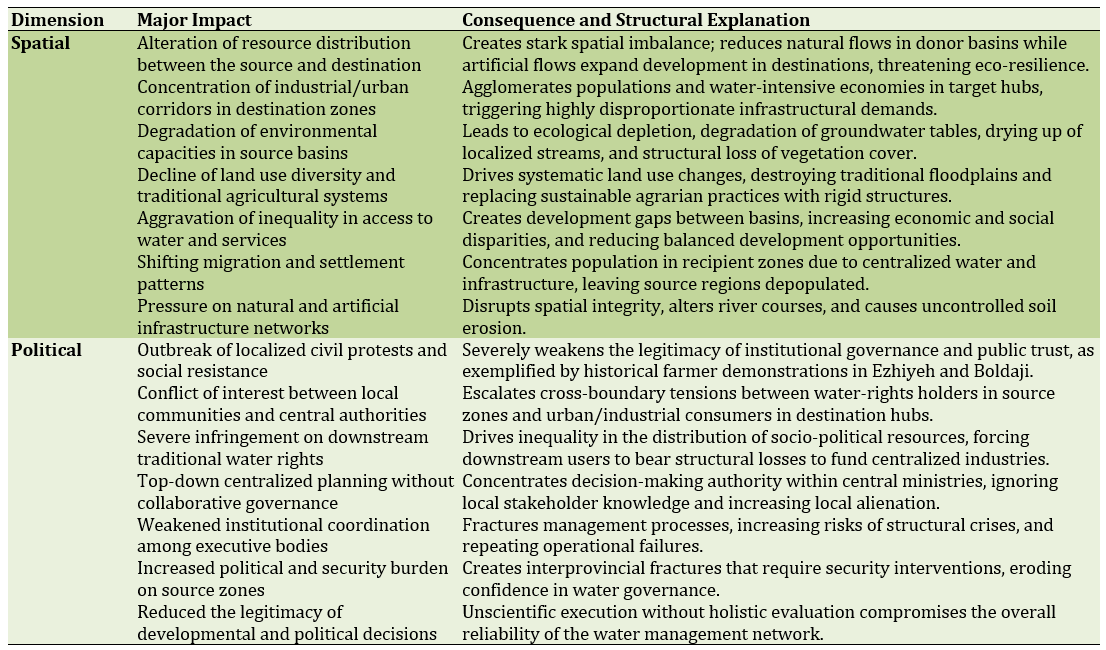
The structural data and expert panel assessments reveal deep distortions across several operational layers of the Zayandeh Rud basin. The main spatial and political consequences of water transfer projects on territorial imbalance, based on expert opinions, are summarized in Table 2.
Table 2. Spatial and Political Major Impacts, Consequences, and Explanations
To isolate the operational variables within the basin's governance network, internal strengths and weaknesses were systematically mapped against external opportunities and threats, as shown in Table 3.
Table 3. Strategic Structural Audit (SWOT Matrix Indicator Mapping)
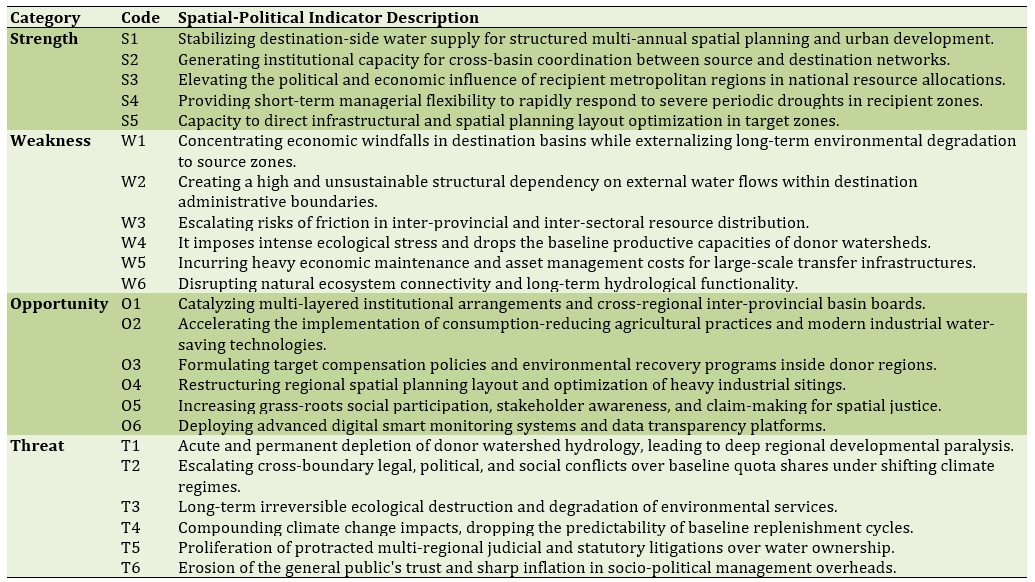
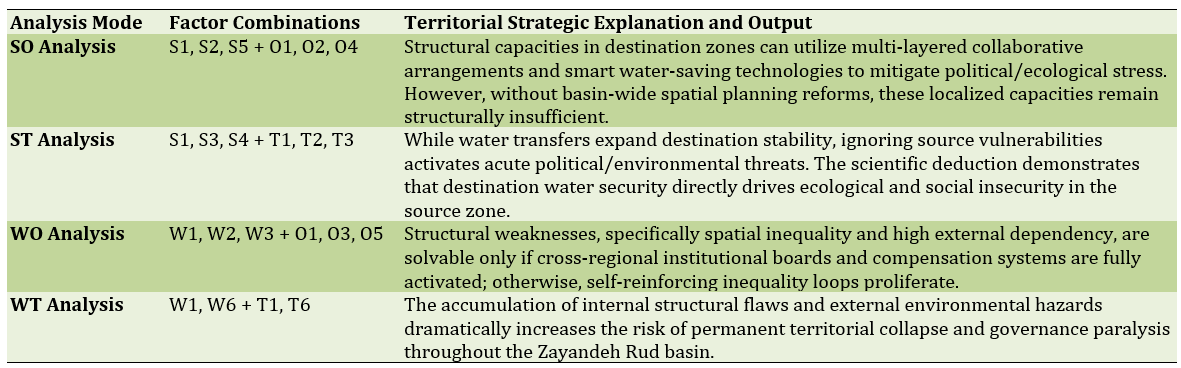
Table 4 presents the qualitative intersections derived from the combined SWOT matrix modeling, highlighting the dynamic linkages between internal and external variables.
Table 4. Combined SWOT Matrix Intersectoral Strategic Analysis
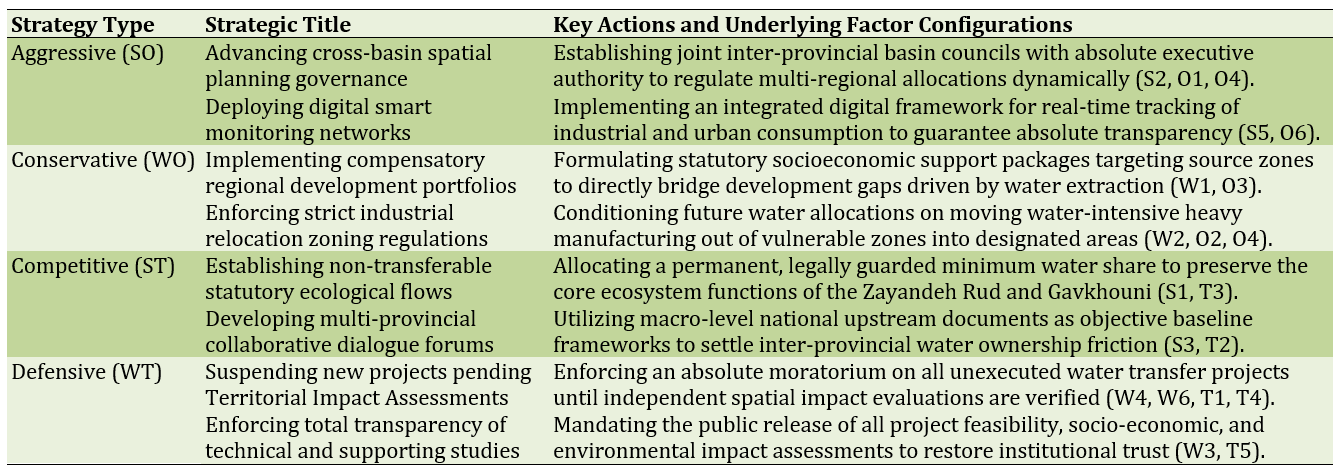
Based on these interactions, a comprehensive planning matrix was generated to guide institutional and spatial corrections, as shown in Table 5.
Table 5. Strategic Action Matrix for Territorial Disparity Mitigation
To provide rigorous mathematical quantification, the Internal Factor Evaluation (IFE) matrix was constructed in Table 6.
Table 6. Internal Factor Evaluation (IFE) Matrix
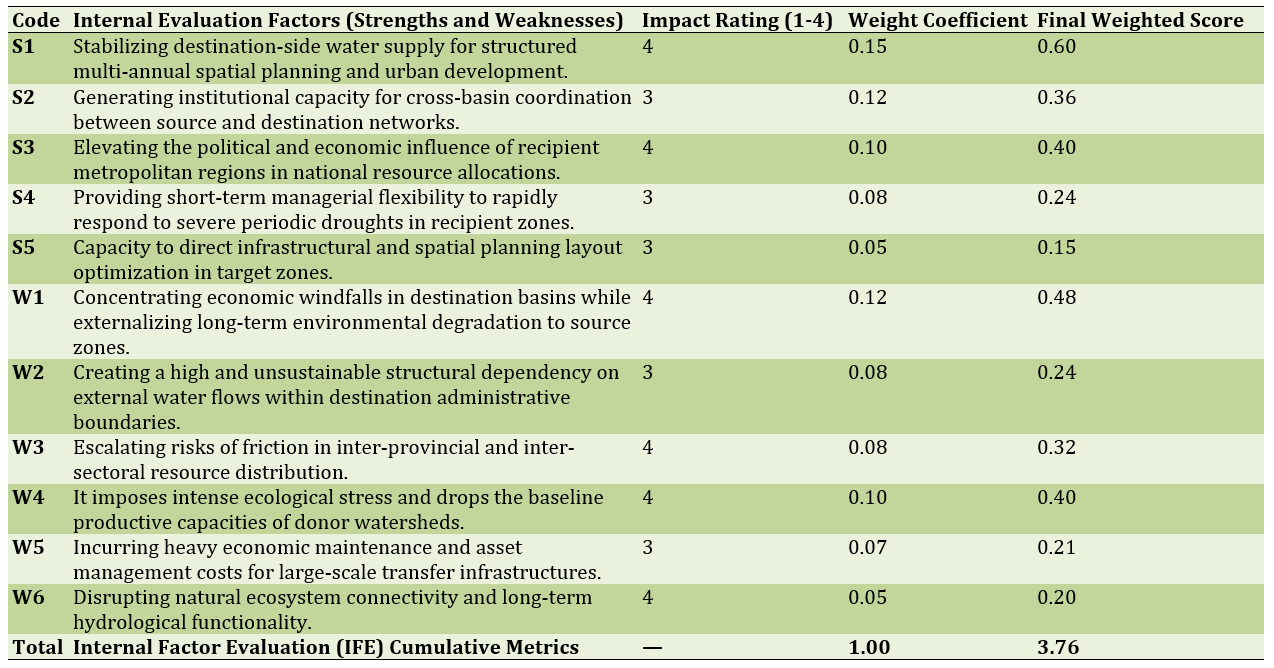
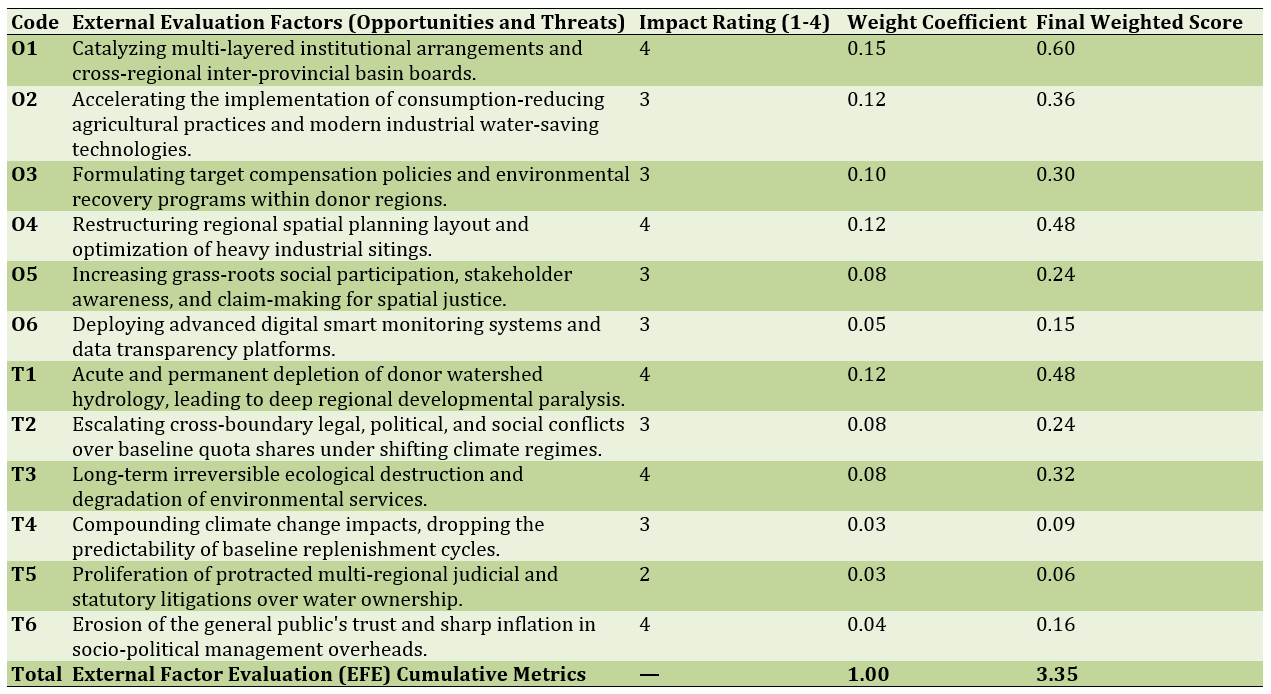
Concurrently, the external driving forces were computed via the External Factor Evaluation (EFE) matrix in Table 7.
Table 7. External Factor Evaluation (EFE) Matrix
Main Comparisons to Similar Studies
The scientific deductions generated throughout this study strongly converge with leading national and international research on hydropolitics and spatial planning. The findings regarding the rapid accumulation of recipient-side dependency on external basins, combined with the artificial inflation of non-resilient economic sectors in destination zones, align with the conclusions of Rahimizadeh and Bozorg Haddad (2018). Furthermore, the patterns identifying structural asymmetric development, where environmental hazards are externalized to peripheral source zones while economic benefits are centralized in dominant political hubs, closely parallel the global empirical water transfer evaluations published by Sadeghi et al. (2016) and Wang et al. (2021). The conceptual focus on the critical need to restructure regional spatial planning within multi-layered water governance structures is conceptually congruent with the water resource paradigms advanced by Rollason et al. (2022) and Nadin et al. (2018).
Limitations & Suggestions
Despite the valuable results, this study also had limitations that could inform future research. Among the most important limitations was the difficulty of accessing certain quantitative, disaggregated data at the sub-basin level, especially accurate statistics on industrial and agricultural consumption, as well as details of the financial and legal agreements for water transfer projects. This limitation reduced the possibility of deeper quantitative analyses. Also, the study's focus on the Zayandeh-Rud watershed limits the generalizability of the results to other watersheds in the country, although the theoretical framework and methodology presented can be adapted to other regions. Accordingly, it is suggested that future research, using combined methods (quantitative-qualitative) and employing techniques such as system dynamics, should address the modeling of the long-term consequences of water transfer projects on territorial imbalance. Also, conducting a comparative study across several critical basins in the country (such as the Karun, Hirmand, and Aras basins) can help identify broader patterns in the impact of these projects on the country's power structure and political space. Finally, examining the role and effectiveness of local institutions and public participation mechanisms in moderating the consequences of these projects can open a new horizon towards realizing planning governance.
Conclusion
New water transfer projects in the Zayandeh-Rud basin have created a “territorial development gap” by redistributing power and resources in favor of destination areas. This gap has manifested itself in the form of dual challenges; on the one hand, the source areas have faced a severe reduction in river flow, destruction of ecosystems, weakening of agriculture, and threats to livelihoods; and on the other hand, the destination areas are faced with structural dependence on extra-basin resources, intensified concentration, and increased inter-provincial tensions.
Acknowledgments: The authors sincerely thank all colleagues, institutions, and individuals who collaborated in completing this research and provided valuable data for the study. Special appreciation is also extended to Lorestan University for facilitating this research.
Ethical Permissions: This research was conducted in accordance with institutional and national ethical guidelines. All stages of data collection and analysis have been observed in accordance with ethical standards.
Conflict of Interest: The authors declare that there is no financial, institutional, or personal conflict of interest associated with this research, and all potential conflicts have been fully disclosed.
Authors’ Contributions: Abed Golkarami (First Author), Principal Researcher/Introduction Writer/Methodologist/Data Analyst/Discussion Writer (50%); Mehran Fatemi (Second Author), Assistant Researcher/Introduction Writer/Statistical Analyst (30%); Mohammad Yousefi Shatori (Third Author), Assistant Researcher/Statistical Analyst/Discussion Writer (20%).
Funding/Support: This research received no specific financial support from government, commercial, or non-profit organizations.
In recent decades, securing sustainable water resources has emerged as one of the most critical environmental, economic, and political challenges globally. In arid and semi-arid regions such as Iran, this issue exhibits far more complex dimensions, with its compounding consequences heavily impacting economic development, ecological sustainability, and social stability (Kaviani Rad, 2016). Climate change, protracted droughts, and surging water demands across agricultural, industrial, and urban sectors have exerted unprecedented pressure on the nation's hydrological networks (Mokhtari Hashi, 2013). In response to this compounding crisis, policymakers—particularly in the central plateaus of the country—have consistently prioritized implementing inter-basin water transfer projects as a standard engineering and managerial mechanism to compensate for local water deficits (Zaki & Rashidi, 2016).
However, inter-basin water transfers can no longer be evaluated merely as technical engineering solutions. Because it forces the physical relocation of a vital, survival-ensuring resource, this process radically reconfigures the spatial structure of accessibility, the distribution of socio-economic benefits, and regional power dynamics at both national and sub-national scales (Golkarami, 2025). Research demonstrates that while these massive infrastructure projects systematically deplete the ecological resilience of source basins, they concurrently bolster the developmental and competitive advantages of destination basins (Sadeghi et al., 2016). This structural imbalance sparks an asymmetrical spatial redistribution of economic benefits and environmental burdens. Analyzing water transfers without integrating spatial justice and regional governance mechanisms offers an incomplete and dangerously flawed understanding of their long-term socio-political impacts (Faryadi, 2019). Concentrating economic windfalls in recipient regions while trapping severe environmental liabilities within source zones ultimately exacerbates spatial inequalities and drives systematic territorial imbalances (Jabalameli, 2021).
Previous Studies
Globally and domestically, the expansion of water transfer projects has spurred scholarly interest in their multidimensional impacts. International experiences reveal that large-scale infrastructure projects frequently cultivate a rigid 'center-periphery' paradigm, where highly developed, resource-demanding destination zones act as centers of consumption and political leverage, while the source basins are systematically relegated to ecological peripheries tasked with absorbing resource depletion (Ma et al., 2020; Wang et al., 2021).
Domestically, official historical documents and technical reports from the Ministry of Energy indicate that since the 1950s, five primary water transfer schemes have deeply influenced the hydrological and socio-political dynamics of the Zayandeh Rud basin (Statistical Yearbook, 2018):
1. The Dez-Karun Basin Transfer Scheme: Engineered to route substantial water flows from the headwaters of the Great Karun River to the arid central plateau, including the Zayandeh Rud (Zarabi et al., 2010).
2. The Beheshtabad Transfer Project: Formulated to supply expanding agricultural and industrial sectors across central provinces, its geographic scope directly intersects the critical plains and primary urban areas of Chaharmahal and Bakhtiari Province (Davoodi Dehaghani & Ameri, 2019; Mohammadi et al., 2020).
3. The Ben-Boroujen Transfer Project: Launched in 2012, this initiative specifically aimed to supply safe drinking and sanitary water to more than half of the population residing within Chaharmahal and Bakhtiari Province (IRNA, 2020).
4. The Persian Gulf to Central Iran Plateau Project: Executed as one of the country's largest national water security initiatives, it was designed to supply desalinated water to Isfahan, Yazd, Qom, and Kashan (Zafarnajad, 2016; Khaelghifar & Vafaeian, 2015).
5. The Golab Tunnel Transfer Scheme: Designed through a two-phase implementation schedule to secure drinking water for Isfahan and its northern metropolitan perimeters (Esmaeili, 2020).
Scholars emphasize that a majority of these domestic projects were carried out under intense political lobbying and localized pressures, lacking holistic expert review, comprehensive environmental evaluations, or long-term social impact assessments (Golkarami & Kavianirad, 2017). Such non-systemic policies systematically ignored the hydrological interdependencies among interconnected watersheds, resulting in severe spatial fractures (Eteaat & Salehian, 2020).
Aim(s)
The primary objective of this research is to analyze the underlying structural mechanisms through which inter-basin water transfer projects produce and reinforce territorial imbalances within the Zayandeh Rud watershed from an integrated spatial-political perspective. Furthermore, the study aims to formulate targeted strategic guidelines and spatial interventions within the overarching framework of spatial planning governance to mitigate these deep-seated regional imbalances.
Research Type
This study is categorized as an Original Research paper that applies a mixed qualitative-quantitative approach utilizing a spatial-political analysis framework alongside strategic structural evaluation models.
Research Society, Place, and Time
Geographic Focus (Place): The study focuses on the Zayandeh Rud watershed, a critical basin covering approximately 26,972 square kilometers. Administratively, nearly 90% of the basin's physical footprint lies within Isfahan Province, 7% within Chaharmahal and Bakhtiari Province, and the remaining 3% is distributed across neighboring provinces such as Fars and Yazd (Gohari et al., 2017). Demographically and economically, it is one of Iran's most densely populated basins and serves as the nation's primary heavy-industrial corridor (Safavi & Rashtghalam, 2016).
Temporal Scope (Time): The active empirical tracking, data aggregation, and structural assessment cover the multi-year period from 2016 to 2023.
Sampling Method and Number
The research employed purposive (targeted) sampling to gather elite data and validate the extracted variables. The expert panel (research society sample) comprised 15 specialized members, including senior university faculty and prominent executive consultants with verified research credentials or administrative backgrounds in political geography, spatial planning, hydrology, and water resource management.
Used Devices & Materials
Data collection and analysis relied on the following methodology and analytical tools:
- Documentary and Desk Research Materials: Evaluation of macro-level national upstream documents, official hydrological tracking registers from the Ministry of Energy, and peer-reviewed scientific literature.
- Expert Deliberation Questionnaire: An evaluation questionnaire consisting of 30 distinct spatial-political indicators using a 5-point Likert scale. Its analytical reliability was optimized to a Cronbach’s Alpha coefficient of 0.81.
- Matrices: Internal Factor Evaluation (IFE) matrix and External Factor Evaluation (EFE) matrix to systematically weigh and rate internal strengths/weaknesses and external opportunities/threats (Faludi, 2000).
- Strategic Evaluation Tool: The SWOT Analysis Model was applied to cross-examine internal competencies against external vulnerabilities to extract actionable strategic variations.
Findings
The structural data and expert panel assessments reveal deep distortions across several operational layers of the Zayandeh Rud basin. The main spatial and political consequences of water transfer projects on territorial imbalance, based on expert opinions, are summarized in Table 2.
Table 2. Spatial and Political Major Impacts, Consequences, and Explanations
To isolate the operational variables within the basin's governance network, internal strengths and weaknesses were systematically mapped against external opportunities and threats, as shown in Table 3.
Table 3. Strategic Structural Audit (SWOT Matrix Indicator Mapping)
Table 4 presents the qualitative intersections derived from the combined SWOT matrix modeling, highlighting the dynamic linkages between internal and external variables.
Table 4. Combined SWOT Matrix Intersectoral Strategic Analysis
Based on these interactions, a comprehensive planning matrix was generated to guide institutional and spatial corrections, as shown in Table 5.
Table 5. Strategic Action Matrix for Territorial Disparity Mitigation
To provide rigorous mathematical quantification, the Internal Factor Evaluation (IFE) matrix was constructed in Table 6.
Table 6. Internal Factor Evaluation (IFE) Matrix
Concurrently, the external driving forces were computed via the External Factor Evaluation (EFE) matrix in Table 7.
Table 7. External Factor Evaluation (EFE) Matrix
Main Comparisons to Similar Studies
The scientific deductions generated throughout this study strongly converge with leading national and international research on hydropolitics and spatial planning. The findings regarding the rapid accumulation of recipient-side dependency on external basins, combined with the artificial inflation of non-resilient economic sectors in destination zones, align with the conclusions of Rahimizadeh and Bozorg Haddad (2018). Furthermore, the patterns identifying structural asymmetric development, where environmental hazards are externalized to peripheral source zones while economic benefits are centralized in dominant political hubs, closely parallel the global empirical water transfer evaluations published by Sadeghi et al. (2016) and Wang et al. (2021). The conceptual focus on the critical need to restructure regional spatial planning within multi-layered water governance structures is conceptually congruent with the water resource paradigms advanced by Rollason et al. (2022) and Nadin et al. (2018).
Limitations & Suggestions
Despite the valuable results, this study also had limitations that could inform future research. Among the most important limitations was the difficulty of accessing certain quantitative, disaggregated data at the sub-basin level, especially accurate statistics on industrial and agricultural consumption, as well as details of the financial and legal agreements for water transfer projects. This limitation reduced the possibility of deeper quantitative analyses. Also, the study's focus on the Zayandeh-Rud watershed limits the generalizability of the results to other watersheds in the country, although the theoretical framework and methodology presented can be adapted to other regions. Accordingly, it is suggested that future research, using combined methods (quantitative-qualitative) and employing techniques such as system dynamics, should address the modeling of the long-term consequences of water transfer projects on territorial imbalance. Also, conducting a comparative study across several critical basins in the country (such as the Karun, Hirmand, and Aras basins) can help identify broader patterns in the impact of these projects on the country's power structure and political space. Finally, examining the role and effectiveness of local institutions and public participation mechanisms in moderating the consequences of these projects can open a new horizon towards realizing planning governance.
Conclusion
New water transfer projects in the Zayandeh-Rud basin have created a “territorial development gap” by redistributing power and resources in favor of destination areas. This gap has manifested itself in the form of dual challenges; on the one hand, the source areas have faced a severe reduction in river flow, destruction of ecosystems, weakening of agriculture, and threats to livelihoods; and on the other hand, the destination areas are faced with structural dependence on extra-basin resources, intensified concentration, and increased inter-provincial tensions.
Acknowledgments: The authors sincerely thank all colleagues, institutions, and individuals who collaborated in completing this research and provided valuable data for the study. Special appreciation is also extended to Lorestan University for facilitating this research.
Ethical Permissions: This research was conducted in accordance with institutional and national ethical guidelines. All stages of data collection and analysis have been observed in accordance with ethical standards.
Conflict of Interest: The authors declare that there is no financial, institutional, or personal conflict of interest associated with this research, and all potential conflicts have been fully disclosed.
Authors’ Contributions: Abed Golkarami (First Author), Principal Researcher/Introduction Writer/Methodologist/Data Analyst/Discussion Writer (50%); Mehran Fatemi (Second Author), Assistant Researcher/Introduction Writer/Statistical Analyst (30%); Mohammad Yousefi Shatori (Third Author), Assistant Researcher/Statistical Analyst/Discussion Writer (20%).
Funding/Support: This research received no specific financial support from government, commercial, or non-profit organizations.
References
1. Afzali R, Pishgahi Fard Z, Zarei B, Rahmani MR (2017). The geopolitical pathology of Iran's water resources management in the south-west drainage basin: Karkheh and Great Karun Rivers. Social and Cultural Strategy Quarterly. 6(23):105-140. [Persian] [Link]
2. Davoodi Dehaghani A, Ameri MA (2019). Social and security consequences of inter-basin water transfer (Case study: Beheshtabad, Chaharmahal and Bakhtiari to Zayandeh Rud, Isfahan). Journal of Administrative Geography. 7(25):51-76. [Persian] [Link]
3. Esmaeili MM (2020). Water supply crisis in Zayandehrud watershed Social issues and solutions to manage it (demonstrations of 2011 to 2014). Social Studies and Research in Iran. 9(3):567-585. [Persian] [Link]
4. Eteaat J, Salehian S (2020). Analysis of "sources and uses" and "water resource instability" in the Zayandeh Rud basin. Iranian Journal of Irrigation and Water. 10(39). [Persian] [Link]
5. Faludi A (2000). The performance of spatial planning. Planning Practice & Research. 15(3-4):299-318. [Link] [DOI:10.1080/713691907]
6. Faryadi M (2019). Legal dimensions of inter-basin water transfer. Public Law Research. 20(61):121-150. [Persian] [Link]
7. Gohari A, Zareian MJ, Eslamian S, Nazari R (2017). Interbasin transfers of water: Zayandeh-Rud River Basin. In: Handbook of drought and water scarcity. Boca Raton: CRC Press. [Link] [DOI:10.1201/9781315226781-32]
8. Golkarami A (2025). Explanation the geopolitical roots of territorial imbalance in Iran's spatial governance. Political Spatial Planning Quarterly. 7(2):109-137. [Persian] [Link]
9. Golkarami A, Kavianirad M (2017). The effect of limited water resources on hydropolitic tensions (case study: Iran's central catchment with emphasis on Zayandehrood basin). Geography and Environmental Planning. 28(1):113-134. [Persian] [Link]
10. IRNA (2020). Progress of the Bun-Boroujen inter-basin water transfer project in Chaharmahal and Bakhtiari monitored [Internet]. Tehran: Islamic Republic News Agency [cited 2020, 5 November]. Available from: https://www.irna.ir/news. [Persian] [Link]
11. JabalAmeli MS (2021). Explaining the spatial aspect of justice in the Islamic-Iranian Model of Progress. Transcribed text. Tehran: Center for Islamic-Iranian Model of Progress [cited 2021, 18 May]. Available from: www.olgou.ir. [Persian] [Link]
12. Janin Rivolin U, Santangelo M, Cotella G, Govema F, Caruso N, De Luca A, et al (2013). ESPON TANGO-Territorial approaches for new governance: Final report. ESPON & Nordregio. [Link]
13. KavianiRad M (2016). Hydro-political challenges and the securitization of water in Iran [Internet]. Azerbaijan: Azariha [cited year? month? day?]. Available from: https://azariha.org/1830/. [Persian] [Link]
14. KhaleghiFar A, Vafaian M (2015). Feasibility study of water transfer from the Persian Gulf to central Iran. Proceedings of the Fifth International Conference on Sustainable Development and Urban Construction. Isfahan: Danesh Pazhouhan Higher Education Institute. [Persian] [Link]
15. Kiani Salmi S, Nouri SH, Sadrezadeh Khui A (2015). Forecasting Zayandeh Rud streamflow using time series: Case study: East of Isfahan plain. Geography and Urban-Regional Planning. 5(17):1-18. [Persian] [Link]
16. Ma J, Li X, Zhao Y (2020). Ecological impacts of inter-basin water transfer projects: A review. Environmental Science and Pollution Research. 27(12):12867-12879. [Link]
17. Mahmoudi SM (2023). Spatial planning. Tehran: University of Tehran Press. [Persian] [Link]
18. Mansouri R, Torabi Pudeh H, Yonesi HA, Haghiabi AH (2017). Dynamic programming model for hydraulics and water resources simulating and optimizing water transfer system (a case study in Iran). Journal of Water Supply Research and Technology-Aqua. 66(8):684-700. [Link] [DOI:10.2166/aqua.2017.110]
19. Mirhaj M (2006). Role of climate change in reduction or intensification of natural disasters with emphasis on drought (Case study: Zayandeh Rud basin) [Master's thesis]. Isfahan: University of Isfahan. [Persian] [Link]
20. Mohammadi HR, Hakimi Khoram A, Ahmadi E (2020). Feasibility study of the implementation of inter-basin water transfer projects in Iran (case study: Beheshtabad-central plateau water transfer project). Human Geography Research. 51(4):1073-1092. [Persian] [Link]
21. Mokhtari Hashi H (2013). Hydropolitics of Iran: The geography of the water crisis toward the 2025 horizon. Geopolitics Quarterly. 9(31):49-83. [Persian] [Link]
22. Nadin V, Fernandez Maldonado AM, Zonneveld W, Stead D, Dabrowski M, Piskorek K, et al (2018). COMPASS-Comparative analysis of territorial governance and spatial planning systems in Europe: Final report. ESPON & TU Delft. [Link]
23. Nikoii A, Zibaei M (2012). Water resources management and food security in the Zayandehrood basin: Application of integrated river basin analysis method. Journal of Agricultural Economics and Development. 26(3):183-196. [Persian] [Link]
24. Omidvar K (2019). Water resources of Iran. Yazd: Yazd University Press. [Persian] [Link]
25. Rahimizadeh MR, Bozorg Haddad A (2018). Effects of interbasin water transfer projects on Iran's water resources. Strategic Research Journal in Agricultural Sciences and Natural Resources. 3(1):27-42. [Persian] [Link]
26. Rollason E, Bracken LJ, Hardy RJ, Large ARG (2022). Rethinking spatial planning in multi-scalar water governance. Geoforum. 128:11-21. [Link]
27. Sadeghi SHR, Kazemi Kia S, Kheirfam H, Hazbavi Z (2016). Experiences and consequences of inter-basin water transfer worldwide. Iran-Water Resources Research. 12(2):120-140. [Persian] [Link]
28. Safavi H, Rastghalam M (2016). Solutions to the water crisis in the Zayandeh Rud basin: Joint supply and demand management. Iran-Water Resources Research. 12(4):12-22. [Persian] [Link]
29. SNN (2021). Postponement of Ben-Brojen water transfer project for various reasons/Half of Chaharmahal and Bakhtiari population suffers from water scarcity [Internet]. Tehran: Student News Network [cited 2022, 9 April]. Available from: http://snn.ir/fa/news/927401/. [Persian] [Link]
30. Statistical Yearbook of the Country's Water (2018). Tehran: Ministry of Energy, Office of Macro Planning for Water and Wastewater. [Persian] [Link]
31. Talebi Soumehsaraei M, Zokaei MS, Fazeli M, Jomahpour M (2019). Sociology of a crisis: The social pathology of the water crisis in the Zayandeh-Rood river basin. Interdisciplinary Studies in the Humanities. 11(4):133-165. [Persian] [Link]
32. Torfeh MA, Hatamian A (2015). Adoption of domestic water diplomacy: Goals and necessities with emphasis on Zayandeh Rud basin. DANESH NAMA. 23(230-232):67-78. [Persian] [Link]
33. Wang Z, Nixon R, Erwin A, Ma Z (2021). Assessing the impacts of large-scale water transfer projects on communities: Lessons learned from a systematic literature review. Society & Natural Resources. 34(6):820-841. [Link] [DOI:10.1080/08941920.2020.1859029]
34. Yaghoobnia H, Moteqi A, Yousefi Shatouri M (2025). Re-engineering water governance in the Zayandeh Rud basin. Geographical Engineering of the Land. 8(4):157-170. [Persian] [Link]
35. Zafarnajad F (2016). A critique of the water transfer project from the Persian Gulf and the Oman Sea to the Central Iran Plateau. Journal of Water and Sustainable Development. 3(1):124-129. [Persian] [Link]
36. Zarabi A, Halabian AH, Shabankari M (2010). Planning for water transfer from the Karun basin to Zayandehrood. Journal of Humanities Research. 22(1):67-84. [Persian] [Link]
37. Zaki Y, Ehteshami MR (2014). Analysis of hydro-political issues in the 21st century. Proceedings of the First National Conference on Water, Human and Earth. Isfahan: CIVILICA. [Persian] [Link]
38. Zaki Y, Rashidi M (2016). Water policy in the Karun basin and its hydro-political challenges. New Perspectives in Human Geography Research Quarterly. 8(4):43-59. [Persian] [Link]
39. Ziaei L (2014). Water crisis in the Zayandeh Rud basin: Components and solutions. DANESH NAMA. 23(230-232):8. [Persian] [Link]