

Bilingual
En/Fa
Geographical Research is Published in both Persian and English Full-text.
Volume 40, Issue 4 (2025)
GeoRes 2025, 40(4): 381-389 |
Back to browse issues page
Article Type:
Subject:




History
Received: 2025/11/22 | Accepted: 2025/12/29 | Published: 2025/12/31
Received: 2025/11/22 | Accepted: 2025/12/29 | Published: 2025/12/31
How to cite this article
Abdollahzadeh Roodposhti M, Joodaki H, Adibi Sadinejad F. (2025). The Feasibility Indicators of a Low-Carbon City; a Case Study of Tehran Metropolis’s District 2. GeoRes. 40(4), 381-389. doi:10.58209/geores.40.4.381
URL: http://georesearch.ir/article-1-1879-en.html
URL: http://georesearch.ir/article-1-1879-en.html
Download citation:
BibTeX | RIS | EndNote | Medlars | ProCite | Reference Manager | RefWorks
Send citation to:


Rights and permissions
BibTeX | RIS | EndNote | Medlars | ProCite | Reference Manager | RefWorks
Send citation to:

1- Department of Geography and Urban Planning, Islamshahr Campus (Is.C.), Islamic Azad University, Islamshahr, Iran
Full-Text (HTML) (2 Views)
1. Background
After 1978, urban development and rapid population growth have increased greenhouse gas emissions; cities, as the main drivers of economic growth, consume vast amounts of energy [Cui & Pan, 2024]. It is estimated that cities, which occupy only 2% of the world's total surface area, produce more than 70% of human carbon gas accumulation. Carbon gas accumulation in cities in developing countries accounts for more than 80% of total gas accumulation [Shi et al., 2020]. Traditional carbon reduction measures — based on technology and policy solutions — have led to increased direct research on the relationship between urban spatial structure and urban carbon gas accumulation. Therefore, urban planning must guarantee a sustainable future by facilitating carbon emission reduction [Liu et al., 2021].
Since the beginning of the 21st century, energy consumption and climate change have been among the most widespread concerns in the international community, and low-carbon cities are one of the well-known approaches to balancing cities so as to reduce the effects of human activities on greenhouse gas production [Sheikhi et al., 2022]. The traditional 'high carbon production' spatial pattern that has existed since the Industrial Revolution — more than 300 years ago — must be changed. The low-carbon city, aligned with the environment, is becoming a global principle in urban development [Wentong & Hu, 2010].
Iran, with a production of 1.65% of total greenhouse gases, ranks tenth among the world's countries and produces 715 million tons of carbon dioxide annually; all of this percentage is produced in the energy sector. Iran, as a developing country, is not in a favorable position in terms of energy consumption in the production process of goods and services and is considered a country with high energy intensity [Moradi & Charejo, 2021]. The actions taken with the aim of reducing urban pollution are still in their early stages and have been implemented on a small scale in various regions; for example, the use of renewable energy in Iran is still less than 1% of the country's total energy. Therefore, planning for carbon dioxide reduction in Iran is extremely necessary [Mousavi Sarvineh Baghi, 2014].
2. Previous Studies
Soytas et al. examined the relationship between energy consumption growth and air pollution emissions on urban environments. Results of the pooled data and GMM-SYS technique showed that energy consumption leads to carbon dioxide emissions [Soytas et al., 2007]. Tian et al. used two models to predict particulate matter concentration: in the first model, only linear regression between Aerosol Optical Depth (AOD) observations and particulate matter concentration measured at ground stations was used; in the second model, a quasi-empirical relationship between AOD calculated from MODIS imagery and ground and satellite meteorological information was used [Tian et al., 2016]. Heinonen & Junnila examined the effects of urban structure on carbon consumption in urban areas, aiming to present a multivariate composite algorithm model to evaluate carbon consumption in urban areas as affected by urban structure. Results showed that the carbon impact of urban density and the dominant building type in selected urban areas stems from different greenhouse gas emission effects in urban structure and consumption classes related to services; notably, no clear relationship was found between the density of the cities studied and carbon emissions [Heinonen & Junnila, 2011]. Bambrick et al. examined climate change and health in Australia's urban environment and found that fundamental changes in future land-use patterns relative to the existing situation are needed to improve community health and wellness and reduce the harmful effects of the urban environment on nature [Bambrick et al., 2011]. Chavez & Ramaswami examined low-carbon cities and sustainable approaches to greenhouse gas emissions, concluding that there is no standard method for measuring the scale of greenhouse gas emissions and that a single parameter is not sufficient for measuring these emissions; a combination of variables such as greenhouse gases per unit of city residents together with city workers or total economic output should be used as potential criteria for defining a low-carbon city [Chavez & Ramaswami, 2013]. Sarkodie et al. examined the global impact of urban expansion, industrialization, trade, and economic development on carbon dioxide emissions and concluded that urban expansion leads to a reduction in carbon storage space in the city, increased energy consumption in daily life, and increased carbon emissions [Sarkodie et al., 2020]. Zhu et al. examined the low-carbon city using a dynamic regional assessment model and concluded that promoting technological innovation through environmental regulations can reduce carbon dioxide emissions and energy consumption [Zhu et al., 2021].
Hosseinzadeh et al. examined the synoptic patterns affecting air pollution in the Mashhad Metropolis. Results indicated that the presence of a trough around the Aral Sea caused cold air to flow into northeastern Iran, strengthening the Siberian high-pressure system at the surface level. At the same time, the establishment of a high-pressure system in western Iran caused the inflow of northwestern currents; these pressure patterns led to a sharp decrease in temperature, atmospheric stability, and the concentration of pollutants in Mashhad [Hosseinzadeh et al., 2013]. Qoreishi et al. examined the environmental effects of climate change with an emphasis on air pollutants, concluding that climate change is a very important factor in the intensification of dust occurrence, biodiversity loss, pest and disease outbreaks in ecosystems, threats to wetland biological functions, changes in the geographical distribution of animals, and increased salinity [Qoreishi et al., 2014]. Asiabanipour evaluated urban development plans and programs with a zero-carbon approach, finding that it is necessary for development programs to address the improvement of these factors; from the perspective of qualitative factors, the city's efforts to reduce carbon dioxide and environmental monitoring were in an unfavorable state [Asiabanipour, 2014]. Hosseini et al. evaluated the effects of indiscriminate urban expansion in the Torghabe Mehr Housing project, finding that water pollution (weight 0.498) ranked first, followed by vegetation (0.258), soil pollution (0.143), air pollution (0.076), and noise pollution (0.034) [Hosseini et al., 2015]. Lutfi et al. examined urban design criteria for zero-carbon and low-carbon neighborhoods, reviewing the indicators of form and physical environment, transportation and land use, energy, landscape, and creativity, with the aim of creating a neighborhood with low energy consumption [Lutfi et al., 2015]. Mofidi, in a mixed research based on analogy and reasoning and by examining factors influencing carbon dioxide emissions in Iran, formulated the principles and indicators for designing the form of low-carbon urban neighborhoods in the Tajrish neighborhood of Tehran [Mofidi, 2017]. Noorian et al. analyzed the effects of land use and the transportation network on greenhouse gas emissions with a low-carbon city approach, proposing the concept of the low-carbon city as a solution; by examining the principles of the low-carbon city and presenting various scenarios for the new city of Hashtgerd, they showed that changes in the street network form and the development of integrated transportation can lead to a reduction of up to 41% in greenhouse gas emissions in the transportation sector [Noorian et al., 2012]. Malekpour Asl & Boostani addressed a collaborative planning approach to achieve a low-carbon city in Tehran Metropolis, focusing on the development of a low-carbon city in Tehran with an emphasis on collaborative planning and low-carbon city principles; using a favorable scenario model, they described strategies and solutions for achieving the superior scenario through collaborative planning [Malekpour Asl & Boostani, 2022]. Sheikhi et al. presented a conceptual and evaluative model of low-carbon cities, with the main aim of re-reading and conceptual and theoretical recognition of low-carbon cities [Sheikhi et al., 2022]. Jabarpour Mehrabad & Abedini evaluated and assessed the feasibility of implementing a low-carbon city approach in Urmia, finding that among low-carbon city components, urban form was in the most unfavorable condition [Jabarpour Mehrabad & Abedini, 2023]. Mehdizadeh et al. developed a model of low-carbon cities for reducing climate change and development in Ahvaz, showing that the utilities and infrastructure sector, the cultural and social sector, the green spaces sector, and the industrial sector in Ahvaz have an influential character [Mehdizadeh et al., 2014].
3. Aim(s)
The aim of this study was to evaluate the feasibility indicators of a low-carbon city in District 2 of Tehran Metropolis and to propose appropriate strategies and measures for reducing air pollution in Tehran Metropolis. The study specifically examined three index categories — urban form, transportation and infrastructure, and governance — and identified the most suitable options for reducing carbon emissions under each index.
4. Research Type
This is an original survey research study conducted from April to October 2025 (Farvardin to Mehr 1404) in District 2 of Tehran Metropolis.
5. Research Society, Place and Time
The study was conducted from April to October 2025 in District 2 of Tehran Metropolis. District 2 of Tehran is geographically located on the southern slopes of the Alborz mountains. This district is bounded to the north by the southern slopes of the Alborz mountain range, to the south by the southern alluvial plain, and to the east and west by the Farahzad and Ovin-Darake waterways. The overall shape of the district is rectangular, measuring 12 km in the north-south direction and 4 km in the east-west direction, covering an area of approximately 6,959 hectares. The southern sections, located in the Tehran plain, have a warm and dry climate, while the northern sections on the Alborz mountain slopes have a more temperate climate. The general slope of the district is from north to south, varying from 30–40 degrees in the northern parts to gentle slopes of 5–10 degrees in the southern parts. The district consists of 9 sub-districts and 21 neighborhoods, and is adjacent to Districts 1, 3, 5, 6, 9, and 10. Its geographical boundaries extend from the Alborz heights in the north, Azadi Street in the south, Shahid Chamran Expressway in the east, and Ayatollah Ashrafi Isfahani Expressway in the west. According to the 2021 census, the population is 992,079 persons, with 239,992 households and a population density of 127.7 persons per hectare. The statistical population consisted of experts and urban affairs officials in District 2 of Tehran Metropolis.
6. Sampling Method and Number
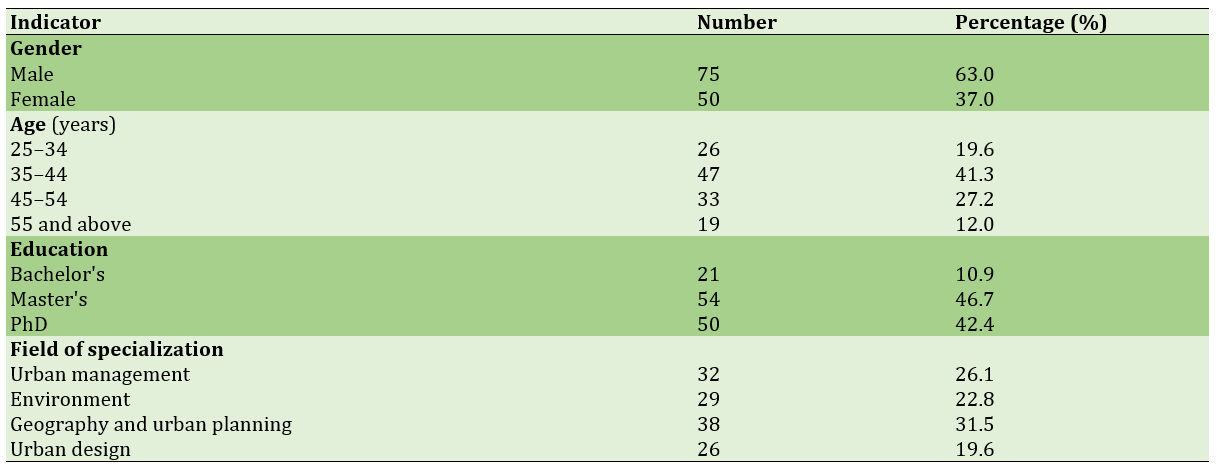
The sample size was determined at 125 persons using the Morgan table. Samples were selected using simple random sampling from among experts and urban affairs officials of District 2 of Tehran Metropolis. The mean age of participants was 40.4 ± 8.5 years (minimum 35, maximum 45), and the majority (63%) were male (Table 1).
Table 1. Demographic characteristics of study participants (n=125)
7. Used Devices & Materials
A two-section questionnaire was used for data collection; the first section included participants' personal information and the second section included questions on the low-carbon city. A total of 15 items were placed within 3 indicators: form, transportation and infrastructure, and governance. After scoring on a scale of 1 to 9, pairwise matrix comparison was performed. The minimum relative content validity ratio (CVR) for 5 judges was calculated at 0.99 for all items. Cronbach's alpha for the checklist was calculated at greater than 0.7, indicating the reliability of the instrument. The Analytic Hierarchy Process (AHP) was used to examine the influence of indicators on one another. The components of the low-carbon city form index, the transportation and infrastructure index, and the governance index were first calculated by collecting information from questionnaires; then, respondents' opinions on the importance of one factor relative to another sub-factor were multiplied together and raised to the power of one-fifteenth. To determine the weight of each component, normalization of the pairwise comparison matrix was carried out — the sum of each column was calculated in the geometric mean table of respondents' opinions, each value was divided by the column sum, and finally the arithmetic mean was calculated (values in each row were summed and divided by their count). Prioritization of the carbon reduction options was conducted based on each indicator separately, followed by combining these results to extract the carbon reduction option for District 2 of Tehran. All calculations were performed using SPSS 20 software.
8. Findings
The components of 'increasing urban density' (0.215), 'compactness of urban form' (0.180), 'creation of green spaces' (0.165), 'mixed land use' (0.161), 'buildings and district fabric' (0.139), and 'neighborhood form of the district' (0.139) ranked first through sixth in the low-carbon urban form index (Table 2).
Table 2. Normalized matrix of low-carbon urban form components

The components of 'public transportation' (0.170), 'smart urban infrastructure' (0.167), 'clean vehicles' (0.160), 'pedestrian facilities' (0.157), 'renewable energy in housing' (0.145), and 'access to public services within 5 minutes' (0.058) ranked first through sixth in the low-carbon city transportation and infrastructure index (Table 3).
Table 3. Normalized matrix of low-carbon city transportation and infrastructure components

The components of 'public participation' (0.411), 'education on energy consumption reduction' (0.309), and 'investment in infrastructure' (0.280) ranked first through third in the low-carbon city governance index (Table 4).
Table 4. Normalized matrix of low-carbon city governance components

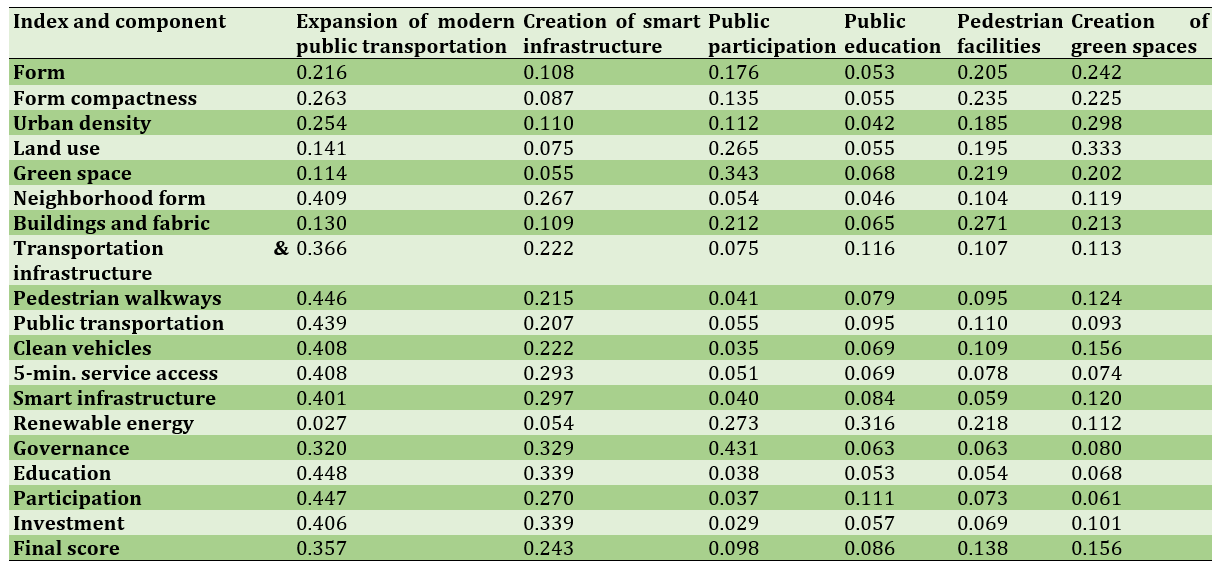
The final scores of the factors affecting air pollution reduction were, respectively: 'expansion of modern public transportation' (0.357), 'creation of smart infrastructure' (0.243), 'creation of green spaces' (0.156), 'pedestrian facilities' (0.138), 'public participation' (0.098), and 'public education' (0.086). Accordingly, the most appropriate option for the form index was 'creation of urban green spaces'; for the transportation and infrastructure index, 'expansion of modern public transportation'; and for the governance index, 'public participation' (Table 5).
Table 5. Index and component scores based on factors effective in reducing air pollution in District 2 of Tehran Metropolis
9. Main Comparisons to Similar Studies
The findings of the present research are consistent with Jabarpour Mehrabad & Abedini [2023], who reported that among low-carbon city components, the urban form component in Urmia was in the most unfavorable condition, and with Sarkodie et al. [2020], who identified industrialization, trade, and economic development as the most important factors influencing carbon dioxide emissions.
Bambrick et al. [2011] argue that laws must be enacted to reduce the damages caused by fundamental changes in future land-use patterns relative to the existing situation, so that the harmful effects of the urban environment on nature are reduced. Although the present research did not specifically address this, the concepts of creating and expanding urban green spaces and expanding low-carbon city infrastructure are consistent with that research. Furthermore, Chavez & Ramaswami [2013] emphasize that a combination of variables should be used as potential criteria for defining a low-carbon city, and the limited generalizability of the present study's results confirms this claim. Sarkodie et al. [2020] showed that urban expansion leads to increased energy consumption in daily life and increased carbon emissions; the present research also emphasizes the increase in urban density and compactness of urban form in carbon emissions, while studies such as Zhu et al. [2021] have identified the promotion of technological innovation through environmental regulations as an important factor in CO2 emissions. Our findings identify the expansion of modern public transportation and the creation of smart infrastructure as the best methods for carbon reduction. Malekpour Asl & Boostani [2022] emphasize collaboration between urban institutions and citizens to reduce urban pollutants, which is consistent with the findings of the present research, including the governance indicators of the low-carbon city (public participation). Sheikhi et al. [2022] did not directly introduce an indicator but conceptually and theoretically re-read and recognized low-carbon cities, which is consistent with the present research in terms of evaluating and developing low-carbon city options. Jabarpour Mehrabad & Abedini [2023] reported that among low-carbon city components, the urban form component was in the most unfavorable condition, which is consistent with the urban form index cited as the most important index in the present research. Mehdizadeh et al. [2014] did not provide an indicator for low-carbon cities, but their emphasis on utilities and infrastructure, industries, and green spaces is consistent with the findings of the present research.
10. Suggestions & Limitations
Despite its limitations — such as focusing on a single district of Tehran Metropolis — the results of this research are generalizable to urban areas and metropolises that face air pollution.
To improve the status of District 2 of Tehran Metropolis in terms of low-carbon city indicators, the following are recommended: (1) establishing public transportation systems with service coverage throughout the district, especially in the northern and eastern sections; (2) protecting and improving the quality of the district's natural spaces, including Tarshit Garden, Golestan Forest Park, Farahzad river valley, and neighborhood and district parks, as well as creating and expanding neighborhood parks in the southern sections, particularly from the Navab area to Azadi Square; (3) strengthening and developing mixed and compatible land uses for neighborhood and district-level services in homogeneous residential sections, to reduce urban car trips and provide access to urban services at the neighborhood and sub-district scale, mainly in the northern and northeastern sections including Gisha and Sattar Khan neighborhoods; (4) harnessing solar and wind energy and installing solar panels on urban and industrial buildings in the district; (5) implementing energy efficiency projects in buildings, using low-carbon building materials, and encouraging the construction of green buildings in the district; (6) strengthening modern public transportation infrastructure such as metro, electric buses, and bike-sharing programs, and creating dedicated cycling and pedestrian routes in the district.
11. Conclusion
The expansion of modern public transportation, the creation of smart infrastructure, the creation of green spaces, and walking facilities are effective in reducing air pollution in District 2 of Tehran Metropolis.
Acknowledgments: The sincere appreciation of all experts and urban affairs officials who participated in completing the questionnaire is acknowledged.
Ethical Permission: This research was conducted in accordance with research ethics principles, and all respondents participated in the study with informed consent.
Conflict of Interest: The authors declare that there is no conflict of interest in this research.
Authors' Contributions: Mostafa Abdollahzadeh Roodposhti (First Author): Introduction writer / Methodologist / Principal researcher / Statistical analyst / Discussion writer (40%); Hamidreza Joodaki (Second Author): Introduction writer / Assistant researcher / Discussion writer (30%); Fatemeh Adibi Sadinejad (Third Author): Introduction writer / Assistant researcher / Statistical analyst (30%)
Funding/Support: This research received no direct or indirect financial support.
After 1978, urban development and rapid population growth have increased greenhouse gas emissions; cities, as the main drivers of economic growth, consume vast amounts of energy [Cui & Pan, 2024]. It is estimated that cities, which occupy only 2% of the world's total surface area, produce more than 70% of human carbon gas accumulation. Carbon gas accumulation in cities in developing countries accounts for more than 80% of total gas accumulation [Shi et al., 2020]. Traditional carbon reduction measures — based on technology and policy solutions — have led to increased direct research on the relationship between urban spatial structure and urban carbon gas accumulation. Therefore, urban planning must guarantee a sustainable future by facilitating carbon emission reduction [Liu et al., 2021].
Since the beginning of the 21st century, energy consumption and climate change have been among the most widespread concerns in the international community, and low-carbon cities are one of the well-known approaches to balancing cities so as to reduce the effects of human activities on greenhouse gas production [Sheikhi et al., 2022]. The traditional 'high carbon production' spatial pattern that has existed since the Industrial Revolution — more than 300 years ago — must be changed. The low-carbon city, aligned with the environment, is becoming a global principle in urban development [Wentong & Hu, 2010].
Iran, with a production of 1.65% of total greenhouse gases, ranks tenth among the world's countries and produces 715 million tons of carbon dioxide annually; all of this percentage is produced in the energy sector. Iran, as a developing country, is not in a favorable position in terms of energy consumption in the production process of goods and services and is considered a country with high energy intensity [Moradi & Charejo, 2021]. The actions taken with the aim of reducing urban pollution are still in their early stages and have been implemented on a small scale in various regions; for example, the use of renewable energy in Iran is still less than 1% of the country's total energy. Therefore, planning for carbon dioxide reduction in Iran is extremely necessary [Mousavi Sarvineh Baghi, 2014].
2. Previous Studies
Soytas et al. examined the relationship between energy consumption growth and air pollution emissions on urban environments. Results of the pooled data and GMM-SYS technique showed that energy consumption leads to carbon dioxide emissions [Soytas et al., 2007]. Tian et al. used two models to predict particulate matter concentration: in the first model, only linear regression between Aerosol Optical Depth (AOD) observations and particulate matter concentration measured at ground stations was used; in the second model, a quasi-empirical relationship between AOD calculated from MODIS imagery and ground and satellite meteorological information was used [Tian et al., 2016]. Heinonen & Junnila examined the effects of urban structure on carbon consumption in urban areas, aiming to present a multivariate composite algorithm model to evaluate carbon consumption in urban areas as affected by urban structure. Results showed that the carbon impact of urban density and the dominant building type in selected urban areas stems from different greenhouse gas emission effects in urban structure and consumption classes related to services; notably, no clear relationship was found between the density of the cities studied and carbon emissions [Heinonen & Junnila, 2011]. Bambrick et al. examined climate change and health in Australia's urban environment and found that fundamental changes in future land-use patterns relative to the existing situation are needed to improve community health and wellness and reduce the harmful effects of the urban environment on nature [Bambrick et al., 2011]. Chavez & Ramaswami examined low-carbon cities and sustainable approaches to greenhouse gas emissions, concluding that there is no standard method for measuring the scale of greenhouse gas emissions and that a single parameter is not sufficient for measuring these emissions; a combination of variables such as greenhouse gases per unit of city residents together with city workers or total economic output should be used as potential criteria for defining a low-carbon city [Chavez & Ramaswami, 2013]. Sarkodie et al. examined the global impact of urban expansion, industrialization, trade, and economic development on carbon dioxide emissions and concluded that urban expansion leads to a reduction in carbon storage space in the city, increased energy consumption in daily life, and increased carbon emissions [Sarkodie et al., 2020]. Zhu et al. examined the low-carbon city using a dynamic regional assessment model and concluded that promoting technological innovation through environmental regulations can reduce carbon dioxide emissions and energy consumption [Zhu et al., 2021].
Hosseinzadeh et al. examined the synoptic patterns affecting air pollution in the Mashhad Metropolis. Results indicated that the presence of a trough around the Aral Sea caused cold air to flow into northeastern Iran, strengthening the Siberian high-pressure system at the surface level. At the same time, the establishment of a high-pressure system in western Iran caused the inflow of northwestern currents; these pressure patterns led to a sharp decrease in temperature, atmospheric stability, and the concentration of pollutants in Mashhad [Hosseinzadeh et al., 2013]. Qoreishi et al. examined the environmental effects of climate change with an emphasis on air pollutants, concluding that climate change is a very important factor in the intensification of dust occurrence, biodiversity loss, pest and disease outbreaks in ecosystems, threats to wetland biological functions, changes in the geographical distribution of animals, and increased salinity [Qoreishi et al., 2014]. Asiabanipour evaluated urban development plans and programs with a zero-carbon approach, finding that it is necessary for development programs to address the improvement of these factors; from the perspective of qualitative factors, the city's efforts to reduce carbon dioxide and environmental monitoring were in an unfavorable state [Asiabanipour, 2014]. Hosseini et al. evaluated the effects of indiscriminate urban expansion in the Torghabe Mehr Housing project, finding that water pollution (weight 0.498) ranked first, followed by vegetation (0.258), soil pollution (0.143), air pollution (0.076), and noise pollution (0.034) [Hosseini et al., 2015]. Lutfi et al. examined urban design criteria for zero-carbon and low-carbon neighborhoods, reviewing the indicators of form and physical environment, transportation and land use, energy, landscape, and creativity, with the aim of creating a neighborhood with low energy consumption [Lutfi et al., 2015]. Mofidi, in a mixed research based on analogy and reasoning and by examining factors influencing carbon dioxide emissions in Iran, formulated the principles and indicators for designing the form of low-carbon urban neighborhoods in the Tajrish neighborhood of Tehran [Mofidi, 2017]. Noorian et al. analyzed the effects of land use and the transportation network on greenhouse gas emissions with a low-carbon city approach, proposing the concept of the low-carbon city as a solution; by examining the principles of the low-carbon city and presenting various scenarios for the new city of Hashtgerd, they showed that changes in the street network form and the development of integrated transportation can lead to a reduction of up to 41% in greenhouse gas emissions in the transportation sector [Noorian et al., 2012]. Malekpour Asl & Boostani addressed a collaborative planning approach to achieve a low-carbon city in Tehran Metropolis, focusing on the development of a low-carbon city in Tehran with an emphasis on collaborative planning and low-carbon city principles; using a favorable scenario model, they described strategies and solutions for achieving the superior scenario through collaborative planning [Malekpour Asl & Boostani, 2022]. Sheikhi et al. presented a conceptual and evaluative model of low-carbon cities, with the main aim of re-reading and conceptual and theoretical recognition of low-carbon cities [Sheikhi et al., 2022]. Jabarpour Mehrabad & Abedini evaluated and assessed the feasibility of implementing a low-carbon city approach in Urmia, finding that among low-carbon city components, urban form was in the most unfavorable condition [Jabarpour Mehrabad & Abedini, 2023]. Mehdizadeh et al. developed a model of low-carbon cities for reducing climate change and development in Ahvaz, showing that the utilities and infrastructure sector, the cultural and social sector, the green spaces sector, and the industrial sector in Ahvaz have an influential character [Mehdizadeh et al., 2014].
3. Aim(s)
The aim of this study was to evaluate the feasibility indicators of a low-carbon city in District 2 of Tehran Metropolis and to propose appropriate strategies and measures for reducing air pollution in Tehran Metropolis. The study specifically examined three index categories — urban form, transportation and infrastructure, and governance — and identified the most suitable options for reducing carbon emissions under each index.
4. Research Type
This is an original survey research study conducted from April to October 2025 (Farvardin to Mehr 1404) in District 2 of Tehran Metropolis.
5. Research Society, Place and Time
The study was conducted from April to October 2025 in District 2 of Tehran Metropolis. District 2 of Tehran is geographically located on the southern slopes of the Alborz mountains. This district is bounded to the north by the southern slopes of the Alborz mountain range, to the south by the southern alluvial plain, and to the east and west by the Farahzad and Ovin-Darake waterways. The overall shape of the district is rectangular, measuring 12 km in the north-south direction and 4 km in the east-west direction, covering an area of approximately 6,959 hectares. The southern sections, located in the Tehran plain, have a warm and dry climate, while the northern sections on the Alborz mountain slopes have a more temperate climate. The general slope of the district is from north to south, varying from 30–40 degrees in the northern parts to gentle slopes of 5–10 degrees in the southern parts. The district consists of 9 sub-districts and 21 neighborhoods, and is adjacent to Districts 1, 3, 5, 6, 9, and 10. Its geographical boundaries extend from the Alborz heights in the north, Azadi Street in the south, Shahid Chamran Expressway in the east, and Ayatollah Ashrafi Isfahani Expressway in the west. According to the 2021 census, the population is 992,079 persons, with 239,992 households and a population density of 127.7 persons per hectare. The statistical population consisted of experts and urban affairs officials in District 2 of Tehran Metropolis.
6. Sampling Method and Number
The sample size was determined at 125 persons using the Morgan table. Samples were selected using simple random sampling from among experts and urban affairs officials of District 2 of Tehran Metropolis. The mean age of participants was 40.4 ± 8.5 years (minimum 35, maximum 45), and the majority (63%) were male (Table 1).
Table 1. Demographic characteristics of study participants (n=125)
7. Used Devices & Materials
A two-section questionnaire was used for data collection; the first section included participants' personal information and the second section included questions on the low-carbon city. A total of 15 items were placed within 3 indicators: form, transportation and infrastructure, and governance. After scoring on a scale of 1 to 9, pairwise matrix comparison was performed. The minimum relative content validity ratio (CVR) for 5 judges was calculated at 0.99 for all items. Cronbach's alpha for the checklist was calculated at greater than 0.7, indicating the reliability of the instrument. The Analytic Hierarchy Process (AHP) was used to examine the influence of indicators on one another. The components of the low-carbon city form index, the transportation and infrastructure index, and the governance index were first calculated by collecting information from questionnaires; then, respondents' opinions on the importance of one factor relative to another sub-factor were multiplied together and raised to the power of one-fifteenth. To determine the weight of each component, normalization of the pairwise comparison matrix was carried out — the sum of each column was calculated in the geometric mean table of respondents' opinions, each value was divided by the column sum, and finally the arithmetic mean was calculated (values in each row were summed and divided by their count). Prioritization of the carbon reduction options was conducted based on each indicator separately, followed by combining these results to extract the carbon reduction option for District 2 of Tehran. All calculations were performed using SPSS 20 software.
8. Findings
The components of 'increasing urban density' (0.215), 'compactness of urban form' (0.180), 'creation of green spaces' (0.165), 'mixed land use' (0.161), 'buildings and district fabric' (0.139), and 'neighborhood form of the district' (0.139) ranked first through sixth in the low-carbon urban form index (Table 2).
Table 2. Normalized matrix of low-carbon urban form components
The components of 'public transportation' (0.170), 'smart urban infrastructure' (0.167), 'clean vehicles' (0.160), 'pedestrian facilities' (0.157), 'renewable energy in housing' (0.145), and 'access to public services within 5 minutes' (0.058) ranked first through sixth in the low-carbon city transportation and infrastructure index (Table 3).
Table 3. Normalized matrix of low-carbon city transportation and infrastructure components
The components of 'public participation' (0.411), 'education on energy consumption reduction' (0.309), and 'investment in infrastructure' (0.280) ranked first through third in the low-carbon city governance index (Table 4).
Table 4. Normalized matrix of low-carbon city governance components
The final scores of the factors affecting air pollution reduction were, respectively: 'expansion of modern public transportation' (0.357), 'creation of smart infrastructure' (0.243), 'creation of green spaces' (0.156), 'pedestrian facilities' (0.138), 'public participation' (0.098), and 'public education' (0.086). Accordingly, the most appropriate option for the form index was 'creation of urban green spaces'; for the transportation and infrastructure index, 'expansion of modern public transportation'; and for the governance index, 'public participation' (Table 5).
Table 5. Index and component scores based on factors effective in reducing air pollution in District 2 of Tehran Metropolis
9. Main Comparisons to Similar Studies
The findings of the present research are consistent with Jabarpour Mehrabad & Abedini [2023], who reported that among low-carbon city components, the urban form component in Urmia was in the most unfavorable condition, and with Sarkodie et al. [2020], who identified industrialization, trade, and economic development as the most important factors influencing carbon dioxide emissions.
Bambrick et al. [2011] argue that laws must be enacted to reduce the damages caused by fundamental changes in future land-use patterns relative to the existing situation, so that the harmful effects of the urban environment on nature are reduced. Although the present research did not specifically address this, the concepts of creating and expanding urban green spaces and expanding low-carbon city infrastructure are consistent with that research. Furthermore, Chavez & Ramaswami [2013] emphasize that a combination of variables should be used as potential criteria for defining a low-carbon city, and the limited generalizability of the present study's results confirms this claim. Sarkodie et al. [2020] showed that urban expansion leads to increased energy consumption in daily life and increased carbon emissions; the present research also emphasizes the increase in urban density and compactness of urban form in carbon emissions, while studies such as Zhu et al. [2021] have identified the promotion of technological innovation through environmental regulations as an important factor in CO2 emissions. Our findings identify the expansion of modern public transportation and the creation of smart infrastructure as the best methods for carbon reduction. Malekpour Asl & Boostani [2022] emphasize collaboration between urban institutions and citizens to reduce urban pollutants, which is consistent with the findings of the present research, including the governance indicators of the low-carbon city (public participation). Sheikhi et al. [2022] did not directly introduce an indicator but conceptually and theoretically re-read and recognized low-carbon cities, which is consistent with the present research in terms of evaluating and developing low-carbon city options. Jabarpour Mehrabad & Abedini [2023] reported that among low-carbon city components, the urban form component was in the most unfavorable condition, which is consistent with the urban form index cited as the most important index in the present research. Mehdizadeh et al. [2014] did not provide an indicator for low-carbon cities, but their emphasis on utilities and infrastructure, industries, and green spaces is consistent with the findings of the present research.
10. Suggestions & Limitations
Despite its limitations — such as focusing on a single district of Tehran Metropolis — the results of this research are generalizable to urban areas and metropolises that face air pollution.
To improve the status of District 2 of Tehran Metropolis in terms of low-carbon city indicators, the following are recommended: (1) establishing public transportation systems with service coverage throughout the district, especially in the northern and eastern sections; (2) protecting and improving the quality of the district's natural spaces, including Tarshit Garden, Golestan Forest Park, Farahzad river valley, and neighborhood and district parks, as well as creating and expanding neighborhood parks in the southern sections, particularly from the Navab area to Azadi Square; (3) strengthening and developing mixed and compatible land uses for neighborhood and district-level services in homogeneous residential sections, to reduce urban car trips and provide access to urban services at the neighborhood and sub-district scale, mainly in the northern and northeastern sections including Gisha and Sattar Khan neighborhoods; (4) harnessing solar and wind energy and installing solar panels on urban and industrial buildings in the district; (5) implementing energy efficiency projects in buildings, using low-carbon building materials, and encouraging the construction of green buildings in the district; (6) strengthening modern public transportation infrastructure such as metro, electric buses, and bike-sharing programs, and creating dedicated cycling and pedestrian routes in the district.
11. Conclusion
The expansion of modern public transportation, the creation of smart infrastructure, the creation of green spaces, and walking facilities are effective in reducing air pollution in District 2 of Tehran Metropolis.
Acknowledgments: The sincere appreciation of all experts and urban affairs officials who participated in completing the questionnaire is acknowledged.
Ethical Permission: This research was conducted in accordance with research ethics principles, and all respondents participated in the study with informed consent.
Conflict of Interest: The authors declare that there is no conflict of interest in this research.
Authors' Contributions: Mostafa Abdollahzadeh Roodposhti (First Author): Introduction writer / Methodologist / Principal researcher / Statistical analyst / Discussion writer (40%); Hamidreza Joodaki (Second Author): Introduction writer / Assistant researcher / Discussion writer (30%); Fatemeh Adibi Sadinejad (Third Author): Introduction writer / Assistant researcher / Statistical analyst (30%)
Funding/Support: This research received no direct or indirect financial support.
Keywords:
References
1. Asiabanipour E (2014). Evaluation of urban development plans and programs with a zero-carbon approach: A case study of Tabriz city [Master's thesis]. Tabriz: University of Tabriz. [Persian] [Link]
2. Bambrick HJ, Guy Capon A, Barnett Guy B (2011). Climate change and health in the urban environment: adaptation opportunities in Australian cities. [Link] [DOI:10.1177/1010539510391774]
3. Chavez A, Ramaswami A (2013). Articulating a trans-boundary infrastructure supply chain greenhouse gas emission footprint for cities: Mathematical relationships and policy relevance. Energy Policy. 54:376-384. [Link] [DOI:10.1016/j.enpol.2012.10.037]
4. Cui T, Pan K (2024). An analysis and prediction of carbon emissions in the sphere of consumer lifestyles in Beijing. Environmental Science and Pollution Research. 31(6):95-96. [Link] [DOI:10.1007/s11356-023-31748-2]
5. Heinonen J, Junnila S (2011). A carbon consumption comparison of rural and urban lifestyles. Sustainability. 3(8):1234-1249. [Link] [DOI:10.3390/su3081234]
6. Hosseini M, Bargchi M, Bagherzadeh F, Sayami Q (2015). Assessment the effect of the indiscriminate spread of cities on environment (case study: Mehr housing project in Torghabe City). Journal of Regional Planning. 5(18):43-58. [Persian] [Link]
7. Hosseinzadeh SR, Dostan R, Haghighat SM, Haghighat SM (2013). The study of synoptic patterns of air pollution in Mashhad metropolis. Journal of Geography and Regional Development. 11(2). [Persian] [Link]
8. Jabarpour Mehrabad F, Abedini A (2023). Evaluation and feasibility study on the implementation of low carbon city in Urmia. Urban Planning Knowledge. 7(4):25-51. [Persian] [Link]
9. Kopnina H (2016). The victims of unsustainability: A challenge to sustainable development goals. International Journal of Sustainable Development & World Ecology. 23(2):113-121. [Link] [DOI:10.1080/13504509.2015.1111269]
10. Liu J, Li M, Ding Y (2021). Econometric analysis of the impact of the urban population size on carbon dioxide (CO2) emissions in China. Environment, Development and Sustainability. 23(12):181-182. [Link] [DOI:10.1007/s10668-021-01433-w]
11. Liu Q, Wu S, Lei Y, Li S, Li L (2021). Exploring spatial characteristics of city-level CO2 emissions in China and their influencing factors from global and local perspectives. Science of the Total Environment. 754:14-22. [Link] [DOI:10.1016/j.scitotenv.2020.142206]
12. Lutfi S, Sholeh M, Farmand M, Fattahi K (2016). Urban design criteria for zero-carbon neighborhood. Naqsh-e Jahan Scientific and Research Quarterly. 6(1):80-92. [Persian] [Link]
13. Malekpour Asl B, Boostani P (2022). Collaborative planning approach to achieve low-carbon city in Tehran Metropolis. Scientific Journal of Geography and Planning. 21(81):209-226. [Persian] [Link]
14. Mehdizadeh N, Ghorbanian J, Borna R, Morshidi J, Neel Saz H (2014). Developing a model of low-carbon cities to reduce climate change and development (case study of Ahvaz metropolis). Journal of Geography. 22(83):123-141. [Persian] [Link]
15. Mofidi MA (2017). Developing principles and indicators for designing low-carbon urban neighborhoods: A case study of Tajrish neighborhood in Tehran [Master's thesis]. Department of Urban Design. University of Arts. Faculty of Architecture and Urban Planning. [Persian] [Link]
16. Moradi A, Charejo F (2021). Strategic planning of sustainable urban development with special approach to low carbon city (case study: Sanandaj City). Journal of Urban Research and Planning. 12(46):111-129. [Persian] [Link]
17. Mousavi Sarvineh Baghi ES (2014). Development of an urban design guide for healthy urban development with a carbon reduction approach, Case study of Semnan [Master's thesis]. Tehran: Tarbiat Modares University. [Persian] [Link]
18. Noorian F, Fath Jalali A, Saojbalaghi T (2012). Analysis of the effects of land use and transportation network on greenhouse gas emissions with a low-carbon city approach. Arman Shahr Architecture and Urban Planning Journal. 14(35):311-330. [Persian] [Link]
19. Qoreishi SK, Rahimi A, Taheri M (2014). Environmental impacts on climate change. Proceedings of the First National Conference on Environmental Pollution. Ardabil: CIVILICA. [Persian] [Link]
20. Sarkodie S, Asumadu O, Phebe Asantewaa Leirvik T (2020). Global effect of urban sprawl, industrialization, trade and economic development on carbon dioxide emissions. Environmental Research Letters. 15(3). [Link] [DOI:10.1088/1748-9326/ab7640]
21. Sheikhi S, Habib F, Habib F (2022). Developing conceptual and evaluative model of low carbon cities. Journal of Environmental Science and Technology. 24(8):61-75. [Persian] [Link]
22. Shi K, Xu T, Li Y, Chen Z, Gong W, Wu J, et al (2020). Effects of urban forms on CO2 emissions in China from a multi-perspective analysis. Journal of Environmental Management. 262:110300. [Link] [DOI:10.1016/j.jenvman.2020.110300]
23. Soytas U, Sari R, Bradley TE (2007). Energy consumption, income, and carbon emissions in United States. Ecological Economics. 62(3-4):482-489. [Link] [DOI:10.1016/j.ecolecon.2006.07.009]
24. Tian H, Lu C, Ciais P, Michalak AM, Canadell JG, Saikawa E, et al (2016). The terrestrial biosphere as a net source of greenhouse gases to the atmosphere. Nature. 531(7593):225-228. [Link] [DOI:10.1038/nature16946]
25. Tigges J, Churkina G, Lakes T (2017). Modeling above-ground carbon storage: A remote sensing approach to derive individual tree species information in urban settings. Urban Ecosystems. 20:97-111. [Link] [DOI:10.1007/s11252-016-0585-6]
26. Wang L, Wang J, Tan X, Fang C (2019). Analysis of NOx pollution characteristics in the atmospheric environment in Changchun city. Atmosphere. 11(1):30. [Link] [DOI:10.3390/atmos11010030]
27. Wentong Z, Hu Y (2010). Planning strategy and practice of lowcarbon city construction, development in Wuhan, China. Proceedings of the 43th ISOCARP Congress 2010. Riyadh: ISOCARP. [Link]
28. Xi FM, Liang WJ, Niu MF, Wang JY (2016). Carbon emissions and low-carbon regulation countermeasures of land use change in the city and town concentrated area of central Liaoning Province, China. The Journal of Applied Ecology. 27(2):577-584. [Chinese] [Link]
29. Yang D, Ye C, Wang X, Lu D, Xu J, Yang H (2018). Global distribution and evolvement of urbanization and PM2. 5 (1998-2015). Atmospheric Environment. 182:171-178. [Link] [DOI:10.1016/j.atmosenv.2018.03.053]
30. Zhu B, Guo R, Deng Z, Zhao W, Ke P, Dou X, et al (2021). Unprecedented decarbonization of China's power system in the post-COVID era. arXiv preprint arXiv:2104.25-37. [Link]