

Bilingual
En/Fa
Geographical Research is Published in both Persian and English Full-text.
Volume 40, Issue 4 (2025)
GeoRes 2025, 40(4): 329-338 |
Back to browse issues page
Article Type:
Subject:




History
Received: 2025/10/27 | Accepted: 2025/12/9 | Published: 2025/12/17
Received: 2025/10/27 | Accepted: 2025/12/9 | Published: 2025/12/17
How to cite this article
Ahmady H, Amanpour S, Babaei Morad B. Factors Affecting the Resilience of Urban Infrastructure in Ahvaz within the Framework of Smart City Principles. GeoRes 2025; 40 (4) :329-338
URL: http://georesearch.ir/article-1-1872-en.html
URL: http://georesearch.ir/article-1-1872-en.html
Download citation:
BibTeX | RIS | EndNote | Medlars | ProCite | Reference Manager | RefWorks
Send citation to:


Rights and permissions
BibTeX | RIS | EndNote | Medlars | ProCite | Reference Manager | RefWorks
Send citation to:

1- Department of Urban Planning, Ahvaz Campus (Ahv.C.), Islamic Azad University, Ahvaz, Iran
Full-Text (HTML) (47 Views)
Background
Rapid urbanization and increasing urban complexity have underscored the necessity of enhancing infrastructure resilience. In this context, the smart city approach, through the application of emerging technologies, has been presented as an effective strategy for strengthening urban resilience and improving crisis management, particularly in hazard-prone cities such as Ahvaz.
Previous Studies
Previous research has examined the relationship between smart cities and urban resilience. Zali et al. (2025), using a scenario-based foresight approach in Rasht, have highlighted the role of technology governance and sustainable development in shaping a resilient smart city. Tahmasebi Moghadam and Rasoulzadeh (2025) have demonstrated that smart city dimensions, especially smart transportation and infrastructure, have a significant positive effect on resilience. Behzadfar and Shirani (2025) have identified smart infrastructure as the most critical component in enhancing resilience. Qureshi et al. (2019), through an analysis of 42 documents, point to the lack of a comprehensive integrated framework. Internationally, Apostu et al. (2022) confirm a significant correlation between smartization and urban resilience in Europe, while Zhou et al. (2021) report a positive impact of smart cities on social resilience, with varying effects on other dimensions.
Aim(s)
This study aimed to identify the factors affecting urban infrastructure resilience with an emphasis on smart city principles in Ahvaz.
Research Type
In terms of purpose, the study was applied research; methodologically, it employed a survey design with a causal–analytical approach using a mixed-methods (qualitative–quantitative) framework.
Research Society, Place, and Time
The research was conducted between 2023–2025 in Ahvaz. The qualitative population included experts in urban planning, urban technology, and crisis management, selected purposively until theoretical saturation was achieved. The quantitative population consisted of experts and managers from organizations related to Ahvaz’s urban infrastructure, including the municipality, governorate, and crisis management organization.
Sampling Method and Number
In the qualitative phase, purposive and systematic sampling based on the principle of theoretical saturation was applied, and 10 experts were selected.
In the quantitative phase, stratified random sampling was employed, and a sample of 100 experts and managers from relevant urban infrastructure organizations was determined.
Used Devices & Materials
Data collection tools included library–documentary sources and field instruments. In the qualitative phase, semi-structured interviews were conducted and analyzed using MAXQDA 2020 software. In the quantitative phase, a researcher-developed questionnaire (derived from qualitative findings) was used. Quantitative data were analyzed using AMOS software through Structural Equation Modeling (SEM) and second-order confirmatory factor analysis. Content validity was confirmed by experts, and reliability was verified using Cronbach’s alpha coefficients (above 0.70).
Findings by Text
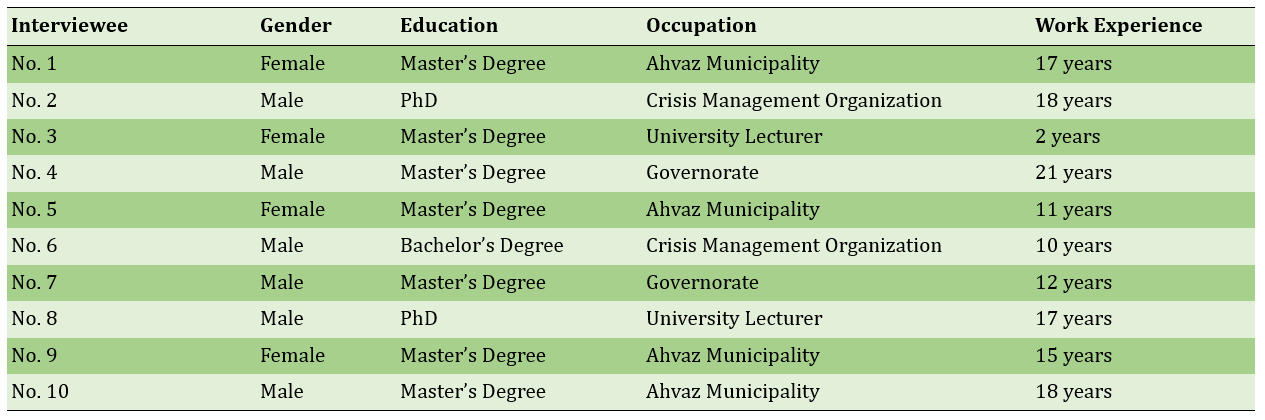
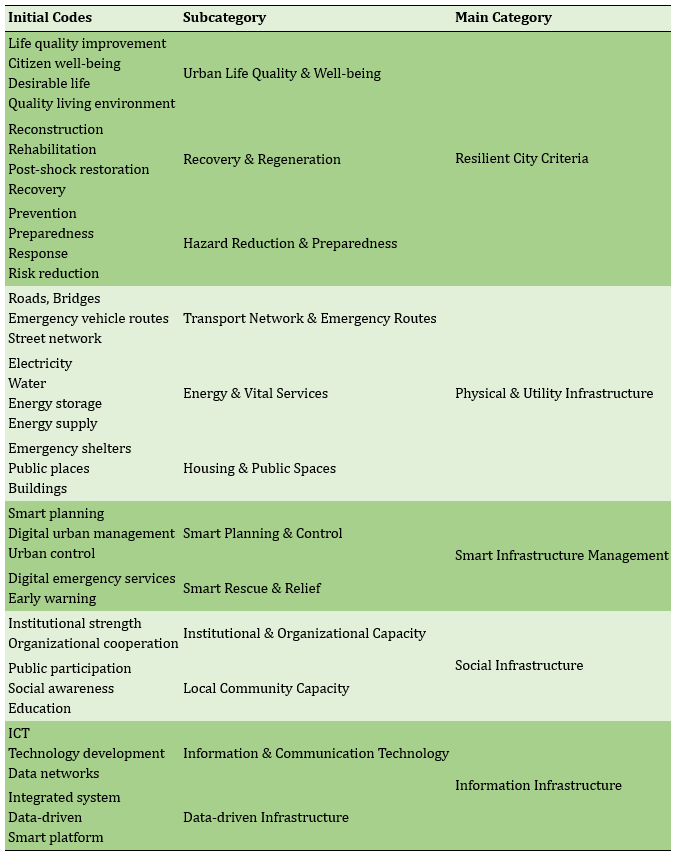
This study began with interviews conducted with 10 experts, whose characteristics are presented (Table 1). The data were analyzed using MAXQDA software. In the open coding stage, 84 conceptual codes were extracted, with the highest frequency related to smart infrastructure management.
Table 1. Characteristics of Interviewees
In the axial coding stage, these codes were organized into five main categories (Table 2):
Resilient City: The ability of a city to recover and improve after crises
Physical and Utility Infrastructure: The physical foundation of urban functionality
Smart Urban Infrastructure Management: Enhancing adaptability and responsiveness
Social Infrastructure: The role of institutions and public participation
Information Infrastructure: The importance of data and technology in urban management
Table 2. Axial coding of urban infrastructure resilience in Ahvaz
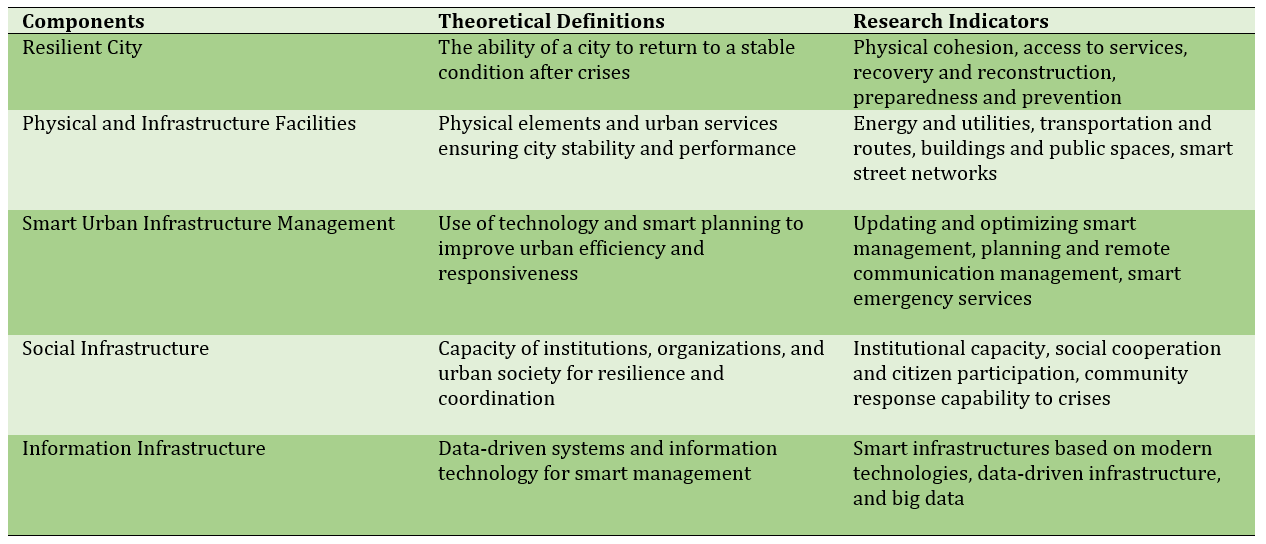
In the selective coding stage, findings indicated that achieving a smart city requires strengthening multiple infrastructure dimensions (Figure 1; Table 3).
Table 3. Components, theoretical definitions and research indicators
Statistical results demonstrated a good model fit (with indices such as CFI, GFI, and RMSEA). Confirmatory factor analysis (second-order), confirmed that all components had acceptable statistical validity (Table 4).
Among the factors, the resilient city had the greatest impact, while social infrastructure had the least (Figure 2). Additionally, indicators such as physical cohesion, smart transportation, and access to services had the strongest influence on enhancing urban infrastructure resilience.
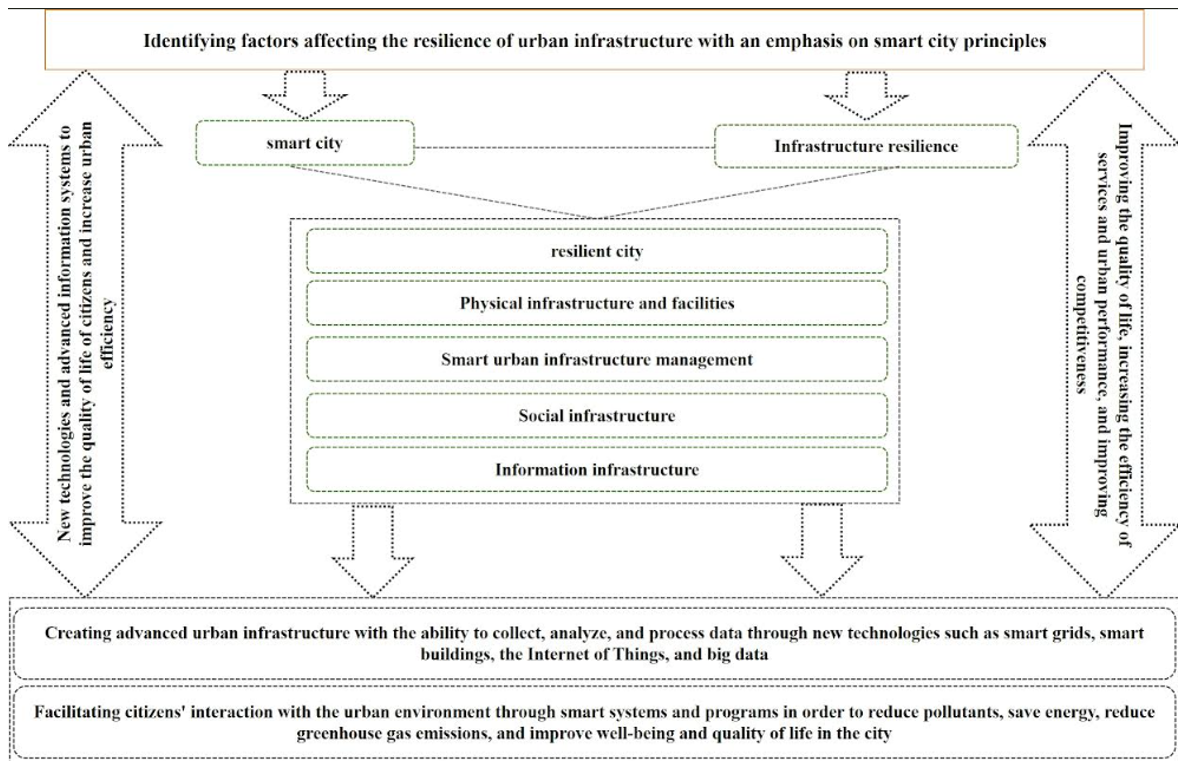
Figure 1. Conceptual model based on selective coding
Table 4. Results of confirmatory factor analysis
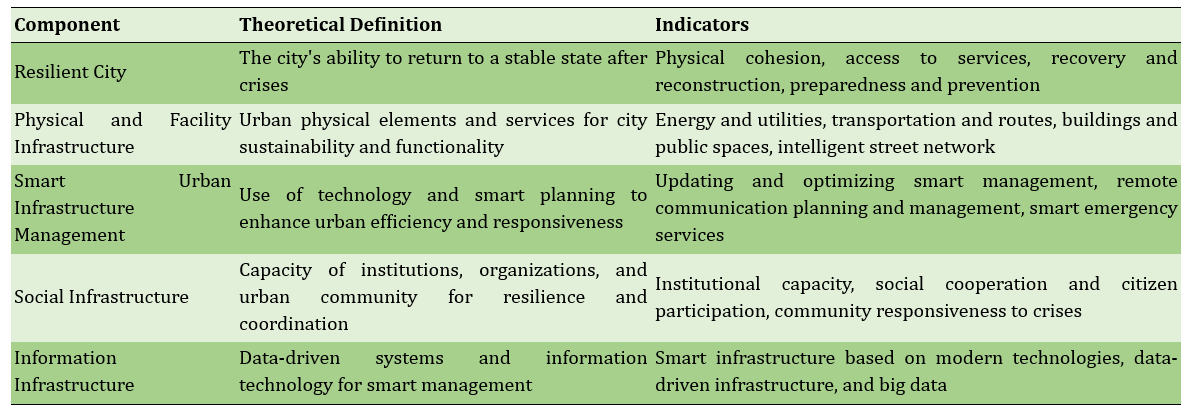
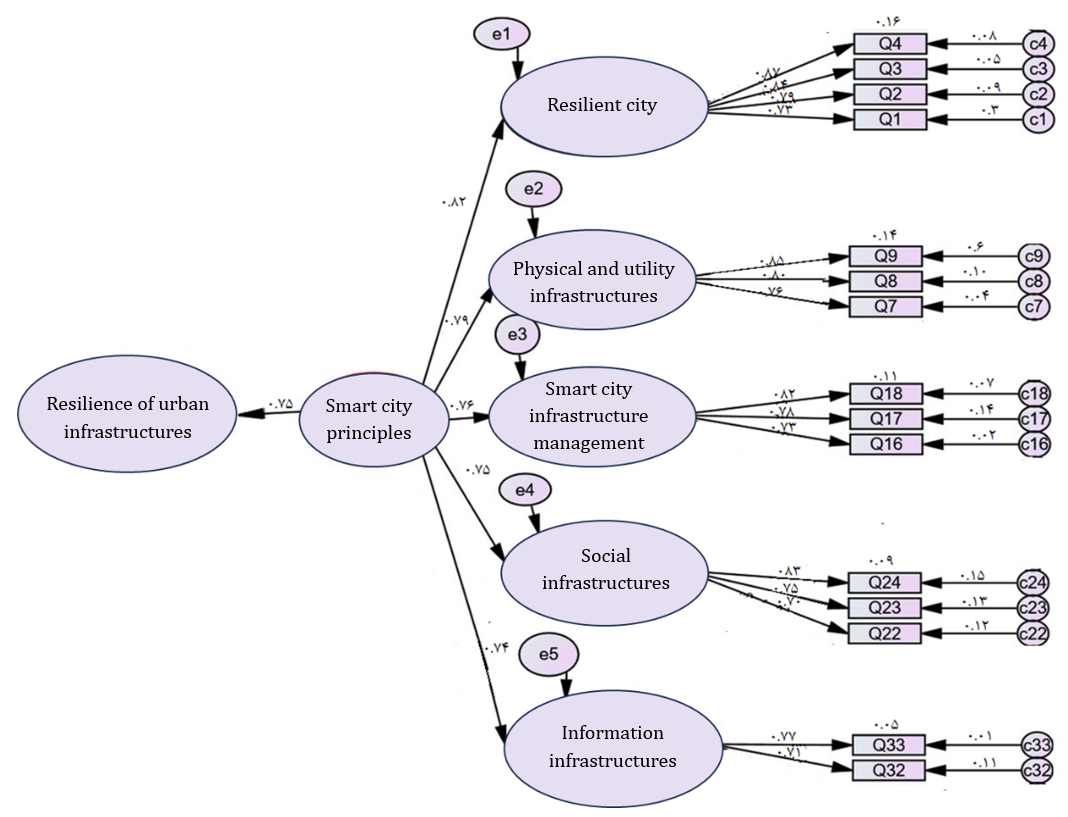
Figure 2. Causal relationship model between research parameters using second order confirmatory factor analysis
Main Comparisons to Similar Studies
The findings regarding the central role of smart infrastructure management and the necessity of integrating physical, social, economic, and informational dimensions are consistent with domestic studies. Zali et al. (2025) and Tahmasebi Moghadam and Rasoulzadeh (2025) emphasize the simultaneity of smartization and resilience-oriented planning. The emphasis on smart infrastructure as a key resilience component aligns with the findings of Behzadfar and Shirani (2025), as well as Alizadeh’s analysis of critical infrastructure [Alizadeh, 2022]. Internationally, the results correspond with Apostu et al., Peixoto et al. (2022) and Ateş (2024) regarding the positive effects of integrating smart city principles with resilience. Conversely, Zhou et al.’s findings, suggesting that lack of integrated planning may weaken infrastructure resilience, further reinforce the necessity of a comprehensive approach, as emphasized in this study [Zhou et al., 2021].
Suggestions
To enhance infrastructure resilience in Ahvaz based on smart city principles, it is recommended to modernize key urban networks (energy, water, wastewater, and transportation) through smart technologies and establish an integrated crisis and infrastructure management center supported by intelligent monitoring systems.
Additionally, developing data-driven infrastructure, creating a unified urban database, and strengthening institutional capacity and citizen participation through smart education programs are essential for improving urban preparedness and recovery.
Conclusion
Indicators such as physical cohesion, smart transportation, and access to services play a significant role in strengthening urban infrastructure resilience.
Acknowledgments: Not reported by the authors.
Ethical Permission: Not reported by the authors.
Conflict of Interest: This article is derived from the first author’s doctoral dissertation.
Author Contributions: Ahmadi H (First Author), Discussion Writer/Methodologist (50%); Amanpour S (Second Author), Assistant Researcher/Statistical Analyst (30%); Babaei Morad B (Third Author), Introduction Writer (20%)
Funding: Not reported by the authors.
Rapid urbanization and increasing urban complexity have underscored the necessity of enhancing infrastructure resilience. In this context, the smart city approach, through the application of emerging technologies, has been presented as an effective strategy for strengthening urban resilience and improving crisis management, particularly in hazard-prone cities such as Ahvaz.
Previous Studies
Previous research has examined the relationship between smart cities and urban resilience. Zali et al. (2025), using a scenario-based foresight approach in Rasht, have highlighted the role of technology governance and sustainable development in shaping a resilient smart city. Tahmasebi Moghadam and Rasoulzadeh (2025) have demonstrated that smart city dimensions, especially smart transportation and infrastructure, have a significant positive effect on resilience. Behzadfar and Shirani (2025) have identified smart infrastructure as the most critical component in enhancing resilience. Qureshi et al. (2019), through an analysis of 42 documents, point to the lack of a comprehensive integrated framework. Internationally, Apostu et al. (2022) confirm a significant correlation between smartization and urban resilience in Europe, while Zhou et al. (2021) report a positive impact of smart cities on social resilience, with varying effects on other dimensions.
Aim(s)
This study aimed to identify the factors affecting urban infrastructure resilience with an emphasis on smart city principles in Ahvaz.
Research Type
In terms of purpose, the study was applied research; methodologically, it employed a survey design with a causal–analytical approach using a mixed-methods (qualitative–quantitative) framework.
Research Society, Place, and Time
The research was conducted between 2023–2025 in Ahvaz. The qualitative population included experts in urban planning, urban technology, and crisis management, selected purposively until theoretical saturation was achieved. The quantitative population consisted of experts and managers from organizations related to Ahvaz’s urban infrastructure, including the municipality, governorate, and crisis management organization.
Sampling Method and Number
In the qualitative phase, purposive and systematic sampling based on the principle of theoretical saturation was applied, and 10 experts were selected.
In the quantitative phase, stratified random sampling was employed, and a sample of 100 experts and managers from relevant urban infrastructure organizations was determined.
Used Devices & Materials
Data collection tools included library–documentary sources and field instruments. In the qualitative phase, semi-structured interviews were conducted and analyzed using MAXQDA 2020 software. In the quantitative phase, a researcher-developed questionnaire (derived from qualitative findings) was used. Quantitative data were analyzed using AMOS software through Structural Equation Modeling (SEM) and second-order confirmatory factor analysis. Content validity was confirmed by experts, and reliability was verified using Cronbach’s alpha coefficients (above 0.70).
Findings by Text
This study began with interviews conducted with 10 experts, whose characteristics are presented (Table 1). The data were analyzed using MAXQDA software. In the open coding stage, 84 conceptual codes were extracted, with the highest frequency related to smart infrastructure management.
Table 1. Characteristics of Interviewees
In the axial coding stage, these codes were organized into five main categories (Table 2):
Resilient City: The ability of a city to recover and improve after crises
Physical and Utility Infrastructure: The physical foundation of urban functionality
Smart Urban Infrastructure Management: Enhancing adaptability and responsiveness
Social Infrastructure: The role of institutions and public participation
Information Infrastructure: The importance of data and technology in urban management
Table 2. Axial coding of urban infrastructure resilience in Ahvaz
In the selective coding stage, findings indicated that achieving a smart city requires strengthening multiple infrastructure dimensions (Figure 1; Table 3).
Table 3. Components, theoretical definitions and research indicators
Statistical results demonstrated a good model fit (with indices such as CFI, GFI, and RMSEA). Confirmatory factor analysis (second-order), confirmed that all components had acceptable statistical validity (Table 4).
Among the factors, the resilient city had the greatest impact, while social infrastructure had the least (Figure 2). Additionally, indicators such as physical cohesion, smart transportation, and access to services had the strongest influence on enhancing urban infrastructure resilience.
Figure 1. Conceptual model based on selective coding
Table 4. Results of confirmatory factor analysis
Figure 2. Causal relationship model between research parameters using second order confirmatory factor analysis
Main Comparisons to Similar Studies
The findings regarding the central role of smart infrastructure management and the necessity of integrating physical, social, economic, and informational dimensions are consistent with domestic studies. Zali et al. (2025) and Tahmasebi Moghadam and Rasoulzadeh (2025) emphasize the simultaneity of smartization and resilience-oriented planning. The emphasis on smart infrastructure as a key resilience component aligns with the findings of Behzadfar and Shirani (2025), as well as Alizadeh’s analysis of critical infrastructure [Alizadeh, 2022]. Internationally, the results correspond with Apostu et al., Peixoto et al. (2022) and Ateş (2024) regarding the positive effects of integrating smart city principles with resilience. Conversely, Zhou et al.’s findings, suggesting that lack of integrated planning may weaken infrastructure resilience, further reinforce the necessity of a comprehensive approach, as emphasized in this study [Zhou et al., 2021].
Suggestions
To enhance infrastructure resilience in Ahvaz based on smart city principles, it is recommended to modernize key urban networks (energy, water, wastewater, and transportation) through smart technologies and establish an integrated crisis and infrastructure management center supported by intelligent monitoring systems.
Additionally, developing data-driven infrastructure, creating a unified urban database, and strengthening institutional capacity and citizen participation through smart education programs are essential for improving urban preparedness and recovery.
Conclusion
Indicators such as physical cohesion, smart transportation, and access to services play a significant role in strengthening urban infrastructure resilience.
Acknowledgments: Not reported by the authors.
Ethical Permission: Not reported by the authors.
Conflict of Interest: This article is derived from the first author’s doctoral dissertation.
Author Contributions: Ahmadi H (First Author), Discussion Writer/Methodologist (50%); Amanpour S (Second Author), Assistant Researcher/Statistical Analyst (30%); Babaei Morad B (Third Author), Introduction Writer (20%)
Funding: Not reported by the authors.
Keywords:
References
1. Aina YA, Abubakar IR, Almulhim AI, Dano UL, Maghsoodi Tilaki MJ, Dawood SR (2023). Digitalization and smartification of urban services to enhance urban resilience in the post-pandemic era: The case of the pilgrimage city of Makkah. Smart Cities. 6(4):1973-1995. [Link] [DOI:10.3390/smartcities6040092]
2. Alabi BN, Du R, Guo Y, Alinizzi M, Labi S (2025). A framework for incorporating smart city concepts into the management of municipal infrastructure. Frontiers in Engineering and Built Environment. 5(2):109-124. [Link] [DOI:10.1108/FEBE-07-2024-0027]
3. Alizadeh H (2022). Analyzing and recognizing urban critical infrastructure resilience capacity based on resilience adaptive cycle (RAC) in Ahvaz metropolis. Geographical Urban Planning Research. 9(4):1103-1123. [Persian] [Link]
4. Almulhim AI (2025). Building urban resilience through smart city planning: A systematic literature review. Smart Cities. 8(1):12. [Link] [DOI:10.3390/smartcities8010022]
5. Apostu SA, Vasile V, Vasile R, Rosak-Szyrocka J (2022). Do smart cities represent the key to urban resilience? Rethinking urban resilience. International Journal of Environmental Research and Public Health. 19(22):15410. [Link] [DOI:10.3390/ijerph192215410]
6. Ateş M (2024). The relationship between smart cities, urban resilience and sustainability: Implications for urban planning. Journal of Planning Architecture and Design. 2(1-2):1-19. [Link]
7. Behzadfar M, Shirani Z (2025). Conceptual analysis of climate-smart cities and their indicators; A systematic review. Geographical Research. 40(1):53-61. [Persian] [Link]
8. Gallego-Lopez C, Essex J (2016). Smart city resilience: Learning from the city of Bristol. Procedia Engineering. 159:91-97. [Link]
9. Gren Å, Colding J, Berghauser Pont M, Marcus L (2018). How smart is smart growth? Examining the environmental validation behind city compaction. Ambio. 48(6):580-589. [Link] [DOI:10.1007/s13280-018-1087-y]
10. Hafeznia MR (2016). Introduction to research method in humanities. Tehran: SAMT. [Persian] [Link]
11. Kuzmаk O, Pontrandolfo P, Kuzmаk O, Stepura T (2026). Smart cities and urban resilience in Ukraine: Towards sustainable recovery and digital transformation. In: Data-centric business and applications. Cham: Springer. p. 145-173. [Link] [DOI:10.1007/978-3-032-06608-4_8]
12. Lopez LJR, Grijalba Castro AI (2021). Sustainability and resilience in smart city planning: A review. Sustainability. 13(1):181. [Link] [DOI:10.3390/su13010181]
13. Meerow S, Newell JP (2016). Urban resilience for whom, what, when, where, and why?. Urban Geography. 40(3):309-329. [Link] [DOI:10.1080/02723638.2016.1206395]
14. Peixoto JPJ, Costa DG, Da Franca Rocha WDJ, Portugal P, Vasques F (2023). On the positioning of emergencies detection units based on geospatial data of urban response centres. Sustainable Cities and Society. 97:104713. [Link] [DOI:10.1016/j.scs.2023.104713]
15. Qureshi GhS, Parsi HR, Nourian F (2019). An analytical review on the theory of smart resilient city and its applicability. Journal of Fine Arts: Architecture and Urban Planning. 25(4):55-69. [Persian] [Link]
16. Qureshi MI, Khan NU, Rasli AM, Zaman K (2015). The battle of health with environmental evils of Asian countries: Promises to keep. Environmental Science and Pollution Research. 22(15):11708-11715. [Link] [DOI:10.1007/s11356-015-4440-8]
17. Ramazanpour Karizaki A, Mahdavinejad M, Motalebi G (2023). Explaining physical-spatial indicators of smart city: A case study of Torbat Heydarieh. Journal of Urban Management. 12(2):145-158. [Link]
18. Shahivand R, Pourhasanzadeh M (2024). Explanation the effective Factors and indicators of the smart city on improving urban resilience against Covid-19 (Case study: Shiraz city). Geographical Urban Planning Research. 11(4):257-277. [Persian] [Link]
19. Tahmasebi Moghadam H, Rasoulzadeh Z (2025). Assessing the role of smart cities in enhancing urban resilience against environmental hazards (case study: Zanjan City). Geography and Environmental Hazards. 14(4):181-200. [Persian] [Link]
20. Zali N, Fallah Heidari F, Gholipour Y (2025). Future planning of a resilient smart city based on scenario planning (case study: Rasht city). Scientific Journal of Sustainable Development of Geographical Environment. 7(12):1-13. [Persian] [Link]
21. Zhou Q, Zhu M, Qiao Y, Zhang X, Chen J (2021). Achieving resilience through smart cities? Evidence from China. 111:102348. [Link] [DOI:10.1016/j.habitatint.2021.102348]