

Bilingual
En/Fa
Geographical Research is Published in both Persian and English Full-text.
Volume 40, Issue 4 (2025)
GeoRes 2025, 40(4): 287-293 |
Back to browse issues page
Article Type:
Subject:




Research code: ART-1836
History
Received: 2025/09/30 | Accepted: 2025/11/29 | Published: 2025/12/1
Received: 2025/09/30 | Accepted: 2025/11/29 | Published: 2025/12/1
How to cite this article
Kolyaei Y, Malek Hosseini A, Shams M. Structural and Economic Barriers to Bold Urban Management in Kermanshah, Iran. GeoRes 2025; 40 (4) :287-293
URL: http://georesearch.ir/article-1-1836-en.html
URL: http://georesearch.ir/article-1-1836-en.html
Download citation:
BibTeX | RIS | EndNote | Medlars | ProCite | Reference Manager | RefWorks
Send citation to:


Rights and permissions
BibTeX | RIS | EndNote | Medlars | ProCite | Reference Manager | RefWorks
Send citation to:

1- Department of Urban Geography and Urban Planning, Malayer Campus (Ma.C.), Islamic Azad University, Malayer, Iran
Full-Text (HTML) (52 Views)
Background
Cities in developing countries face challenges such as centralization, institutional weakness, limited financial resources, and inadequate technological infrastructures. The “bold urban management” approach has emerged as an innovative response to enhance governance, participation, and resilience. Kermanshah, facing similar challenges, particularly institutional weakness and limited public participation requires an examination of the obstacles to implementing this approach.
Previous Studies
Previous research has extensively examined the challenges of urban management in developing countries. Studies indicate that centralization, weak delegation of authority, and institutional inefficiency are primary obstacles to urban development [Devas et al., 2001; World Bank, 2021; Sharma & Singh, 2022]. Moreover, research on the role of emerging technologies has highlighted the importance of geographic information systems, data analytics, and smart infrastructures in enhancing urban governance [Albino et al., 2015; Sharma & Singh, 2022]. The literature on urban resilience emphasizes cities’ capacity to adapt to crises and maintain sustainable performance, considering it a complement to bold urban management [Ahern, 2011; Meerow et al., 2016]. Additionally, studies underscore the significance of citizen participation in decision-making and the role of participatory management in improving governance quality [Arnstein, 1969; Bai et al., 2020]. Comparative studies in cities such as Istanbul and Delhi have also shown that the success of bold urban management requires institutional support, financial autonomy, and social participation [Baycan-Levent & Kundak, 2009; Roy, 2011].
Aim(s)
This study was conducted with the aim of examining the obstacles to implementing bold urban management in the city of Kermanshah.
Research Type
The present study is qualitative in nature.
Research Society, Place and Time
The study population comprised managers, urban planners, and experts in the field of urban management in Kermanshah, who possess extensive experience and in-depth knowledge of the city’s administrative structure. The research was conducted in the city of Kermanshah, and the study period spanned from March–October 2025.
Sampling Method and Number
In this study, purposive sampling was employed. Participants were selected based on criteria such as managerial experience, involvement in urban development projects, familiarity with institutional structures, and proficiency in innovative governance concepts. In total, 11 individuals, including managers, urban planners, and urban management experts, participated in the study.
Used Devices & Materials
Data were collected through in-person semi-structured interviews, each lasting between 45 and 75 minutes and recorded using a digital voice recorder. For data analysis, MAXQDA 2022 was used for qualitative analysis and theme extraction, while SPSS version 26 was employed for statistical analysis and to examine the participants’ demographic characteristics.
Findings by Text
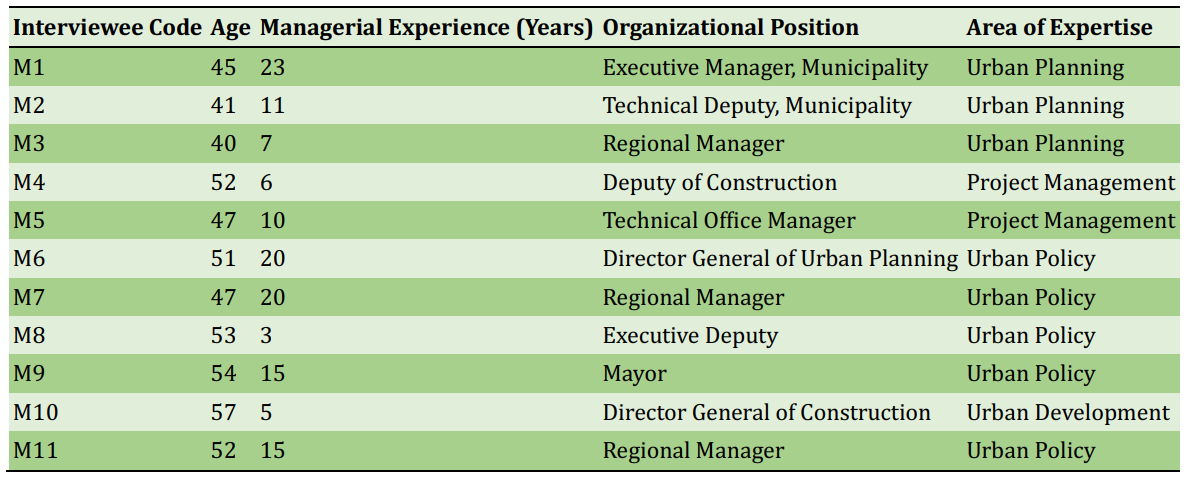
The findings of the study were presented based on semi-structured interviews with 11 managers, planners, and urban experts in Kermanshah, along with complementary questionnaires, through both qualitative and quantitative phases (Table 1). Interview excerpts indicated that centralization, dependence on government funding, weak technological infrastructures, organizational cultural resistance, lack of training and team capabilities, bureaucratic complexity, and lack of institutional coordination were among the main obstacles to bold urban management in Kermanshah.
Table 1. Main characteristics of the interviewees
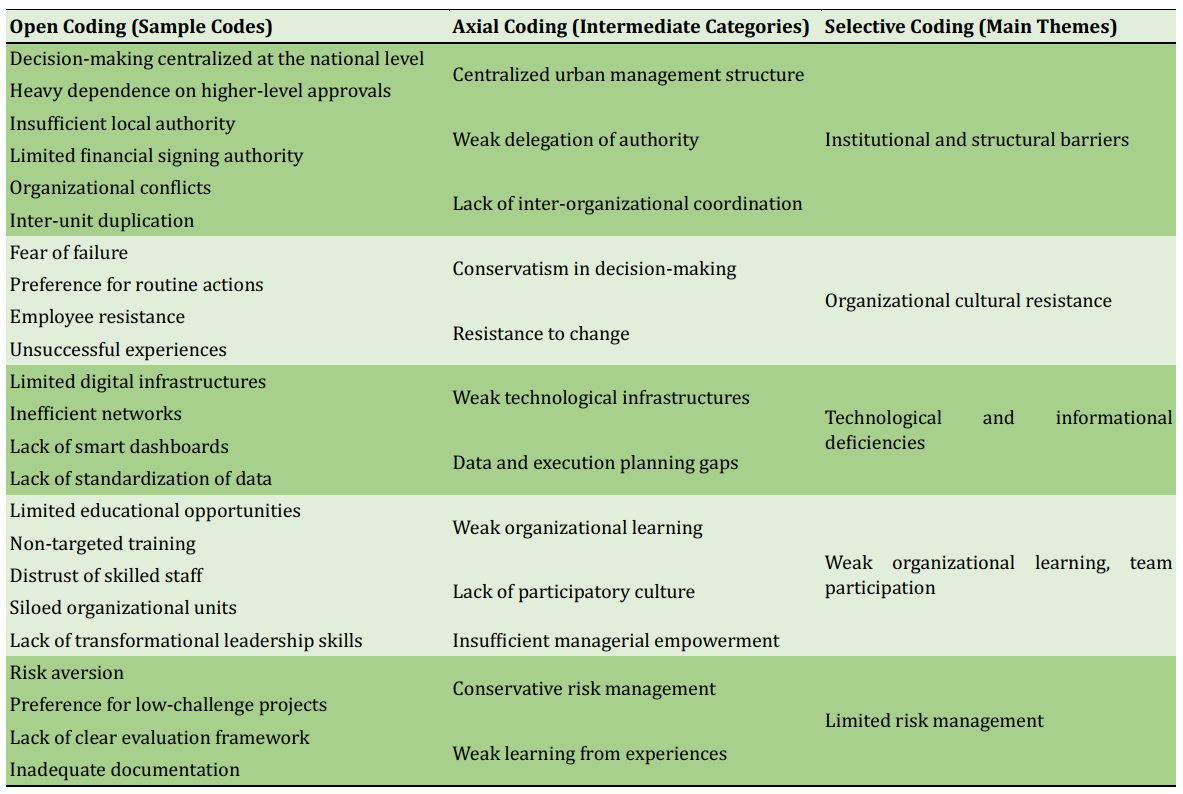
In the theme-based qualitative analysis, data were processed using MAXQDA 2022 and a three-stage coding process (open, axial, and selective), resulting in the identification of five main themes: institutional and legal barriers, organizational cultural resistance, weak technological infrastructures, deficiencies in organizational learning and team participation, and limited risk management (Table 2).
Table 2. Coding process of the data
In the quantitative analysis using SPSS, indicators such as the mean managerial experience (6.49 years), the maximum number of subordinates managed (100 people), and the mean references to legal authorities (2.82 times) were extracted. The correlation coefficient between managerial experience and decision-making boldness was -0.138 (p = 0.685), indicating that individual experience does not have a significant effect on decision-making boldness, while institutional and structural factors play a more prominent role.
Main Comparisons to Similar Studies
The findings of the present study indicated that the obstacles to bold urban management in Kermanshah, including centralization, financial dependence, institutional weakness, and inadequate technological infrastructures are consistent with patterns observed in international studies. The results align with the research of Devas et al. (2001) and the World Bank (2021), which have identified centralization and bureaucracy as key barriers to urban development in developing countries, although the level of financial dependence on the government in Kermanshah was reported to be higher than in comparable cases. Additionally, these findings support the perspectives of Roy (2011) and Baycan-Levent & Kundak (2009), who consider financial autonomy and institutional reforms essential for implementing innovative management.
In the technological domain, alignment with the findings of Albino et al. (2015) and Sharma & Singh (2022) is evident, with the difference that Kermanshah showed a greater lag in transitioning to smart management. Regarding social participation, the lack of efficient mechanisms was comparable to the model of Arnstein (1969). Overall, compared to cities such as Istanbul and São Paulo, Kermanshah exhibits deeper institutional and financial gaps, highlighting the urgent need for structural reforms.
Suggestions
The study suggests that transitioning to bold urban management in Kermanshah requires fostering a culture of innovation and open dialogue, empowering managers through leadership and risk-management training, reforming decision-making structures to enhance agility and delegation, ensuring sustainable resources via innovation funds and stakeholder participation, and strengthening participatory governance through citizen platforms and community oversight mechanisms.
Conclusion
Institutional centralization, weak technological infrastructures, and organizational cultural resistance are among the key obstacles to implementing bold urban management in Kermanshah.
Acknowledgments: Sincere thanks are extended to all urban managers and experts who participated in the interviews and generously provided their valuable data.
Ethical Permission: This study was conducted in accordance with research ethics principles, and all participants provided informed consent.
Conflict of Interest: The authors declare that there are no conflicts of interest in this study.
Authors’ Contributions: Kolyaei Y (first author), Introduction Writer/Methodologist/Main Researcher/Statistical Analyst/Discussion Writer (40%); Malek Hosseini A (second author), Introduction Writer, Assistant Researcher,/Discussion Writer (30%); Shams M (third author), Methodologist/Assistant Researcher/Statistical Analyst (30%)
Funding: This study did not receive any direct or indirect financial support.
Cities in developing countries face challenges such as centralization, institutional weakness, limited financial resources, and inadequate technological infrastructures. The “bold urban management” approach has emerged as an innovative response to enhance governance, participation, and resilience. Kermanshah, facing similar challenges, particularly institutional weakness and limited public participation requires an examination of the obstacles to implementing this approach.
Previous Studies
Previous research has extensively examined the challenges of urban management in developing countries. Studies indicate that centralization, weak delegation of authority, and institutional inefficiency are primary obstacles to urban development [Devas et al., 2001; World Bank, 2021; Sharma & Singh, 2022]. Moreover, research on the role of emerging technologies has highlighted the importance of geographic information systems, data analytics, and smart infrastructures in enhancing urban governance [Albino et al., 2015; Sharma & Singh, 2022]. The literature on urban resilience emphasizes cities’ capacity to adapt to crises and maintain sustainable performance, considering it a complement to bold urban management [Ahern, 2011; Meerow et al., 2016]. Additionally, studies underscore the significance of citizen participation in decision-making and the role of participatory management in improving governance quality [Arnstein, 1969; Bai et al., 2020]. Comparative studies in cities such as Istanbul and Delhi have also shown that the success of bold urban management requires institutional support, financial autonomy, and social participation [Baycan-Levent & Kundak, 2009; Roy, 2011].
Aim(s)
This study was conducted with the aim of examining the obstacles to implementing bold urban management in the city of Kermanshah.
Research Type
The present study is qualitative in nature.
Research Society, Place and Time
The study population comprised managers, urban planners, and experts in the field of urban management in Kermanshah, who possess extensive experience and in-depth knowledge of the city’s administrative structure. The research was conducted in the city of Kermanshah, and the study period spanned from March–October 2025.
Sampling Method and Number
In this study, purposive sampling was employed. Participants were selected based on criteria such as managerial experience, involvement in urban development projects, familiarity with institutional structures, and proficiency in innovative governance concepts. In total, 11 individuals, including managers, urban planners, and urban management experts, participated in the study.
Used Devices & Materials
Data were collected through in-person semi-structured interviews, each lasting between 45 and 75 minutes and recorded using a digital voice recorder. For data analysis, MAXQDA 2022 was used for qualitative analysis and theme extraction, while SPSS version 26 was employed for statistical analysis and to examine the participants’ demographic characteristics.
Findings by Text
The findings of the study were presented based on semi-structured interviews with 11 managers, planners, and urban experts in Kermanshah, along with complementary questionnaires, through both qualitative and quantitative phases (Table 1). Interview excerpts indicated that centralization, dependence on government funding, weak technological infrastructures, organizational cultural resistance, lack of training and team capabilities, bureaucratic complexity, and lack of institutional coordination were among the main obstacles to bold urban management in Kermanshah.
Table 1. Main characteristics of the interviewees
In the theme-based qualitative analysis, data were processed using MAXQDA 2022 and a three-stage coding process (open, axial, and selective), resulting in the identification of five main themes: institutional and legal barriers, organizational cultural resistance, weak technological infrastructures, deficiencies in organizational learning and team participation, and limited risk management (Table 2).
Table 2. Coding process of the data
In the quantitative analysis using SPSS, indicators such as the mean managerial experience (6.49 years), the maximum number of subordinates managed (100 people), and the mean references to legal authorities (2.82 times) were extracted. The correlation coefficient between managerial experience and decision-making boldness was -0.138 (p = 0.685), indicating that individual experience does not have a significant effect on decision-making boldness, while institutional and structural factors play a more prominent role.
Main Comparisons to Similar Studies
The findings of the present study indicated that the obstacles to bold urban management in Kermanshah, including centralization, financial dependence, institutional weakness, and inadequate technological infrastructures are consistent with patterns observed in international studies. The results align with the research of Devas et al. (2001) and the World Bank (2021), which have identified centralization and bureaucracy as key barriers to urban development in developing countries, although the level of financial dependence on the government in Kermanshah was reported to be higher than in comparable cases. Additionally, these findings support the perspectives of Roy (2011) and Baycan-Levent & Kundak (2009), who consider financial autonomy and institutional reforms essential for implementing innovative management.
In the technological domain, alignment with the findings of Albino et al. (2015) and Sharma & Singh (2022) is evident, with the difference that Kermanshah showed a greater lag in transitioning to smart management. Regarding social participation, the lack of efficient mechanisms was comparable to the model of Arnstein (1969). Overall, compared to cities such as Istanbul and São Paulo, Kermanshah exhibits deeper institutional and financial gaps, highlighting the urgent need for structural reforms.
Suggestions
The study suggests that transitioning to bold urban management in Kermanshah requires fostering a culture of innovation and open dialogue, empowering managers through leadership and risk-management training, reforming decision-making structures to enhance agility and delegation, ensuring sustainable resources via innovation funds and stakeholder participation, and strengthening participatory governance through citizen platforms and community oversight mechanisms.
Conclusion
Institutional centralization, weak technological infrastructures, and organizational cultural resistance are among the key obstacles to implementing bold urban management in Kermanshah.
Acknowledgments: Sincere thanks are extended to all urban managers and experts who participated in the interviews and generously provided their valuable data.
Ethical Permission: This study was conducted in accordance with research ethics principles, and all participants provided informed consent.
Conflict of Interest: The authors declare that there are no conflicts of interest in this study.
Authors’ Contributions: Kolyaei Y (first author), Introduction Writer/Methodologist/Main Researcher/Statistical Analyst/Discussion Writer (40%); Malek Hosseini A (second author), Introduction Writer, Assistant Researcher,/Discussion Writer (30%); Shams M (third author), Methodologist/Assistant Researcher/Statistical Analyst (30%)
Funding: This study did not receive any direct or indirect financial support.
References
1. Ahern J (2011). From fail-safe to safe-to-fail: Sustainability and resilience in the new urban world. Landscape and Urban Planning. 100(4):341-343. [Link] [DOI:10.1016/j.landurbplan.2011.02.021]
2. Albino V, Berardi U, Dangelico RM (2015). Smart cities: Definitions, dimensions, performance, and initiatives. Journal of Cleaner Production. 102:1-19. [Link] [DOI:10.1080/10630732.2014.942092]
3. Arnstein SR (1969). A ladder of citizen participation. Journal of the American Institute of Planners. 35(4):216-224. [Link] [DOI:10.1080/01944366908977225]
4. Baycan-Levent T, Kundak S (2009). Planning for resilient cities: Lessons from Istanbul. Cities. 26(4):185-194. [Link]
5. Devas N, Amis P, Beall J, Grant U, Mitlin D, Rakodi C, et al (2001). Urban governance and poverty: Lessons from a study of ten cities in the global South. International Development Planning Review. 23(4):345-370. [Link]
6. El-Shahat M (2018). Urban governance challenges in Cairo. Middle East Journal of Urban Studies. 12(2):45-63. [Link]
7. Frontiers in Sustainable Cities (2024). Citizen participation and smart urban governance. Frontiers in Sustainable Cities. 6(2):145-160. [Link]
8. Ghasemi A (2024). State decentralization and good urban governance in Iran. State Studies. 10(38):121-162. [Persian] [Link]
9. Grindle MS (1997). Getting good government: Capacity building in the public sectors of developing countries. Massachusetts: Harvard University Press. [Link]
10. Hajilou M, Meshkini A, Ghaedrahmati S, Mirehei M (2024). Investigating financial motivators and demotivators of urban sprawl through the lens of municipalities: A case of Qom, Iran. Applied Spatial Analysis and Policy. 17:1435-1461. [Link] [DOI:10.1007/s12061-024-09591-w]
11. Hosseinpour M, Kalantari M, Jafarpour Ghalehteimouri K (2025). Exploring urban future: Enhancing good urban governance through scenario planning in Urmia city, Iran. City and Built Environment. 3:18. [Link] [DOI:10.1007/s44213-025-00056-5]
12. Meerow S, Newell JP, Stults M (2016). Defining urban resilience: A review. Landscape and Urban Planning. 147:38-49. [Link] [DOI:10.1016/j.landurbplan.2015.11.011]
13. North DC (1990). Institutions, institutional change and economic performance. Cambridge: Cambridge University Press. [Link] [DOI:10.1017/CBO9780511808678]
14. NUP (2023). National urban policy programme in I.R. Iran. Nairobi: UN-Habitat. [Link]
15. OECD & UN-Habitat (2024). Global state of national urban policy 2024. Paris: OECD Publishing. [Link] [DOI:10.1787/4db6994c-en]
16. Rhodes RAW (1996). The new governance: Governing without government. Political Studies. 44(4):652-667. [Link] [DOI:10.1111/j.1467-9248.1996.tb01747.x]
17. Roy A (2011). Urbanisms, worlding practices and the theory of planning. Planning Theory. 10(1):6-24. [Link] [DOI:10.1177/1473095210386065]
18. Sharma R, Singh G (2022). Digital technologies and smart governance in developing cities. Cities. 120:103-118. [Link]
19. Sotarauta M, Beer A (2017). Governance, leadership and urban development: Theoretical insights and empirical evidence. London: Routledge. [Link]
20. Souza ML (2015). Urban Political Ecology and Governance in São Paulo. Urban Studies, 52(11), 2032-2048. [Link]
21. UN-Habitat (2020). Innovative governance for urban futures. Nairobi: United Nations Human Settlements Programme. [Link]
22. UN-Habitat (2024). World cities report 2024: Urban futures. Nairobi: United Nations Human Settlements Programme. [Link]
23. World Bank (2021). World development report 2021: Data for better lives. Washington, DC: World Bank. [Link]
24. Zali N, Soltani A, Najafi P, Ebadi Qajari S, Mehrju M (2024). Digital twins for smarter Iranian cities: A future studies perspective. Computational Urban Science. 4:43. [Link] [DOI:10.1007/s43762-024-00155-9]